


Ladies Roll Top Desk
These ladies roll top desk pieces are compact writing cabinets offering private storage, prized for their refined timbers and clever enclosed cylinders.
Ladies Roll Top Desk
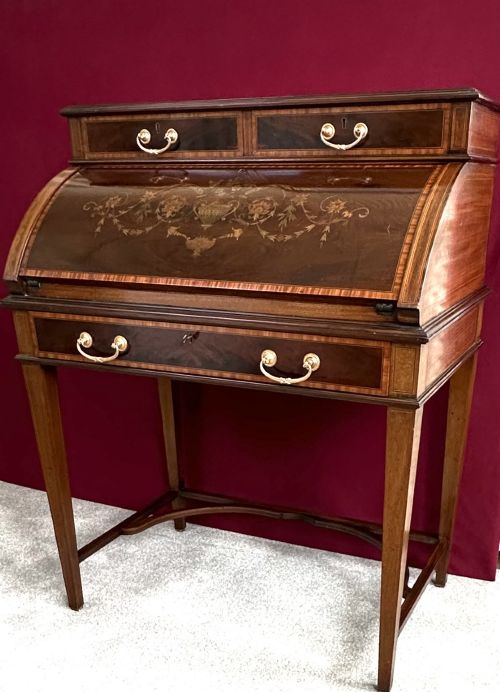
A ladies roll top desk is a compact writing cabinet designed for domestic correspondence, featuring a sliding cylinder or tambour mechanism that conceals the interior pigeonholes and drawers. These pieces appear across several periods, most frequently in Edwardian and Victorian iterations alongside earlier Georgian and Regency examples.
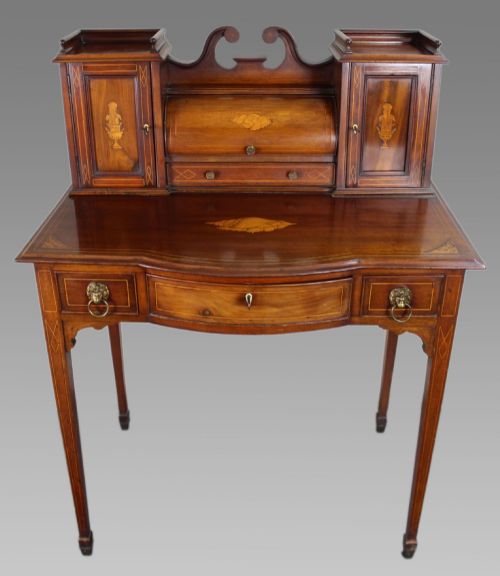
The dominant forms on this page include cylinder desks, tambour desks, and bureau cabinets executed in refined mahogany and satinwood. Buyers will also encounter French stylistic influences, including Louis XVI and Rococo revival pieces incorporating marquetry and marble.
The scale remains distinctly domestic, intended for the boudoir, parlour, or private drawing room rather than the grand library. Makers adapted the traditional bureau into lighter, more decorative formats suited to feminine writing tasks of the nineteenth and early twentieth centuries.
How they were made
Cabinet makers utilised choice hardwoods like mahogany, satinwood, and rosewood, often enhanced with delicate stringing and marquetry inlay. Brass hardware provides functional hinges and pulls, whilst glass and ormolu appear on select French and revival pieces.
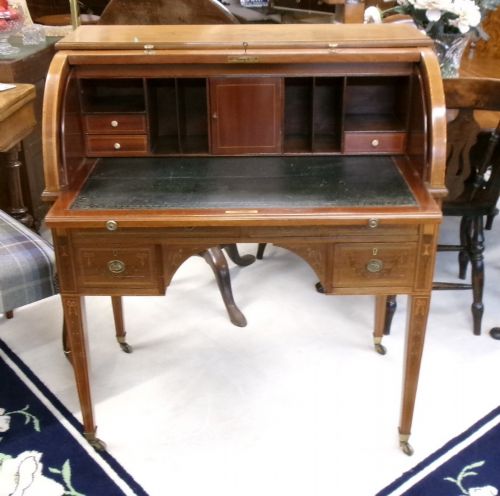
The mechanical cylinder or tambour shutter requires precise joinery to glide smoothly within curved tracks without binding. Writing surfaces frequently incorporate inset leather panels to provide a durable writing plane that contrasts with the polished timber frame.
The inventory spans the eighteenth, nineteenth, and early twentieth centuries, featuring mahogany, satinwood, and rosewood construction across English and French styles.
What varies in quality
The distinction between standard production and the finest work lies in the selection of timber figures and the precision of the cylinder mechanism. Superior examples display perfectly matched veneer grains and smooth, effortless operation of the roll top shutter.
Hand-cut marquetry inlay, finely cast ormolu mounts, and secondary woods of high grade separate exceptional cabinetwork from simpler commercial output. The interior fitments, including secret drawers and well-fitted pigeonholes, reflect the ambition of the original maker.
Edwards & Roberts·Ray & Miles of Liverpool
The Ladies Roll Top Desk Glossary
- Cylinder desk
- A writing table fitted with a quarter-circle rotating wooden cylinder that conceals the desk interior. When the cylinder rolls back, the writing slide extends forward automatically.
- Tambour
- A flexible shutter formed of narrow vertical strips of wood glued to a canvas backing, allowing it to slide around a curved track. This mechanism achieves the same space-saving closure as a solid cylinder.
- Bonheur du jour
- A light lady writing desk featuring a small cabinet or set of drawers on top of the writing surface. The term translates from French as day-happiness.
- Marquetry
- Decorative patterns formed by fitting together contrasting veneers of wood, shell, or ivory onto a structural carcase. This technique defines the surface ornamentation on many formal writing cabinets.
- Satinwood
- A lustrous, hard timber native to the tropics, prized for its golden yellow colour and reflective grain. It was heavily utilised during the Sheraton Revival period.
Ladies Roll Top Desk: Frequently Asked Questions
How do cylinder mechanisms work?
The curved wooden shutter runs in a concealed track cut into the desk sides. Sliding the top down covers the papers and locks the lower drawers simultaneously.
Good examples glide evenly without catching on the interior fittings.
Where were these desks placed?
These compact writing cabinets sat in private sitting rooms, bedrooms, and boudoirs rather than formal studies. Their finished backs allow many examples to stand away from the wall in the middle of a room.
They provided private storage for personal correspondence and domestic accounts.
How do I care for the leather?
The inset leather writing surface benefits from occasional cleaning with specialist wax or balm to prevent drying and cracking. Avoid using excessive moisture near the surrounding timber veneer.
Direct sunlight will fade both the leather hide and the polished mahogany or satinwood beneath.
How do I distinguish Edwardian from Georgian pieces?
Georgian pieces display heavier structural timbers, simpler joinery lines, and authentic period cabinet construction. Edwardian and Sheraton Revival examples often feature lighter satinwood framing with machine-sawn veneers and elaborate decorative stringing.
Secondary woods and internal drawer construction also help determine the true age of the cabinet.