





Lacquered Bamboo Table
A lacquered bamboo table brings distinctive texture and decorative surface detail to a room, combining natural organic stems with rich painted or polished finishes.
Lacquered Bamboo Table
A lacquered bamboo table represents a fusion of organic plant stems and decorative surface finishes, most frequently encountered in nineteenth-century and Victorian pieces. These items serve functional roles as occasional tables, side tables, and two-tier stands within domestic spaces.
The selection ranges from Victorian bamboo designs featuring lacquered panels to papier-mâché tray tables on stands and mid-century interpretations. Buyers encounter compact side tables and multi-tiered sewing or tea tables originating from British and European workshops.
How they were made
Construction relies on natural bamboo stems or faux bamboo turned wood, combined with wooden panels for table tops and shelves. Artisans applied layers of lacquer, sometimes incorporating gold leaf, gilt, and hand-painted Chinoiserie motifs to the surfaces.
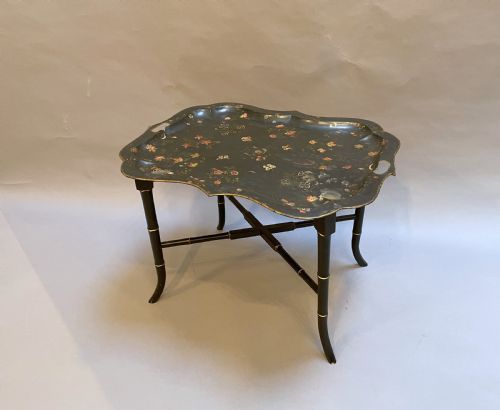
Tray tables utilise removable papier-mâché or toleware trays mounted on folding or fixed wooden stands. Detail work often includes brass fittings and intricate floral or Orientalist decorations fixed directly onto the lacquered ground.
Lacquered Bamboo Table Retail Price Guide 2026
Typical asking prices for lacquered bamboo table among the pieces listed under this phrase on Sellingantiques today, from the lower quarter to the upper quarter. They describe what is for sale here now, not the wider market.
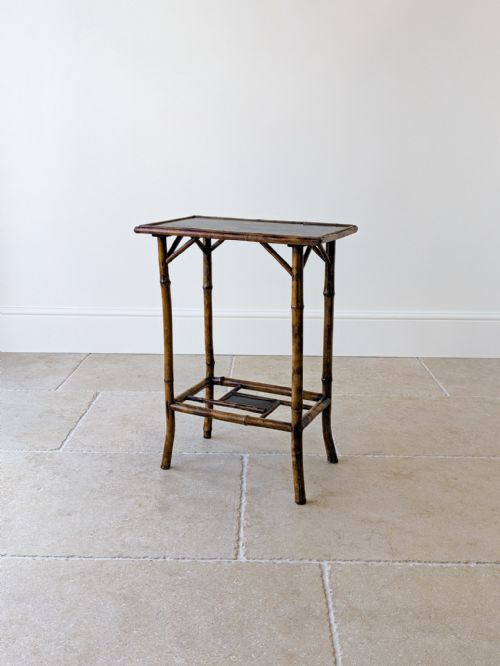
Tiger bamboo stems bring a delightfully wild, striped bark pattern to otherwise orderly Victorian drawing rooms.
What varies in quality
Quality rests in the execution of the surface decoration and the stability of the bamboo frame. Hand-painted Chinoiserie with deep layers of lacquer and intact gold leaf indicates higher workshop skill than simple stencilled patterns.
The rigidity of the joints and the preservation of the lacquer coating distinguish finer examples. Pieces retaining original hardware, functional drop leaves, and undamaged panels command greater appreciation among collectors.
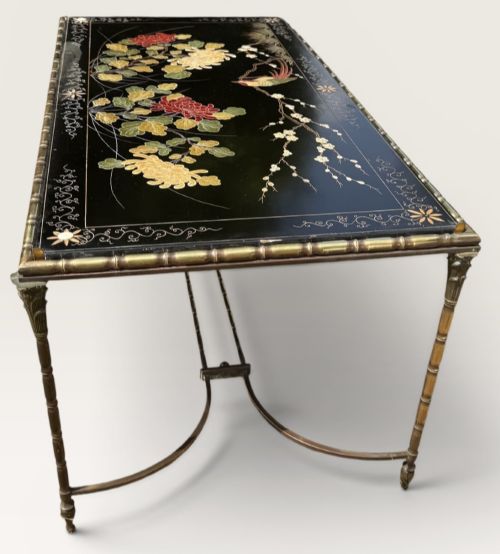
Maison Bagues
The Lacquered Bamboo Table Glossary
- Chinoiserie
- European interpretation and imitation of Chinese and East Asian artistic traditions, often featuring figures, landscapes, and pavilions rendered in lacquer and gold. This style heavily influences Victorian and Regency decorative furniture.
- Papier-mâché
- A composite material made from paper pulp or reinforced paper sheets mixed with adhesive, pressed and dried into sturdy forms. It provides a smooth base for heavy black lacquer and intricate painted decoration.
- Toleware
- Painted or enamelled sheet metal items, frequently utilised for trays and decorative vessels. These pieces display colourful hand-painted botanical or figurative designs.
- Bijouterie table
- A glass-topped display table designed to showcase small decorative objects, medals, or curiosities. They appear in late nineteenth-century interiors.
- Canterbury
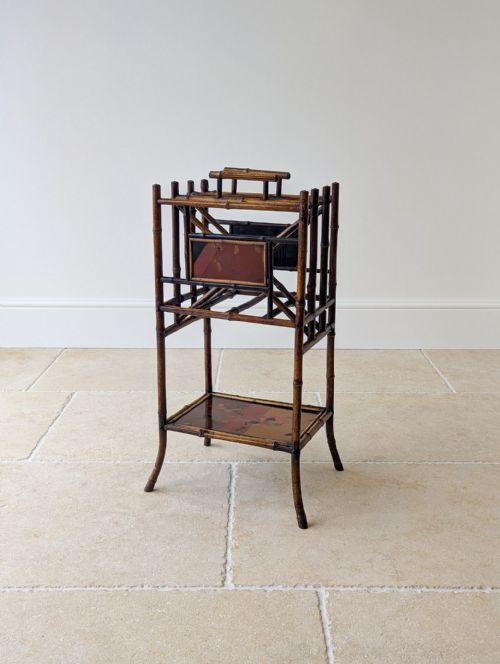
- A small piece of furniture fitted with upright partitions for holding sheet music, books, or periodicals. In bamboo designs, these incorporate lower tiers for storage.
Lacquered Bamboo Table: Frequently Asked Questions
How do I clean a lacquered bamboo table?
Dust surfaces gently with a soft, dry cloth to prevent scratching the delicate lacquer finish. Avoid chemical polishes and keep moisture away from natural bamboo joints.
Place the table away from direct sunlight and heat sources to protect the lacquer and prevent the bamboo stems from drying out and splitting.
Are these tables sturdy enough for daily use?
Occasional and side tables suit light daily tasks such as holding cups or books. The structural integrity depends on the tightness of the original bindings and joints.
Avoid overloading lower shelves or tray sections to preserve the historical bamboo and papier-mâché construction over time.
What is the difference between real and faux bamboo?
Real bamboo consists of natural plant stems selected for uniform thickness, cured and fitted together to form legs and framing. Faux bamboo uses turned timber carved to mimic the segmented rings of the natural cane.
Both methods appear across nineteenth-century furniture, with turned wood frequently employed where greater load-bearing strength is required.
How can I tell a Victorian piece from later ones?
Victorian examples typically display traditional joinery, heavy papier-mâché trays, and hand-applied lacquer with natural wear consistent with age. Materials often include tiger bamboo alongside hand-painted Chinoiserie.
Later twentieth-century interpretations, such as mid-century French designs, utilise distinct construction methods and cleaner, more streamlined silhouettes.