


Kingwood Writing Cabinet
A kingwood writing cabinet brings sophisticated French Revival design and rich timber grain to an interior.
Kingwood Writing Cabinet
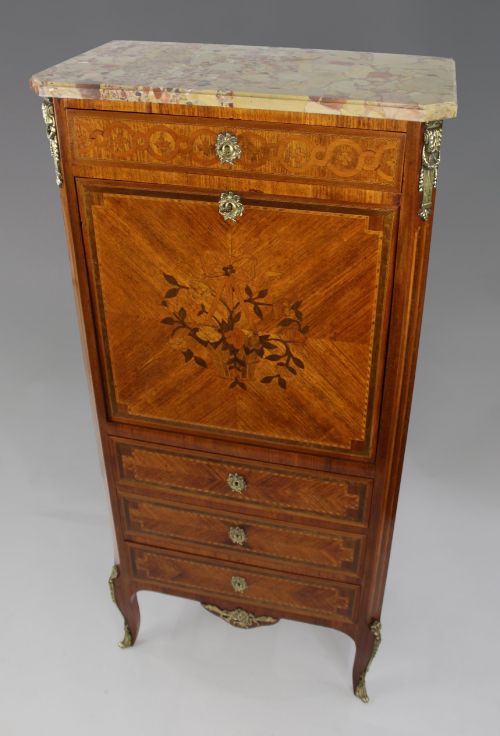
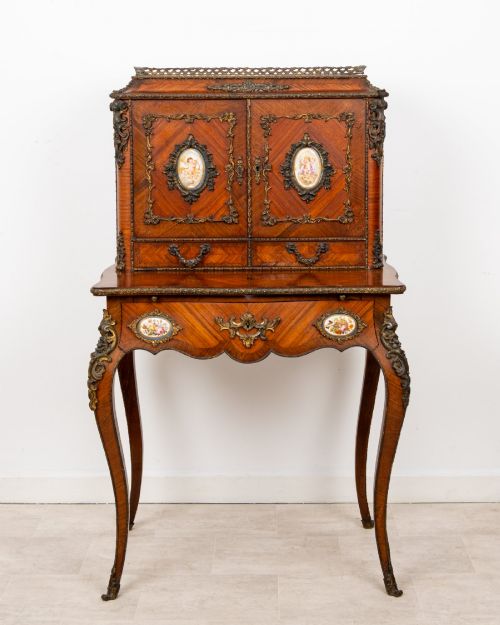
A kingwood writing cabinet is a refined piece of antique furniture designed for correspondence and light storage, often featuring a fall-front desk or a superstructure with small drawers and shelves. When searching this phrase, a buyer encounters sophisticated forms such as the bonheur du jour, the secrétaire à abattant, and the bureau de dame. These pieces predominantly originate from nineteenth-century French workshops influenced by earlier court aesthetics.
The most common versions met on this page are nineteenth-century French creations, spanning Victorian interpretations and items dated around eighteen-eighty to nineteen-hundred. They frequently display revival styles, notably Louis XV and Louis XVI, combining intricate veneering with decorative mounts. Forms range from compact ladies' desks to taller cabinets designed to conceal a fitted writing surface.
Buyers also encounter related writing furniture, including escritoires and bureaus, which share the characteristic use of kingwood veneer. These items reflect the enduring popularity of French cabinet-making techniques during the eighteen-fifties through to the early twentieth century. Each variation offers a distinct approach to domestic organisation and display.
Factors influencing quality
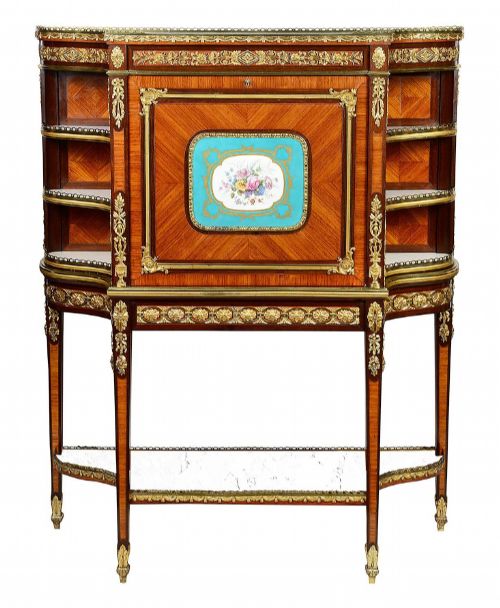
Quality in these cabinets is largely determined by the precision of the marquetry work and the crispness of the ormolu casting. Finer examples exhibit seamless veneer matching and deeply chased bronze mounts that integrate harmoniously with the timber carcase. Lesser pieces often rely on simpler decorative schemes and less detailed metalwork.
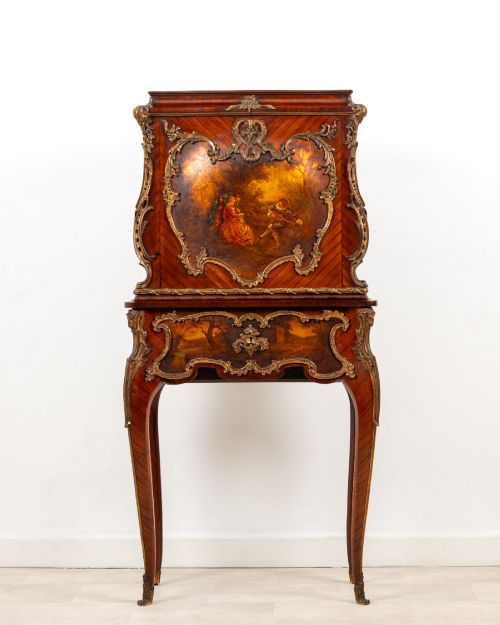
The incorporation of specialist elements such as hand-painted Vernis Martin panels or genuine porcelain plaques elevates a piece within the range. The complexity of the interior fittings, including concealed compartments and leather-lined writing surfaces, also indicates the level of craftsmanship invested by the maker. Structural integrity, particularly in the movement of fall-front doors and drawers, separates superior examples from standard production.
Materials recorded across the inventory include kingwood, ormolu, porcelain, brass, rosewood, marble, glass, and gilt bronze.
Blake London·Jean Werner
The Kingwood Writing Cabinet Glossary
- Kingwood
- A dense, heavy tropical timber prized for its distinctive dark violet-brown grain and golden stripes. It was widely utilised by elite European cabinet-makers for high-status veneered furniture.
- Ormolu
- Gilded bronze ornamentation applied to the mounts, feet, and borders of fine furniture. The technique involves coating metal in a gold amalgam and heating it to achieve a rich, durable lustre.
- Bonheur du jour
- A small, light ladies' writing desk featuring a raised set of drawers, cupboards, or shelves upon the top. This form appeared during the mid-eighteenth century and remained popular through later revival periods.
- Secrétaire à abattant
- A tall upright cabinet featuring a hinged fall-front writing flap that conceals a fitted interior of small drawers and pigeonholes. It provides a generous writing surface while occupying minimal floor space.
- Vernis Martin
- A specialised European lacquer technique developed in imitation of Asian screens, featuring glossy painted scenes. It appears on panels set into fine cabinets and desks of the revival periods.
Kingwood Writing Cabinet: Frequently Asked Questions
How do I use a writing cabinet?
A kingwood writing cabinet is designed for correspondence, featuring a fold-down flap or sliding surface that creates a compact desk. The interior typically houses small drawers and compartments for stationery and letters.
Beneath or above the writing area, enclosed cupboards and drawers provide storage for documents or personal items. Many examples also incorporate display space on upper shelves or marble tops.
Where should I place this cabinet?
These cabinets suit reception rooms, studies, or bedrooms where their decorative timber and gilt mounts can be appreciated. Their compact footprints allow them to fit well against walls or within alcoves.
Position the piece away from direct sunlight and heat sources to protect the polished wood surfaces and delicate veneers from drying out or fading over time.
How do I identify French revival styles?
French revival pieces from the nineteenth century draw inspiration from the decorative arts of the seventeenth and eighteenth courts. Louis XV style is characterised by asymmetrical curves and floral marquetry, while Louis XVI style favours symmetry, straight lines, and classical motifs.
The integration of ormolu mounts, kingwood veneer, and porcelain plaques helps distinguish these later interpretations from genuine eighteenth-century originals.
What is the difference between a bureau and a secrétaire?
A bureau generally refers to a desk with an angled sloping lid that pulls down or lifts to reveal inner compartments. The term encompasses various compact writing forms used in domestic settings.
A secrétaire typically denotes an upright cabinet featuring a vertical fall-front panel that drops down horizontally to form the writing surface. Both forms utilise fine timber veneers like kingwood.