




John Browning London
These john browning london pieces are precision scientific instruments and historical works that bring nineteenth-century optical engineering directly to your desk.
John Browning London
When you search for john browning london, you encounter nineteenth-century scientific instruments associated with the noted Strand optician. These pieces are primarily precision optical devices designed for scientific study rather than decorative display.
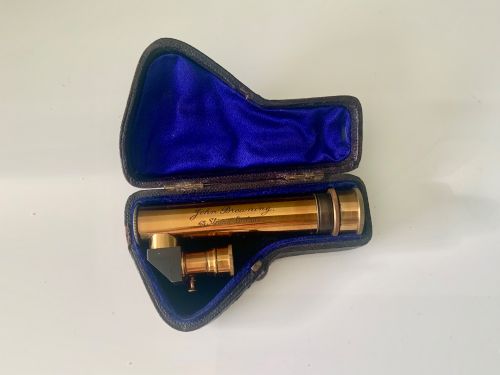
The most common examples on this page are spectroscopes housed in fitted cases, representing the core output of this maker. You also find larger astronomical equipment originating from the same London workshops.
Collectors seek these items for their historical role in Victorian science and the quality of their optical and brass components. They represent a specific period of scientific instrument making in London.
Materials and construction
These instruments rely heavily on turned brass for their main bodies, tubes, and mountings. The metalwork is often polished and fitted with adjustable focus mechanisms.
Many items are completed with fitted wooden cases lined with velvet or leather to protect the delicate optical glass inside. Each component shows the detailed hand assembly typical of nineteenth-century instrument makers.
Nineteenth-century scientists often packed their spectroscopes in velvet-lined boxes so snug the instruments feel like royal jewellery.
Judging quality
Quality in these scientific items rests on the completeness of the original set and the clarity of the optical glass. Lenses and prisms that remain free from clouding or chips command greater interest.
The presence of the original fitted case adds significantly to the completeness of a piece. Engraved signatures on the brass barrel also distinguish the finer examples from standard production.
The John Browning London Glossary
- Spectroscope
- An optical instrument used to produce and examine spectra from light sources. It relies on precision prisms and slits.
- Strand
- A major thoroughfare in London where scientific instrument makers maintained their business premises during the nineteenth century. Makers often engraved this address onto their brass barrels.
- Brass
- An alloy of copper and zinc used widely for nineteenth-century instrument bodies. It provides the necessary durability and stability for precise mechanical parts.
John Browning London: Frequently Asked Questions
What is a John Browning spectroscope?
A John Browning spectroscope is a nineteenth-century optical device used for analysing light. These instruments were made for scientific research and education.
They typically feature brass fittings and are often housed in fitted wooden presentation cases.
How do I care for antique brass instruments?
Antique brass instruments require dry storage away from direct sunlight and damp conditions. Avoid using harsh metal polishes that can remove historic patination.
A soft cloth is usually sufficient for removing dust from the brass and glass surfaces.
Where was John Browning located?
John Browning operated workshops and retail premises on the Strand in London during the Victorian era. This address is frequently engraved on the equipment.
The Strand location places the maker among other notable nineteenth-century opticians and instrument makers.
Are these instruments still usable?
Many of these optical instruments retain their original lenses and prisms and remain functional for demonstration purposes. They are primarily collected as historical artefacts of Victorian science.
Care should be taken when adjusting old focus mechanisms and handling delicate glass components.