
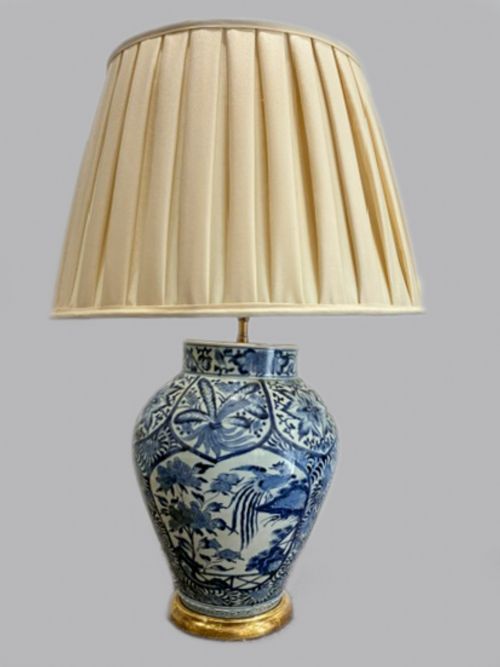

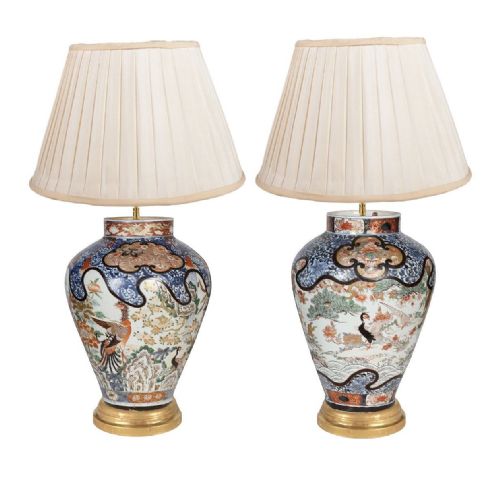


Japanese Imari Lamp
A Japanese Imari lamp brings rich hand-painted palettes into a room, combining centuries-old porcelain with warm domestic lighting.
Japanese Imari Lamp
When you search for a japanese imari lamp, you are looking at table lamps fashioned from historic porcelain vessels, predominantly porcelain vases and bottle forms. These pieces bridge traditional Asian ceramics and European lighting practices, utilising bodies that were originally created centuries ago.
The pieces on this page span the seventeenth, eighteenth, and nineteenth centuries, capturing periods from the Edo to the Meiji eras. You will encounter both single statement pieces and matched pairs, often mounted on bases or fitted with silk and fabric shades.
Many of these items began life as utilitarian or decorative vessels before being converted into lamps at a later date. This conversion history explains why original antique porcelain frequently appears alongside later brass, wood, giltwood, or ormolu mounts.
How They Were Made
The foundation of every japanese imari lamp is hand-thrown porcelain, originating from kilns in Arita and decorated with the characteristic underglaze blue and overglaze iron red and gold pigment. Potters shaped these vessels on wheels before firing them at high temperatures to achieve a durable ceramic body.
Subsequent metalwork involved skilled artisans fitting brass, bronze, or ormolu mounts to secure the electrical components and elevate the porcelain vessel. Wooden and giltwood plinths were frequently introduced to stabilise the base and complement the proportions of the ceramic body.
The listings here include examples spanning three separate centuries, from seventeenth-century Arita vases to nineteenth-century Fukagawa porcelain.
What Varies in Quality
The quality of a japanese imari lamp rests largely on the crispness and complexity of the hand-painted palette on the porcelain body. Finer examples display meticulous brushwork with rich iron red, cobalt blue, and gilding that remain sharp and deep across the surface.
Proportion and mounting also dictate the standard of the piece, distinguishing items with integrated metalwork from those with simpler secondary alterations. The integration of period ormolu mounts or carefully turned wooden bases elevates the overall architectural harmony of the lamp.
Fukagawa
The Japanese Imari Lamp Glossary
- Imari
- A style of Japanese porcelain decorated in underglaze blue, iron red, and gold, named after the port from which these wares were shipped. This palette defines the visual character of the pieces on this page.
- Arita
- The Japanese town and surrounding region where the porcelain industry developed during the Edo period. Kilns here produced the vast majority of the ceramic bodies used for these lamps.
- Ormolu
- Gilt bronze mounted onto furniture and decorative objects, frequently employed by French and European craftsmen. It adds weight and decorative richness to the base of certain porcelain lamps.
- Edo Period
- The period in Japanese history spanning from sixteen hundred and three to eighteen sixty-eight, noted for economic growth and stability. Many of the earliest porcelain bodies date from this era.
- Meiji Period
- The era in Japanese history running from eighteen sixty-eight to nineteen twelve, associated with increased trade and export. Pieces from this time often feature elaborate detailing.
Japanese Imari Lamp: Frequently Asked Questions
How do I date a Japanese Imari lamp?
Dating relies primarily on the characteristics of the ceramic body, the glaze quality, and the iron red and blue pigments used in the decoration. Earlier pieces from the seventeenth and eighteenth centuries often exhibit different potting weights compared to nineteenth-century export wares.
Secondary indicators include any metal or wood mounts added during conversion. European ormolu mounts pointing to specific nineteenth-century French workshops can help narrow down the period of adaptation.
Were these lamps made originally for lighting?
Almost all the porcelain bodies utilised for these pieces were originally created as vases, jars, or bottles rather than lamps. They were adapted into lighting fixtures at a later date, either in Asia or upon arrival in European markets.
This conversion process means the porcelain and the electrical fittings belong to different eras. The ceramic is antique, while the wiring and mounting hardware reflect later domestic utility.
How do I care for my porcelain lamp?
Keep the porcelain surface clean by dusting it gently with a dry, soft cloth to prevent the accumulation of grime in the recessed areas. Avoid using harsh chemical cleaners or abrasive materials that could damage the overglaze red enamel and delicate gilding.
Check the electrical components periodically and consult a professional electrician if any rewiring is required. Handle the lamp by its solid base rather than by decorative mounts or the shade fitting.
What is the difference between Arita and Imari?
Arita refers to the geographical production centre in Japan where the porcelain clay was mined, thrown, and fired in local kilns. Imari is the port town through which these finished ceramics were exported to the West.
Over time, the term Imari became synonymous with the distinct blue, red, and gold decorative style produced in the Arita region. Therefore, an Arita Imari piece describes porcelain made in Arita and decorated in the Imari manner.