
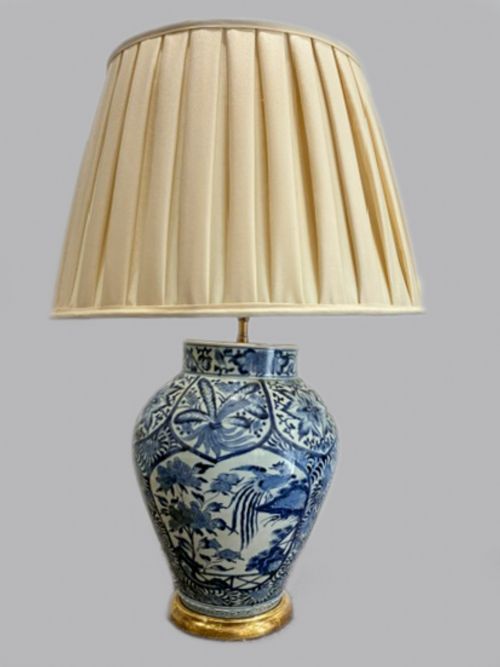

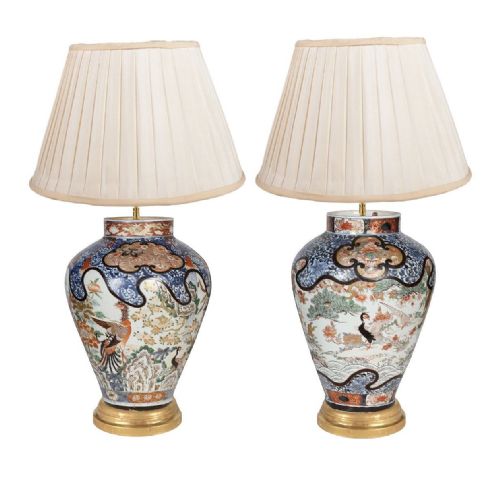


Imari Vase Lamp
An imari vase lamp brings rich palette work and historical ceramic bodies directly into domestic lighting schemes.
Imari Vase Lamp
An imari vase lamp takes a historic ceramic vessel and converts it into a functional table lamp for interior placement. The examples found here span across the seventeenth, eighteenth, and nineteenth centuries, offering a tangible connection to early export porcelain production.
Materials and construction
The primary bodies utilise hard-paste porcelain, decorated beneath and over the glaze in the characteristic iron-red, cobalt blue, and gilt palette associated with imari ware. Artisans shaped these vessels by hand or on the wheel before high-temperature firing.
Conversion for lighting introduced secondary mountings in brass, ormolu, and wood, securing the electrical fittings and providing stable bases. Fabric and silk shades frequently complete the assembly, complementing the colourful ceramic surfaces.
Listings feature porcelain vessels spanning the seventeenth to the nineteenth centuries, incorporating Edo period and Meiji styles.
Judging quality in conversion pieces
Quality rests heavily on the integrity of the original ceramic body and the reversibility of the lamp conversion. Earlier seventeenth and eighteenth-century examples display greater crispness in the hand-painted cobalt and iron-red detailing.
The sophistication of the metal mounts, whether French ormolu or simple turned brass, separates standard utilitarian conversions from finer decorative assemblies. Preservation of the glaze and minimal firing flaws further distinguish superior vessels.
Arita kilns·Fukagawa manufactory
The Imari Vase Lamp Glossary
- Imari
- A style of Japanese porcelain decorated in underglaze blue, iron-red, and gilt. The name derives from the port of export on the island of Kyushu.
- Arita
- The Japanese town and surrounding region where the majority of export porcelain was produced. Kilns here supplied the dense bodies used for these vessels.
- Ormolu
- Gilt-bronze mounts applied to furniture and ceramics. French workshops frequently added these decorative brass elements to imported porcelain during the nineteenth century.
- Spill vase
- A tall, narrow vessel originally designed to hold wooden spills for lighting pipes and candles. Many examples were later drilled and adapted as table lamps.
- Hard-paste porcelain
- A durable ceramic material composed of kaolin and petuntse fired at very high temperatures. It forms the impermeable white body of the vases.
Imari Vase Lamp: Frequently Asked Questions
Are these antique vases damaged by conversion?
Many historic vases were drilled or fitted with metal hardware during the nineteenth and twentieth centuries to accommodate wiring. While this alters the original state of the ceramic, it represents the primary way these decorative objects survived in domestic use.
Collectors weigh the cleanliness of the drill hole and the stability of the mount against the age and visual appeal of the porcelain body itself.
How do I date an imari lamp?
Dating relies on stylistic clues in the hand-painted palette, the density of the porcelain, and the type of metal mounts used in the conversion. Earlier seventeenth and eighteenth-century pieces often show thicker potting and softer underglaze blue tones.
Later nineteenth-century examples tend to feature brighter iron-red enamels and more standardised brass or ormolu hardware applied during the Victorian era.
Can I use modern lampshades with them?
Modern shades attach easily provided the harp and spider fittings match the diameter of the central brass rod. Choosing silk or linen shades helps soften the visual weight of the patterned ceramic body.
Proportion remains the key consideration when selecting a shade to balance the height and girth of the antique vase below.