
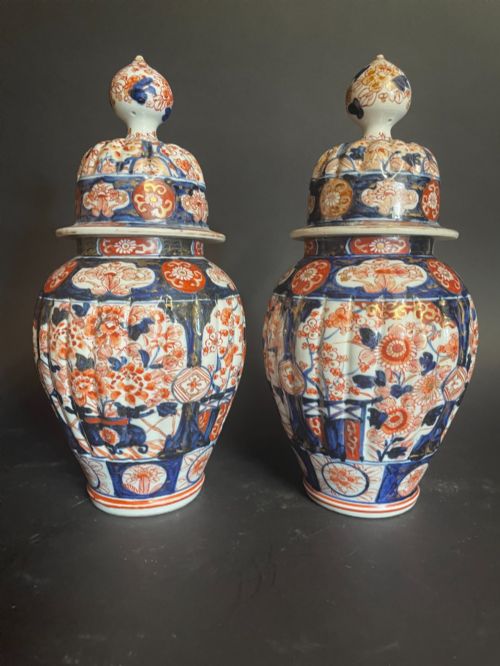
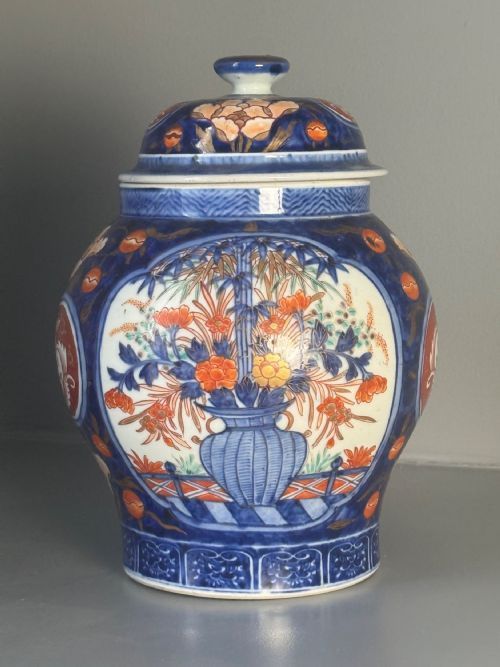


Japanese Covered Temple Jar
These large ceramic vessels bring weight and colour to a room, offering the bold palette of Arita and Satsuma kilns.
Japanese Covered Temple Jar
When you search for a japanese covered temple jar, you are looking at substantial lidded vessels made for display, most commonly found in the Imari palette from the nineteenth century alongside Satsuma and Kutani wares.
The pieces on this page span several centuries, reaching back to earlier Arita productions and extending through the Meiji period into early twentieth-century interpretations.
Makers shaped these pots as baluster vases, ginger jars and octagonal containers complete with matching covers, utilising forms intended to anchor a mantelpiece or sideboard.
Materials and construction
Potters shaped these vessels from porcelain and earthenware, applying complex glaze layers and iron-red and cobalt-blue pigments before firing.
Artisans enriched many surfaces with gold leaf, gilt, and intricate enamel work, building depth and pattern across the body and lid.
Judging the work
Quality rests in the crispness of the porcelain throwing, the precision of the hand-painted enamel, and the balance between the vessel and its cover.
Pieces that succeed visually maintain disciplined brushwork and harmonious gilding without overcrowding the clay body.
The Japanese Covered Temple Jar Glossary
- Imari
- A style of Japanese porcelain decorated in underglaze blue and overglaze red, gold, and green. It originated in the town of Arita and gained immense popularity in Europe.
- Satsuma
- A type of Japanese earthenware featuring a crackle glaze and elaborate polychrome and gilt decoration. These pieces often depict landscapes and figures.
- Baluster
- A vase shape with a rounded body that tapers toward the base and swells near the lower centre. It provides a stable and sculptural silhouette.
- Kutani
- Japanese porcelain or earthenware recognised by its bold palette, frequently incorporating dense greens, purples, and extensive gilding.
Japanese Covered Temple Jar: Frequently Asked Questions
How do I date a Japanese lidded jar?
Look to the potting style, the palette, and any cyclical marks on the base to suggest the period of manufacture.
Nineteenth-century pieces often display heavier porcelain bodies and deep cobalt tones compared to lighter early wares.
Where should I display a temple jar?
These large vessels require sturdy surfaces like sideboards, tables, or mantelpieces where their height and weight remain secure.
Keep them away from direct sunlight to preserve the vibrancy of the enamel and gold leaf.
What is the difference between Imari and Satsuma?
Imari uses hard porcelain with a distinctive blue and red palette, whereas Satsuma employs a cream-coloured earthenware with a fine crackle glaze.
Both styles utilise extensive gilding but differ fundamentally in their clay body and surface texture.
Are the covers usually original?
Many surviving jars retain their matching lids, which share the exact palette, paste, and decorative scheme of the base.
Matching the glaze wear and potting style helps confirm that the cover belongs to the vessel.