
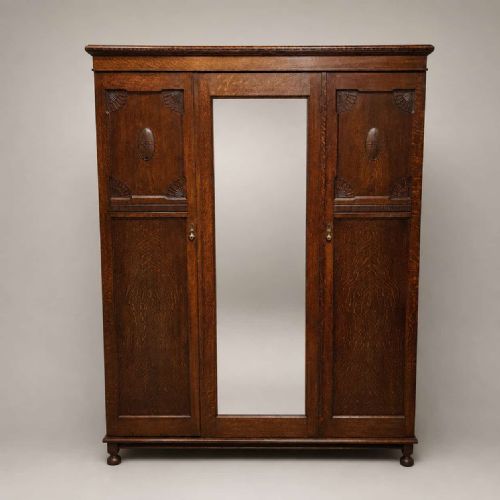
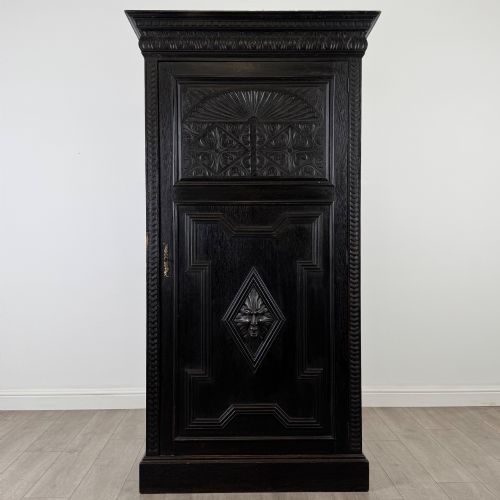

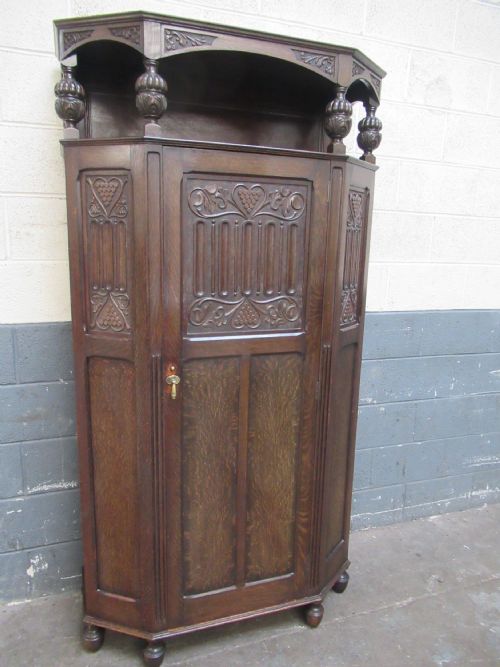

Jacobean Revival Wardrobe
These jacobean revival wardrobe pieces bring substantial storage and deep historical presence into a bedroom.
What a jacobean revival wardrobe is
A jacobean revival wardrobe is a substantial piece of bedroom furniture designed to evoke seventeenth-century domestic styling. Pieces span from the late nineteenth century into the interwar years, represented by dates such as 1880 and 1920 in the current selection.
The primary form encountered on this page is the large oak wardrobe cupboard, frequently built as a triple wardrobe or triple-door wardrobe. These tall constructions provide ample hanging and storage space behind heavy panelled or carved doors.
Originating during periods of historical revivalism, these items adapt earlier decorative motifs for Victorian and early twentieth-century homes. Buyers find both standard hall wardrobes and expansive triple configurations designed to anchor a traditional interior.
Materials and construction
Construction relies heavily upon solid oak, a timber chosen for its durability and suitability for deep carving. Artisans utilised this robust wood to build heavy framing that supports large panelled doors and internal hanging compartments.
Surface decoration frequently involves heavy carving, reflecting the sculptural aesthetics of the revival period. Metalwork details such as brass fixtures and sometimes glass elements complement the dark, figured grain of the timber.
The documented pieces span from the late nineteenth century through to the interwar period of 1920.
Assessing quality
The distinction between standard examples and superior items rests upon the depth and intricacy of the carving. Finely executed relief work and well-balanced proportions elevate a piece above simpler utilitarian cupboards.
Material selection also dictates standing, with dense, well-figured oak and substantial brass hardware marking out the finer end of the range. The integration of panelled doors with smooth structural alignment demonstrates superior cabinet-making skill.
The Jacobean Revival Wardrobe Glossary
- Oak
- A hard, durable timber with a prominent grain pattern that forms the structural basis of these pieces. It takes deep carving exceptionally well.
- Triple wardrobe
- A large three-section storage unit offering expanded capacity for clothing. This configuration provides significant presence in a room.
- Revival
- A design movement that reinterprets historical aesthetics from earlier centuries for contemporary use. It dominated nineteenth and early twentieth-century furniture production.
- Hall wardrobe
- A tall storage cupboard historically placed in an entrance hall or large landing for outerwear. These pieces offer vertical storage solutions in compact footprints.
Frequently Asked Questions
What is a jacobean revival wardrobe?
A jacobean revival wardrobe is a large timber storage piece built in the late nineteenth or early twentieth century. It mimics seventeenth-century decorative traditions using modern cabinet-making methods.
These pieces combine traditional heavy carving and panelled doors with functional internal spaces designed for modern clothing storage.
How do I place one in a modern bedroom?
Due to their substantial height and depth, these wardrobes require a dedicated wall with sufficient clearance. Their dark timber tones anchor light neutral spaces effectively.
Ensure floor levels are even before positioning, as heavy oak structures benefit from stable foundations to keep doors aligned correctly.
Are these wardrobes difficult to move?
Many jacobean revival wardrobes are constructed as single heavy units or modular sections that require multiple people to transport safely. Solid oak adds considerable weight to the frame.
Carefully check whether your chosen piece disassembles into sections before attempting relocation through tight hallways or stairwells.
How do I date a jacobean revival piece?
Dating relies on stylistic markers combined with construction techniques visible in the timber and hardware. Items from the 1880 period often feature denser hand-carving.
Later pieces from around 1920 may display modified internal fittings while retaining the exterior revival aesthetic established decades prior.