
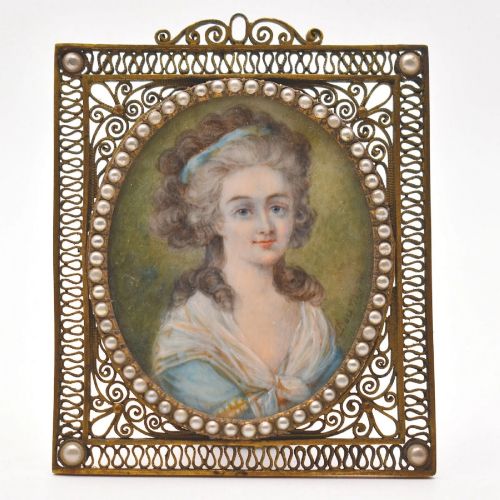


Ivory Portrait Painting
These ivory portrait painting examples are delicate watercolours on thin sheets of ivory, captured in gilt metal, gold, or ebonised wood frames.
Ivory Portrait Painting
When you search for ivory portrait painting, you find portrait miniatures created across the eighteenth century, the Regency period, and the nineteenth century. These small paintings depict subjects such as young girls, ladies, gentlemen, and officers.
You are most likely to meet Georgian and Regency examples on this page, housed behind glass in brass, gilt metal, or simple ebonised wood frames. The subjects often wear period dress, from white dresses with blue sashes to coral beads.
The format ranges from formal bust portraits to detailed studies attributed to listed miniaturists. Works originate from British, Irish, French, and German schools of painting.
Materials and technique
Artists painted these works in watercolour directly onto thin, prepared slices of ivory, utilising the translucent quality of the material to give a lifelike glow to skin tones.
Finished paintings sat behind protective glass, framed in gold, gilt metal, or brass, sometimes accented with seed pearls or set within ebonised wood cases.
Listings feature works painted on ivory across the seventeenth, eighteenth, and nineteenth centuries, utilising watercolour and gouache.
Judging quality
The refinement of the brushwork and the precision in capturing facial expression distinguish standard works from exceptional commissions. Master miniaturists rendered hair, lace, and fabric with remarkable clarity.
The quality of the surrounding frame, whether solid gold, chased gilt metal, or original ebonised wood with brass fittings, contributes significantly to the overall standing of the piece.
Charles Hayter·Nicolas Freese·Frederick Buck·George Engleheart·Archibald Skirving·William Grimaldi·Henry Jacob Burch·Edward Pugh·Samuel Cotes·Jeremiah Steele
The Ivory Portrait Painting Glossary
- Miniature painting
- A small-scale portrait executed with fine brushes, requiring immense control and patience from the artist. These works were often kept as personal tokens or worn as jewellery.
- Watercolour on ivory
- A technique where water-based pigments are applied to a thin slice of animal ivory. The luminosity of the ivory beneath the paint creates a distinct radiance.
- Ebonised wood
- Timber treated to resemble ebony, frequently used for simple, dark frames during the Georgian and Regency periods. It provides a strong contrast to the bright colours of the miniature.
- Gilt metal
- Base metal treated with a thin layer of gold or gold-coloured wash. It was a popular framing material for portable portraits.
Ivory Portrait Painting: Frequently Asked Questions
How were these miniatures displayed?
These portraits were designed to be portable, often kept in pockets, travel cases, or small leather boxes. Owners carried them close as personal mementos of family members.
Over time, many were fitted with loops or rings so they could be hung on a wall or worn as pendants.
Who are the subjects in these portraits?
The subjects include titled nobility, military officers, and prosperous family members from the Georgian and Regency eras. Artists captured likenesses for betrothals, memorials, or personal remembrance.
Many sitters remain unidentified, though inscriptions on the reverse occasionally record names and dates.
How do I care for an ivory miniature?
Keep the piece away from direct sunlight and fluctuating temperatures to prevent the ivory from warping or cracking. Glass fronts should remain sealed to protect the delicate watercolour pigments from moisture.
Dust the frame gently with a dry, soft cloth and avoid using liquid cleaners near the painted surface.
How can I tell the period?
Clothing styles, hairstyles, and framing techniques offer the clearest clues to dating a miniature. Regency portraits often feature high-waisted dresses and soft curls, while earlier Georgian works display distinct tailoring and wig styles.
Signatures, backing papers, and handwritten notes left by earlier owners also help establish the date.