


Italian Rococo Chest Drawers
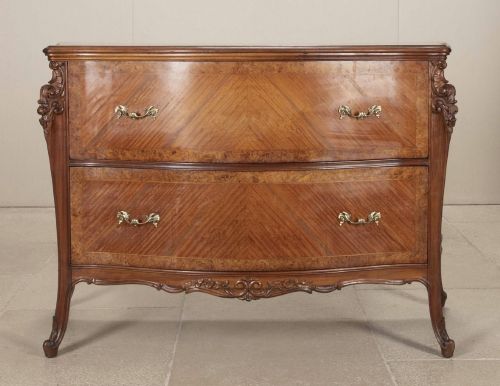
These italian rococo chest drawers are serpentine and bombe commodes built for grand continental interiors, offering sweeping curves and rich walnut or painted finishes.

Italian Rococo Chest Drawers
When you search for italian rococo chest drawers, you encounter serpentine and bombe commodes spanning the eighteenth to the early twentieth century. The form typically presents a rounded or undulating front profile, designed to catch the light in a formal room.
Most examples belong to the nineteenth century or the revival periods around nineteen hundred, though genuine eighteenth-century pieces appear in walnut and olive-wood. Alongside full-size commodes, you also find smaller bedside chests and pairs.
The decorative vocabulary leans heavily on Venetian scenes, painted finishes, and inlaid woodwork. These pieces serve equally as practical storage and as focal points within traditional drawing rooms or hallways.
Materials and Construction
Makers built these pieces primarily from walnut, burr walnut, fruitwood, and olive-wood, often applying intricate inlay or selecting highly figured veneers. Carved details and painted surfaces with Venetian scenes appear frequently across the surviving items.
Many commodes feature shaped marble tops that follow the contour of the serpentine or bombe wooden carcase below. Brass hardware such as handles and escutcheons completes the construction, fastened to drawers that match the curved lines of the frame.
Listings feature woods such as walnut, burr walnut, fruitwood, olive-wood, and satinwood, alongside painted wood and marble.
Assessing Quality and Execution
The distinction between ordinary and exceptional pieces lies in the fluidity of the timber figure and the crispness of the serpentine or bombe shaping. Finer commodes display seamless veneer matching across curved drawer fronts and carefully proportioned carcasses.
Painted examples vary according to the detail and preservation of the Venetian scenes and decorative brushwork on the wood. The integration of the marble top with the wooden base also marks the difference between standard production and superior cabinet-making.
The Italian Rococo Chest Drawers Glossary
- Serpentine
- A furniture front or top curving inward centrally and outward at the ends in a gentle wave. This outline gives the chest a dynamic visual movement.
- Bombe
- A swollen, bulging outward curve on the sides and front of a chest or commode. It requires advanced woodworking skill to execute properly.
- Commode
- A low chest of drawers, functioning primarily as a decorative storage piece in bedrooms or reception rooms. The term originates from French furniture terminology.
- Escutcheon
- A protective plate surrounding the keyhole of a drawer or door, often cast in brass. It serves a practical function while adding decorative detail.
- Inlay
- A technique of inserting contrasting pieces of wood or other materials into a solid wooden surface to form a design. It highlights the natural grain variations of walnut and fruitwood.
Italian Rococo Chest Drawers: Frequently Asked Questions
Where were these chests placed originally?
These commodes stood in grand reception rooms, salons, and formal bedchambers of continental houses. They provided surface space for ornaments while storing household linens or valuables.
Today, they function well in hallways or living rooms as statement furniture pieces.
How do I care for a painted marble top?
Marble tops require gentle cleaning with a damp cloth and mild soap to protect the stone surface and any integrated painted details. Avoid acidic substances that can etch the polish.
Ensure the marble rests evenly on the wooden carcase to prevent stress fractures along the serpentine edges.
How do I distinguish eighteenth-century pieces from later revivals?
Dating relies on examining the interior construction, secondary timbers, and the wear patterns on the drawer runners. Eighteenth-century pieces show hand-cut joinery and period-specific wood selection.
Revival pieces from the nineteenth and early twentieth centuries often employ machine assistance or heavier structural framing.