


Italian Landscape Picture
An italian landscape picture brings classical ruins, sunlit canals and mountain lakes into a room through nineteenth-century oils and watercolours.
Italian Landscape Picture
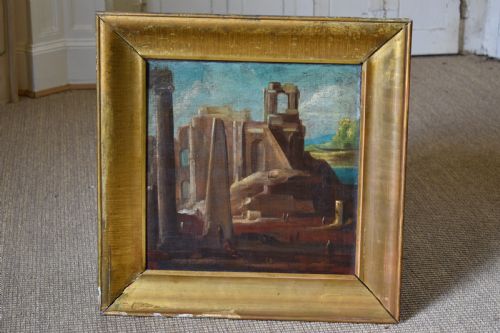
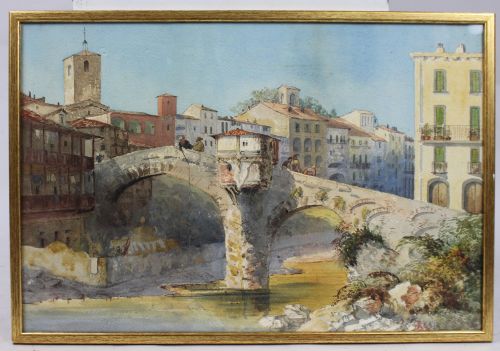
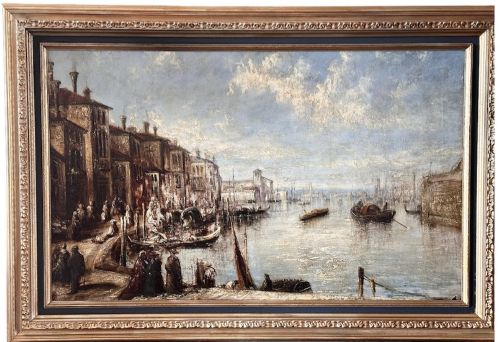
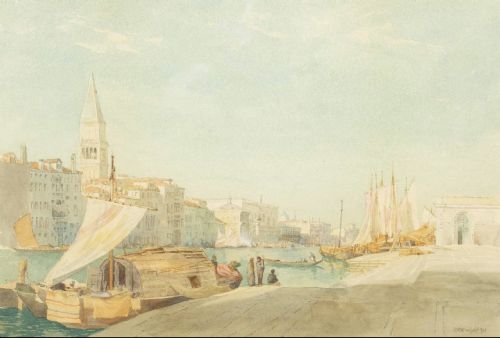
An italian landscape picture captures the scenery of the peninsula, spanning Venetian canals, Neapolitan bays and rural mountains. Buyers encounter these primarily as nineteenth-century oil paintings on canvas and delicate watercolours on paper, often framed for wall display.
The selection ranges from grand architectural views of the Grand Canal and the Forum of Nerva to quiet pastoral scenes with mountains and lakes. Many pieces reflect the tradition of the Grand Tour, recording travels through Northern Italy and Rome during the Victorian era and the early twentieth century.
Materials and construction
Painters utilised oil paint on canvas or wooden panels, alongside watercolour, gouache and pastel on paper, to capture the distinct light of southern Europe. Supporting media include stone inlay such as pietra dura panels and glazed earthenware plaques.
Framing forms an integral part of the physical object, employing carved wood and giltwood surrounds that often match the period of the artwork. Pigments applied to paper or canvas rely on traditional brushwork, occasionally accompanied by ink pen drawings.
Artists frequently painted Venice because the shimmering lagoon water forgave any minor structural liberties taken with the palaces.
Distinctions in quality
The degree of detail in architectural rendering and atmospheric perspective distinguishes accomplished works from simpler souvenirs. Master painters handle light on water and stone with precision, whereas lesser examples rely on formulaic repetition of standard motifs.
The survival of the original mount, glass and giltwood frame contributes substantially to the integrity of a piece. Condition issues such as foxing on paper or craquelure on canvas influence the visual coherence of the composition.
Francis Moltino·Richard Henry Wright·Giulio Cecchini·Claude Jousset·William Raymond Dommersen·Jane Vivian·Alfred Pollentine·Consalvo Carelli·Hercules Brabazon Brabazon·Charles H Poingdestre·David Law·Wilfred Knox·Arthur Severn·Helen Donald-Smith·Thomas Brabazon Aylmer
The Italian Landscape Picture Glossary
- Gouache
- An opaque watercolour paint that dries to a matte finish. Artists utilise it to build solid areas of colour in coastal and architectural views.
- Pietra dura
- A technique of using cut and fitted polished coloured stones to create pictorial designs. It appears on heavy stone panels set within frames.
- Grand Tour
- A traditional trip of Europe undertaken by upper-class European young men of the 18th and 19th centuries. Travellers acquired paintings and watercolours as records of their journeys.
- Foxing
- Brown spots that develop on old paper due to chemical reactions over time. It occurs frequently in nineteenth-century watercolours stored in humid conditions.
- Impressionism
- A nineteenth-century movement characterised by relatively small, thin, yet visible brush strokes. Painters applied this style to capture the shifting effects of light on Venetian lagoons.
Italian Landscape Picture: Frequently Asked Questions
What subjects appear most frequently in these pictures?
Venetian canals, the Lagoon, and classical ruins in Rome dominate the subjects recorded by artists on the peninsula. Coastal views around Naples and Sorrento also recur frequently.
Rural scenes featuring mountains, lakes, and vineyards provide a quieter counterpart to the busy urban architectural vistas.
How do I care for antique paper watercolours?
Watercolours on paper require protection from direct sunlight to prevent the pigments from fading over decades. Acid-free mounting materials and sealed backing boards prevent environmental degradation.
Displaying them away from damp environments like kitchens or bathrooms protects the paper and prevents foxing spots from spreading.
Are these works signed by the artists?
Many pieces carry signatures, monograms, or contemporary inscriptions written on the front or reverse of the canvas, panel, or paper. Signatures help attribute works to specific painters active during the nineteenth and early twentieth centuries.
Unsigned works often relate to specific regional schools, such as the School of Posillipo, based on stylistic conventions and technique.
How do oil paintings differ from watercolours here?
Oil paintings utilise viscous pigments suspended in oil on canvas or wood, offering rich textures and deep colour saturation. Watercolours employ water-soluble pigments on paper, creating luminous and transparent effects.
Oils generally require sturdy wooden frames without glass protection, whereas watercolours need a glass cover and mat to keep the paper away from the surface.