


Victorian Venetian Painting
Victorian venetian painting captures the timeless allure of the canals and lagoons through nineteenth-century brushwork.
Victorian Venetian Painting
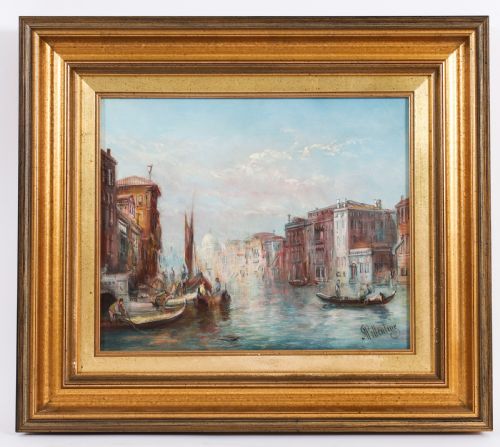
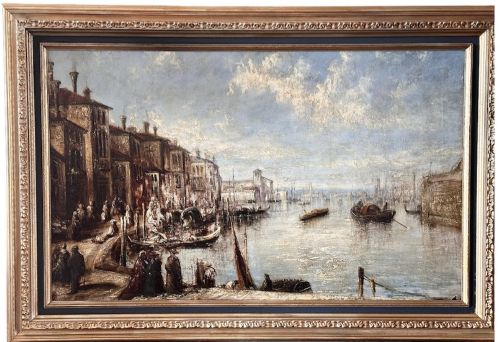
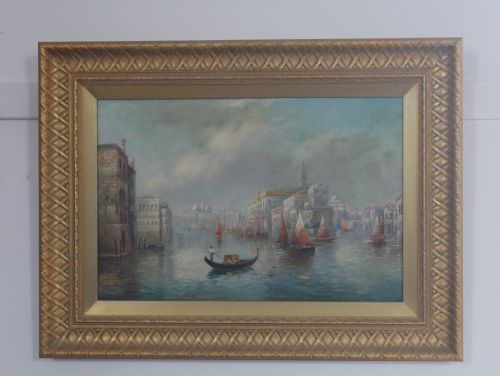
Victorian venetian painting focuses primarily on topographical views of the Grand Canal, the Doge's Palace, and the Santa Maria della Salute. These works record the distinctive architecture and atmospheric light of Italy through the eyes of nineteenth-century artists.
The pieces on this page appear predominantly as oil on canvas or delicate watercolours on paper. Townscapes and canal scenes dominate the selection, often framed in giltwood or carved wood.
Materials and methods
Artists utilised oil paints on stretched canvas to build luminous townscapes and architectural details. Watercolours on paper offered a lighter medium for capturing the translucent quality of the lagoon water and sky.
Listings combine oil on canvas and watercolour on paper within nineteenth-century frameworks.
Distinctions in execution
The calibre of a nineteenth-century Venetian view rests on the precision of architectural rendering and the handling of atmospheric light. Stronger examples command attention through crisp perspective and convincing water reflections rather than mere repetition of famous landmarks.
Medium and scale also establish hierarchy within the selection. Large oil paintings on canvas demonstrate greater ambition than smaller works on paper, though skilful watercolourists achieve remarkable luminosity through washes.
Alfred Pollentine·Francis Moltino·F J Aldridge·Jane Vivian·William Raymond Dommersen·Hercules Brabazon Brabazon·Frank Wasley·David Law·George Stanfield Walters·Henry Wimbush·Arthur Severn
The Victorian Venetian Painting Glossary
- Canvas
- A heavy woven fabric used as a surface for oil painting. It provides the tensile strength needed for large nineteenth-century townscapes.
- Topographical
- A genre of art focused on the accurate representation of specific places. These views of Venice rely on recognizable monuments and canals.
- Watercolour
- A paint consisting of pigment suspended in a water-based solution, applied to paper. It allows for transparent layers suited to lagoon atmospheres.
Victorian Venetian Painting: Frequently Asked Questions
What subjects appear most often?
Canals, palaces, and lagoon vistas dominate these nineteenth-century artworks. Landmarks such as the Grand Canal and the Doge's Palace recur frequently.
Artists also recorded quieter waterways and distant views across the water towards the city. These compositions reflect popular travel routes of the period.
How should these works be framed?
Period giltwood or ebonised wood frames suit the nineteenth-century origins of these paintings. Simple mouldings allow the architectural detail to remain the primary focus.
Original frames often show minor wear that testifies to their age. Preservation of these surrounds maintains the historical context of the artwork.
Are watercolours as durable as oils?
Works on paper require protection from direct sunlight to prevent fading of the pigments. Glazing with appropriate glass helps shield the delicate washes.
Oil paintings on canvas generally offer greater resilience against environmental factors. Both mediums benefit from stable indoor humidity and temperature.
How do I identify the period?
Stylistic markers include nineteenth-century romanticism and detailed townscape conventions. Signatures, dates, and framing materials often provide corroborating evidence for the era.
Subject matter aligned with the Grand Tour indicates nineteenth-century production. Many pieces bear artist inscriptions or historical labels on the reverse.