


Italian Genre Scene Painting
These Italian genre scene painting works capture everyday moments of 19th-century life, offering an engaging glimpse into past domestic and social scenes.
Italian Genre Scene Painting
An Italian genre scene painting depicts everyday life, ordinary people, and social moments rather than grand historical or mythological subjects. When searching for an Italian genre scene painting, buyers encounter works executed during the 19th century.
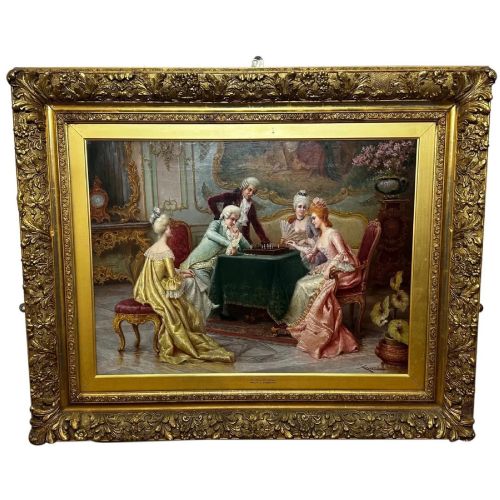
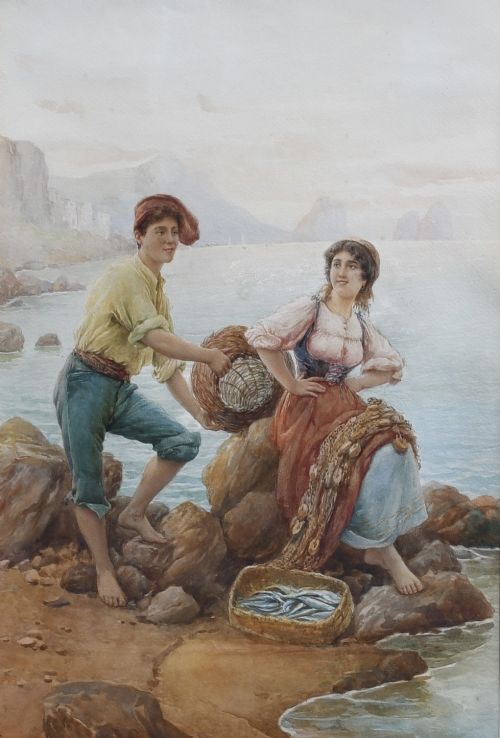
The pieces available on this page present various daily activities, from musical recitals and quiet reading to fisherfolk resting by the sea. Artists recorded these subjects with precise observation, setting them within domestic interiors, gardens, or coastal landscapes.
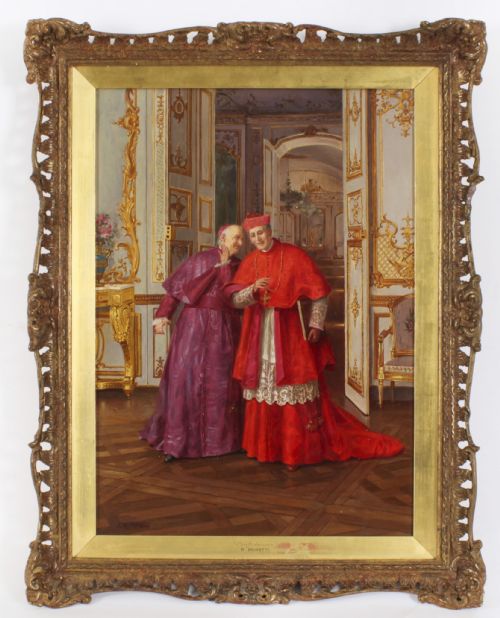
The selection includes both watercolours on paper and oil paintings on canvas, often housed within gilt wood frames. These works showcase styles ranging from Academic Realism and Rococo Revival to Neoclassical interpretations.
Materials and methods
Artists employed oil paint on canvas or watercolour on paper as their primary media to render these detailed compositions. The support materials were stretched or mounted before receiving layers of pigment mixed with oil or water binders.
Finished works were typically mounted behind glass in the case of watercolours, or secured within decorative gilt wood frames for oil paintings. These frames provided structural support and complemented the visual presentation of the artwork.
Several ladies are caught mid-scroll or mid-note, proving that 19th-century relaxation involved plenty of dramatic reading and musical practice.
Factors of quality
Quality rests in the precision of the brushwork and the handling of light and shadow across the figures. Skilled painters captured fabrics, facial expressions, and atmospheric details with greater clarity and depth.
The composition and psychological engagement between the subjects distinguish finer works from simpler decorative pieces. The condition of the canvas, paper, and original gilt wood framing also influences the overall standing of an artwork.
Carlo Ferranti·Renato Moretti·Martinetti·Charles H Poingdestre·Arturo Orselli·Federico Andreotti·Willem Johannes Martens·Pompeo Massani·Belisario Gioja·Francesco Bergamini
The Italian Genre Scene Painting Glossary
- Genre painting
- A branch of fine art depicting scenes from everyday life, such as domestic interiors, markets, and street activities. These works focus on ordinary individuals rather than historical or religious figures.
- Academic Realism
- A painting style that combines the careful, realistic observation of the physical world with the rigorous standards of official art academies. It emphasises accurate anatomy, perspective, and detailed rendering.
- Watercolour
- A painting method where water-soluble pigments are suspended in a water-based solution and applied to paper. It produces translucent washes and delicate tonal gradations.
- Gilt wood
- Wood that has been treated with a thin layer of gold leaf or gilt powder for decorative effect. It was commonly utilised for traditional picture frames during the 19th century.
Italian Genre Scene Painting: Frequently Asked Questions
What is an Italian genre scene painting?
An Italian genre scene painting depicts everyday activities and ordinary people from the 19th century, capturing moments like musical recitals, reading, or coastal rest.
These artworks provide a visual record of social life, fashion, and domestic interiors during that period.
How do I care for these paintings?
Keep watercolour and oil paintings away from direct sunlight and excessive moisture to prevent fading and material degradation.
Display them in stable indoor environments and dust gilt wood frames gently with a soft, dry cloth.
Are these paintings framed?
Many works retain their period gilt wood frames, which complement the visual style of the 19th-century artwork.
Framing materials typically include wood and glass for watercolours, or decorative moulded wood for oil on canvas pieces.
What periods do these paintings represent?
The available works originate from the 19th century, including specific dates recorded around 1880, 1890, and 1900.
They reflect artistic movements such as Academic Realism, Rococo Revival, and Neoclassicism prevalent in Italy during that era.