




Isle of Man Painting
An isle of man painting captures the distinct light, dramatic coastline and busy harbours of the island through Victorian and mid-century British brushwork.
The Nature of Isle of Man Paintings
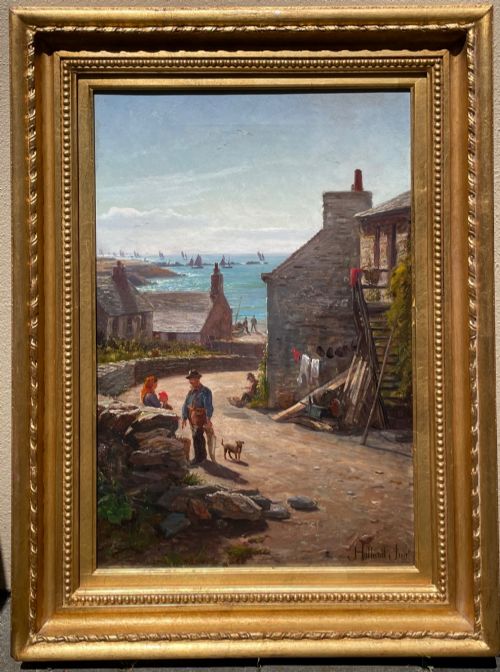
An isle of man painting focuses on topographical views, coastal inlets and local harbours from the nineteenth and twentieth centuries. Works often depict specific locations such as Port Erin, Douglas Harbour, Peel, and Ramsey, reflecting the topographical interest of visiting and resident artists.
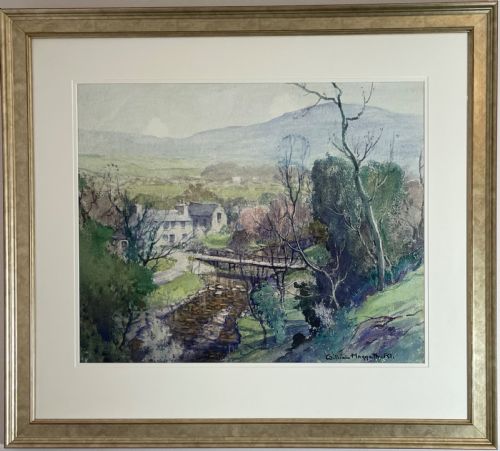
The selection ranges from Victorian marine oils to mid-century British watercolours and pastels. Oil on canvas and watercolour on paper dominate the record, framed in wood or giltwood.
Victorian examples tend to emphasise maritime activity and local steam packet ships, while twentieth-century pieces lean towards broader landscape and river views.
Materials and Technique
Artists utilised oil paint on canvas or canvas board, alongside watercolour and pastel on paper. These mediums allowed painters to capture both the translucent quality of coastal water and the solid textures of rural cottages and cliffs.
Surviving works are typically mounted behind glass in wooden or giltwood frames appropriate to their period. Support materials range from heavy woven canvas to pressed paper sheets.
Retail Price Guide 2026
Typical UK retail prices for isle of man painting, calculated from the Sellingantiques database of over a million retail prices indexed since 2003. This retail price guide relies exclusively on Sellingantiques data; no external sources or auction records are used, so the figures do not describe the wider market.
Early artists frequently braved unpredictable Irish Sea weather to capture local steam packets mid-voyage.
Markers of Distinction
Quality rests upon the handling of light and atmospheric conditions, particularly in coastal scenes where sea and sky meet. Superior works demonstrate confident brushwork and precise topographical detail rather than generic landscape composition.
Attribution to documented artists active on the island, such as William Hoggatt, John Holland, or John Hobson Nicholson, elevates a piece. The condition of the original paint layer and the integrity of the period frame also influence the overall standing of an artwork.
John Holland·William Hoggatt·John Hobson Nicholson·Owen Bowen·William Edward Webb·Thomas Rose Miles·Franz Hoepfner·James Aitken
The Isle of Man Painting Glossary
- Oil on Canvas
- Pigment suspended in drying oil applied to a woven fabric stretched across a wooden frame. This medium allows for rich colour depth and textured application.
- Watercolour
- A paint consisting of colour pigments suspended in a water-soluble vehicle, typically applied to paper. It produces transparent washes that suit luminous skies and coastal water.
- Giltwood
- Wood carved and coated with gold leaf or a gold-coloured metallic finish. It is commonly found on frames housing nineteenth-century oil paintings.
Frequently Asked Questions
How do I identify the location in an isle of man painting?
Many works include inscriptions on the reverse or titles written on the frame or stretcher bars naming specific spots like Garwick Bay or Spanish Head.
Local landmarks such as specific piers, headlands, and steam packet vessels also help pinpoint the exact setting.
What is the difference between the Victorian and twentieth-century works?
Victorian pieces frequently lean towards detailed maritime scenes featuring steamships and dramatic coastal weather.
Twentieth-century examples often adopt British Impressionism or mid-century styles with looser brushwork and softer rural palettes.
How should I care for a paper-based watercolour?
Watercolours on paper require protection from direct sunlight to prevent fading of the pigments.
Keep them away from damp environments to avoid foxing and paper degradation behind the glass.
Are these paintings usually signed by the artist?
A significant portion of the pieces carry the artist signature, either in the wet paint or beneath the watercolour wash.
Unsigned works are occasionally attributed through distinct stylistic traits or contemporary gallery labels.