
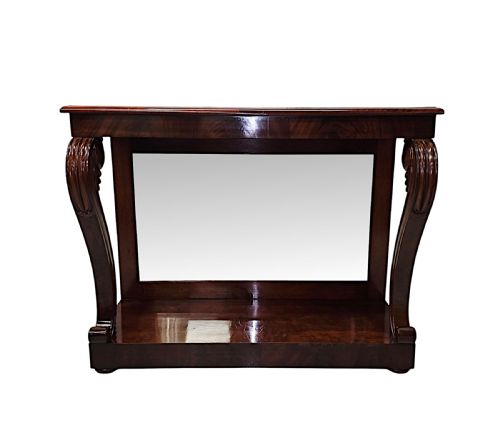
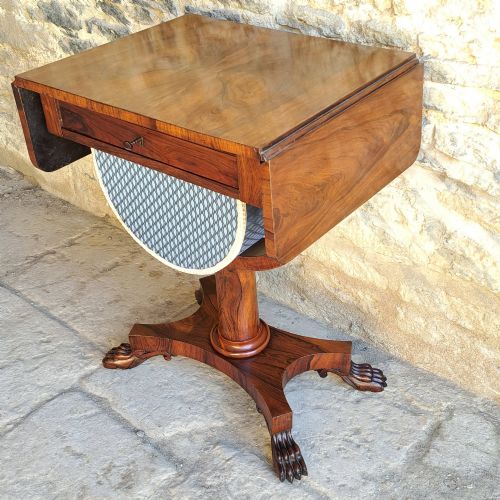
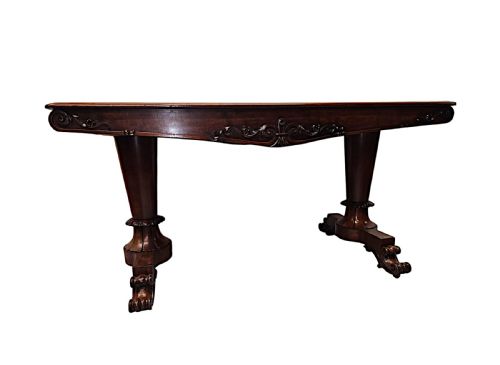


Irish William IV Table
Irish William IV table designs combine robust architectural forms with rich timbers like mahogany and rosewood.
Irish William IV Table
When you search for an irish william iv table, you encounter substantial nineteenth century furniture originating from Irish workshops and country houses. These pieces span dining, library, console, and work tables built during the broader Regency and William IV periods.
You are most likely to meet mahogany and rosewood examples on this page, often featuring heavy carved legs, brass castors, and robust pedestals. The forms range from folding dining tables to compact sewing tables and elaborate library writing desks.
Irish cabinet makers of this era adapted contemporary English Regency and George IV fashions while incorporating distinct local carving traditions. Surviving pieces demonstrate the varied domestic requirements of nineteenth century households, from formal serving tables to specialised tea poys.
Materials and construction methods
Cabinet makers utilised solid mahogany and rosewood, often selecting timber with pronounced figuration for tabletops and drawer fronts. Secondary woods provided structural stability beneath the polished show surfaces.
Joinery techniques included substantial framing, brass fittings, and turned or carved supports. Library and writing tables frequently incorporated inset leather surfaces and fitted interior compartments for paperwork.
Carving was executed by hand directly into the dense timbers, producing bold foliate and scroll motifs on legs and pedestals. Metal components such as castors and hinges were cast in brass to support the heavy forms.
The listings show nineteenth century dining, console, and library tables constructed primarily from mahogany and rosewood.
Distinctions in quality and execution
The degree of carving refinement separates standard workshop production from pieces attributed to prominent Dublin makers. Crisp execution of scrollwork and acanthus leaves indicates skilled hand labour rather than mass production.
Timber selection governs the visual weight of each piece, with highly figured mahogany and rich rosewood commanding greater visual presence. The integrity of the underlying construction and original brass hardware further distinguishes superior examples.
Gillingtons of Dublin·Williams and Gibton·Strahan of Dublin·Mack Williams and Gibton
The Irish William IV Table Glossary
- William IV
- A stylistic period spanning the reign of King William IV from 1830 to 1837, characterised by heavy classical proportions and robust carving. It follows the Regency era and precedes early Victorian design.
- Tea Poy
- A small freestanding table or cabinet designed to hold containers of tea, often fitted with internal caddies and glass mixing bowls. They stand on central pillars or decorative legs.
- Console Table
- A wall table supported by brackets or legs, designed to stand against a flat surface in formal reception rooms. Irish examples often feature elaborate carved mahogany frames.
- Pembroke Table
- A small drop-leaf table with hinged flaps on either side, allowing the surface area to expand when needed. They frequently include a single working drawer and turned legs.
- Library Table
- A large freestanding desk or table used for reading and writing, traditionally finished on all sides so it could sit in the centre of a room. These often include leather writing inserts.
Irish William IV Table: Frequently Asked Questions
What defines an Irish William IV table?
These pieces combine heavy nineteenth century proportions with dense timbers like mahogany and rosewood. They reflect the furniture output of Dublin workshops during the broader Regency period.
Craftsmen incorporated bold carved details, brass castors, and functional forms suited to domestic dining, writing, and sewing.
How do I identify a library table?
Library tables are finished on all four sides so they can stand away from walls in the centre of a room. They frequently feature inset leather writing surfaces and underframe stretchers.
Many examples include working drawers and substantial turned or carved pedestals designed to support heavy volumes.
Where were these tables made?
The surviving evidence points directly to Irish workshops, particularly prominent cabinet makers operating in Dublin. Pieces were commissioned for townhouses and country estates across Ireland.
Attributions to firms like Williams and Gibton or Gillingtons highlight the active urban trade in high quality furniture during the nineteenth century.
How should I care for rosewood?
Rosewood surfaces benefit from minimal intervention, utilising dry dusting and occasional polishing with appropriate natural waxes. Avoid placing them in direct sunlight or near heat sources to prevent timber splitting.
Maintaining stable room humidity protects the dense grain and original polished finish from drying out over time.