
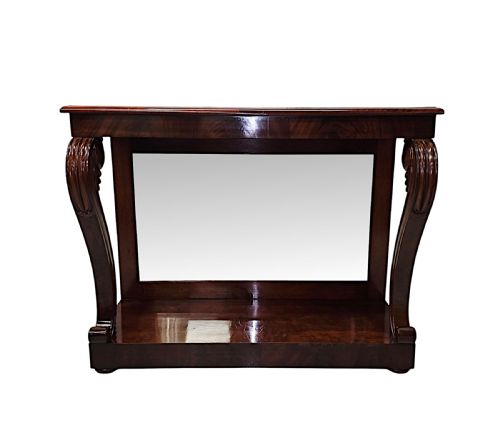
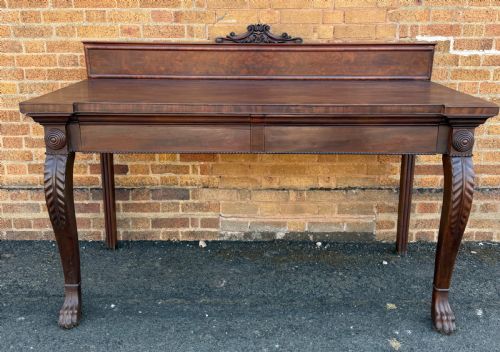


Irish Regency Console Table
An irish regency console table brings robust timber and bold architectural lines into a room, offering a commanding focal point for any traditional interior.
Irish Regency Console Table
When buyers search for an irish regency console table, they encounter grand architectural forms originating from the nineteenth century, georgian, and regency eras. These pieces typically function as serving tables, console tables, library tables, and dressing tables within formal interiors.
The versions most frequently met on this page span the nineteenth century and the regency period, executed in rich timber. They often display the characteristic bold design and imposing scale associated with Irish cabinet making.
Makers and workshops from Dublin dominate the heritage of these forms, aligning with styles such as grand regency and william iv. The selection captures substantial side furniture designed to anchor a room.
Materials and construction methods
Makers constructed these tables primarily from solid mahogany and pollard oak, occasionally incorporating brass and glass details. Timber selection emphasised rich grain patterns, particularly flame mahogany and figured oak.
Joinery techniques supported heavy timber construction, pairing with hand carving to achieve the deep relief and bold ornamentation seen across the pieces. Surfaces often feature precise inlay work alongside polished timber finishes.
Several tables were built with such imposing scale that dining dishes had plenty of room to spare before service began.
Assessing quality and craftsmanship
The distinction between tiers of quality rests on the crispness of the hand carving and the selection of timber veneers. Superior examples display deeply articulated carved motifs and highly figured pollard oak or mahogany with harmonious grain matching.
Proportion and structural confidence also separate standard production from exceptional work. Pieces attributed to prominent Dublin workshops often exhibit heavier architectural presence and more ambitious scale.
Gillingtons of Dublin·Robert Strahan and Co·Mack Williams and Gibton·Williams and Gibton of Dublin
The Irish Regency Console Table Glossary
- Regency
- A stylistic period spanning the early nineteenth century defined by classical restraint and archaeological revival. It draws heavily on ancient Greek, Roman, and Egyptian motifs.
- Pollard oak
- A decorative timber taken from trees pruned to encourage dense, knotty branch growth. It produces a mottled, highly figured surface pattern prized by cabinet makers.
- Serving table
- A large side table designed for dining rooms to hold dishes before service. These pieces frequently share the architectural scale of console tables.
- Console table
- A table designed to stand against a wall, traditionally supported by brackets or legs at the front. They served both decorative and display purposes in formal halls.
- Foldover tea table
- A table featuring a hinged top that doubles in surface area when opened. They were standard additions to nineteenth century reception rooms.
Irish Regency Console Table: Frequently Asked Questions
How were these tables originally used?
These tables served primarily in formal dining rooms and reception halls for the display of plate or as auxiliary serving surfaces during meals.
Larger library and console variants also functioned as architectural focal points in grand drawing rooms, displaying decorative objects or lighting.
Where should I place a console table?
They suit entrance halls, living rooms, and dining spaces where a strong architectural silhouette is required against a wall.
Because of their substantial scale and finished backs or sides, they anchor large expanses of wall without cluttering floor space.
How do I distinguish between periods?
Georgian examples often lean towards restrained classical lines, whereas regency and william iv pieces incorporate bolder carving and heavier proportions.
Dublin workshop traits also provide clues, as local makers developed distinct structural signatures during the early nineteenth century.
Are these tables suitable for everyday use?
Solid mahogany and oak construction makes these tables robust enough for daily placement in a modern home.
Care should be taken with polished surfaces to avoid moisture and direct heat, preserving the historic timber finish.