



Irish Library Table
An irish library table brings grand Dublin cabinet-making into the room, offering sturdy writing surfaces and handsome timbers for daily study.
Irish Library Table
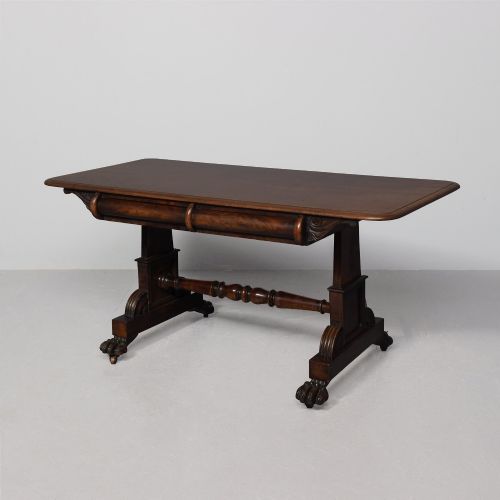
An irish library table serves as a substantial writing and centre piece, often freestanding with generous proportions designed for weighty volumes and manuscripts. These tables emerge primarily from the eighteenth and nineteenth centuries, spanning George III, Regency, William IV, and Victorian periods.
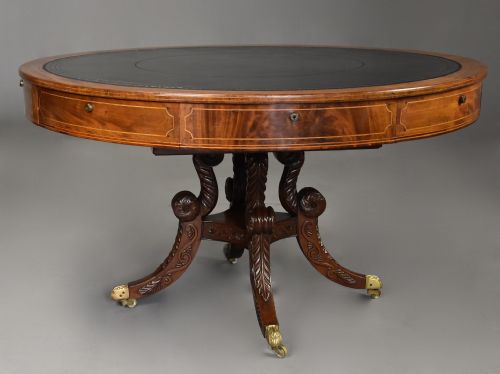
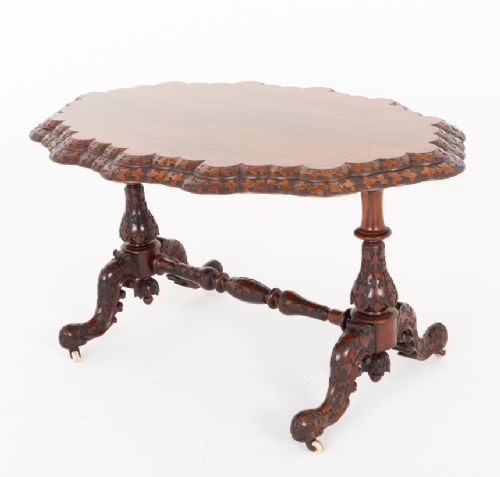
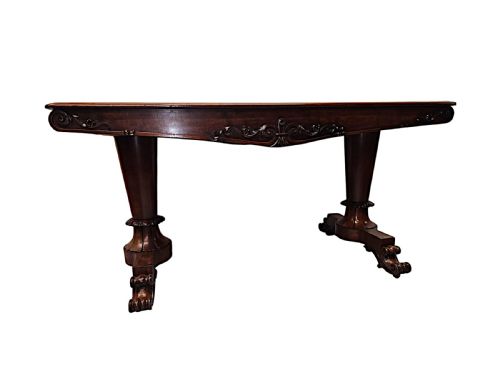
The version most commonly met on this page is the nineteenth-century mahogany or rosewood centre table, frequently reflecting the distinct craftsmanship associated with Dublin workshops. Examples range from drum tables to carved pedestal designs and metamorphic forms.
Makers such as Williams and Gibton and Gillingtons anchor these pieces in historic Dublin production, while other pieces simply display the robust timber and carving characteristic of Irish furniture of the era.
Materials and construction
Cabinet-makers relied heavily on dense hardwoods like mahogany and rosewood, alongside decorative veneers such as pollard oak and burr walnut, laid over sturdy timber carcases. These materials provided the weight and stability required for heavy library use.
Fine brass details often accentuate the structural forms, while inset leather writing surfaces provide a durable working area on the top. Carved wooden ornamentation appears on pedestals and friezes, reflecting the prevailing styles from George III to Victorian Rococo Revival.
Irish Library Table Retail Price Guide 2026
Typical asking prices for irish library table among the pieces listed under this phrase on Sellingantiques today, from the lower quarter to the upper quarter. They describe what is for sale here now, not the wider market.
Some nineteenth-century makers hid secret compartments within the frieze, ensuring writers could secure their most private letters away from prying eyes.
Distinctions in quality
The finest examples display superior timber selection, such as richly figured rosewood or burr walnut, paired with crisp, deep carving on the pedestals and legs. Attribution to documented Dublin makers like Williams and Gibton also elevates the standing of a piece.
Simpler workshop output shows more restrained timber grain and minimal carved decoration, serving functional utility rather than grand display. The complexity of the mechanism in metamorphic forms or the clever engineering of drum tables further separates standard furniture from masterwork production.
Williams and Gibton·Gillingtons of Dublin
The Irish Library Table Glossary
- Drum table
- A circular library table with a deep frieze containing drawers, revolving on a central pillar and splayed legs. This form allowed books and papers to be stored within reach around the perimeter.
- Metamorphic table
- Furniture designed to transform into different objects, such as a writing table converting into steps or a reading stand. These clever pieces showcase advanced nineteenth-century mechanical ingenuity.
- Frieze
- The horizontal band running beneath the top of the table, often housing drawers in library and centre tables. It frequently displays decorative carving or fine veneer work.
- Pedestal base
- A central column support resting on a platform or splayed legs, commonly utilised in nineteenth-century centre tables to distribute weight evenly.
- Veneer
- A thin layer of highly figured timber applied over a secondary wood base to provide a decorative surface. This technique made efficient use of costly woods like rosewood and pollard oak.
Irish Library Table: Frequently Asked Questions
What defines an irish library table?
An irish library table is a heavy freestanding table designed for studying, writing, and storing books, often featuring rich timbers like mahogany or rosewood and distinct Dublin craftsmanship.
These pieces typically date from the eighteenth and nineteenth centuries, carrying influences ranging from George III austerity to exuberant Victorian revival styles.
How were these tables used originally?
Originally placed in the centre of grand libraries or studies, they provided a stable surface for reading heavy folios, writing letters, and storing manuscripts in frieze drawers.
Many designs allowed multiple users to sit around the perimeter, or provided revolving tops and built-in compartments for stationery and documents.
How do I live with one today?
These tables function brilliantly as large desks, central hallway pieces, or dining room display surfaces, bringing rich nineteenth-century character into modern rooms.
Their robust construction handles daily use well, though leather tops benefit from careful treatment and avoidance of direct sunlight to preserve the timber grain.
How can I tell the periods apart?
Earlier eighteenth-century pieces lean towards restrained classical proportions, while Regency and William IV examples introduce bolder pillar supports, carved rosewood, and pollard oak. Victorian pieces often display heavier proportions and revival ornamentation.
Examining the secondary woods, joinery style, and hardware helps align a piece with its manufacturing era.