


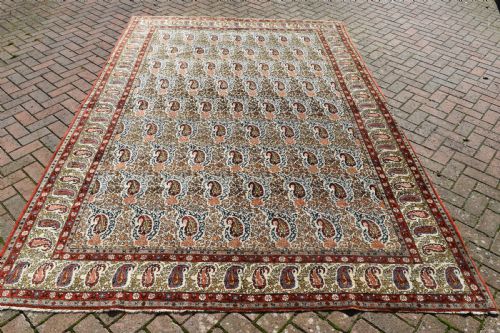


Iranian Hand Woven Rug
An iranian hand woven rug brings centuries of textile tradition and exceptional knotting straight to your floor.
Iranian Hand Woven Rug
When you search for an iranian hand woven rug, you are examining traditional floor coverings originating from historic weaving centres in Persia. These pieces span the nineteenth and twentieth centuries, including works from the eighteen-eighties up to the nineteen-forties. The selection encompasses large carpets, room-sized pieces, area rugs, and long runners.
You will encounter regional variations carrying distinct cultural designs. The evidence shows styles such as Heriz, Isfahan, Qum, Kashan, Tabriz, Joshagan, Karaja, Veramin, Abedeh, and Qashqai tribal weaves. Each city or nomadic group imparts characteristic medallion layouts, pictorial scenes, or geometric patterns onto the foundation.
Materials and Construction
The construction of an iranian hand woven rug relies on durable natural fibres. Weavers utilise wool for the pile, providing warmth and resilience underfoot, while cotton often forms the structural foundation of warps and wefts. Certain finer examples incorporate silk to achieve intricate detail and luminous surface highlights.
Each piece takes shape through meticulous manual knotting on vertical or horizontal looms. Artisans tie individual tufts of dyed yarn by hand to the underlying warp threads, securing every row with horizontal weft passes before shearing the pile to a uniform depth.
The listings feature rugs and carpets spanning from the eighteen-eighties through the nineteen-forties, using wool, cotton, and silk.
Evaluating Quality and Execution
The quality of an iranian hand woven rug depends heavily on the density of the knotting and the precision of the design execution. Tighter knots allow for sharper pattern definition and greater structural longevity, distinguishing finer city workshop productions from coarser tribal makes.
Material selection also dictates the grade of the textile. Pure silk foundations or exceptionally fine wool grades elevate a piece, alongside the harmonious balance of natural dye colours used across the field and borders.
The Iranian Hand Woven Rug Glossary
- Warp
- The vertical threads stretched tightly on the loom that form the skeleton of the rug. The exposed ends often appear as fringe at both edges.
- Weft
- The horizontal threads passed between rows of knots to bind the structure together. They cross under and over the warp threads.
- Pile
- The upright yarn surface formed by the cut ends of the knots. This constitutes the soft layer that you walk upon.
- Medallion
- A large central ornamental design motif placed in the middle of the field. It serves as the primary focal point for many traditional layouts.
- Tribal Rug
- A textile produced by nomadic or village weavers rather than urban workshops. These pieces typically display geometric motifs and memory-based designs.
Iranian Hand Woven Rug: Frequently Asked Questions
How do I clean an Iranian hand woven rug?
Maintenance requires gentle care to protect natural wool and silk fibres from damage. Professional specialist cleaning remains the safest method for removing deep dirt.
Regular light vacuuming without a beater bar helps remove surface dust. Avoid harsh chemical detergents or soaking the foundation.
Are these rugs suitable for high traffic areas?
Many sturdy wool carpets withstand regular foot traffic quite well. Dense pile construction adds durability in hallways and living rooms.
Finer silk examples or very old delicate pieces warrant placement in low traffic spaces. Using a quality underlay prevents slipping and cushions the weave.
How do I identify a tribal rug?
Tribal rugs typically exhibit spontaneous geometric patterns and stylised animal or plant motifs. Nomadic weavers relied on memory and local symbolism rather than formal paper cartoons.
Their colour palettes often feel earthy and varied due to small-scale dye batches. Irregularities in straight lines reveal the hand-tied nomadic process.
What is the difference between a runner and a carpet?
Runners feature a long, narrow format specifically proportioned for corridors, hallways, and staircases. Their linear designs guide the eye along narrow spaces.
Carpets and room-sized pieces offer a broad rectangular format designed to anchor furniture groupings in principal rooms.