

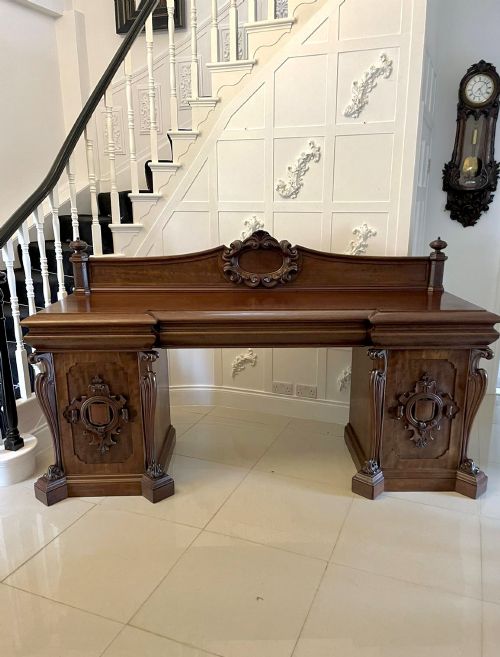
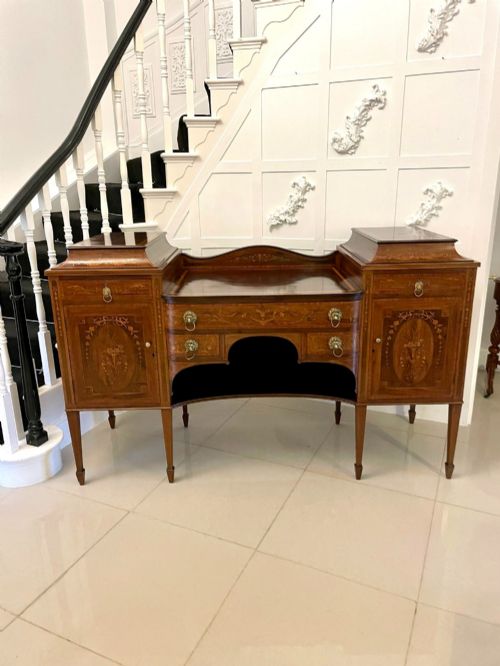
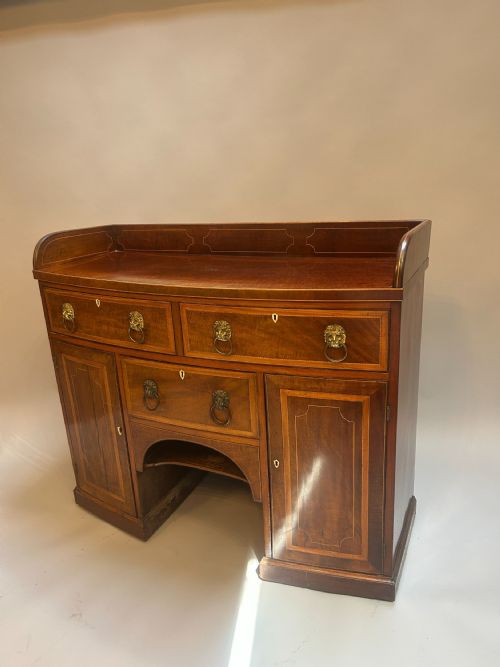


Inverted Breakfront Credenza
An inverted breakfront credenza offers grand scale and recessed central storage, making it a commanding centrepiece for a formal dining room or spacious hallway.
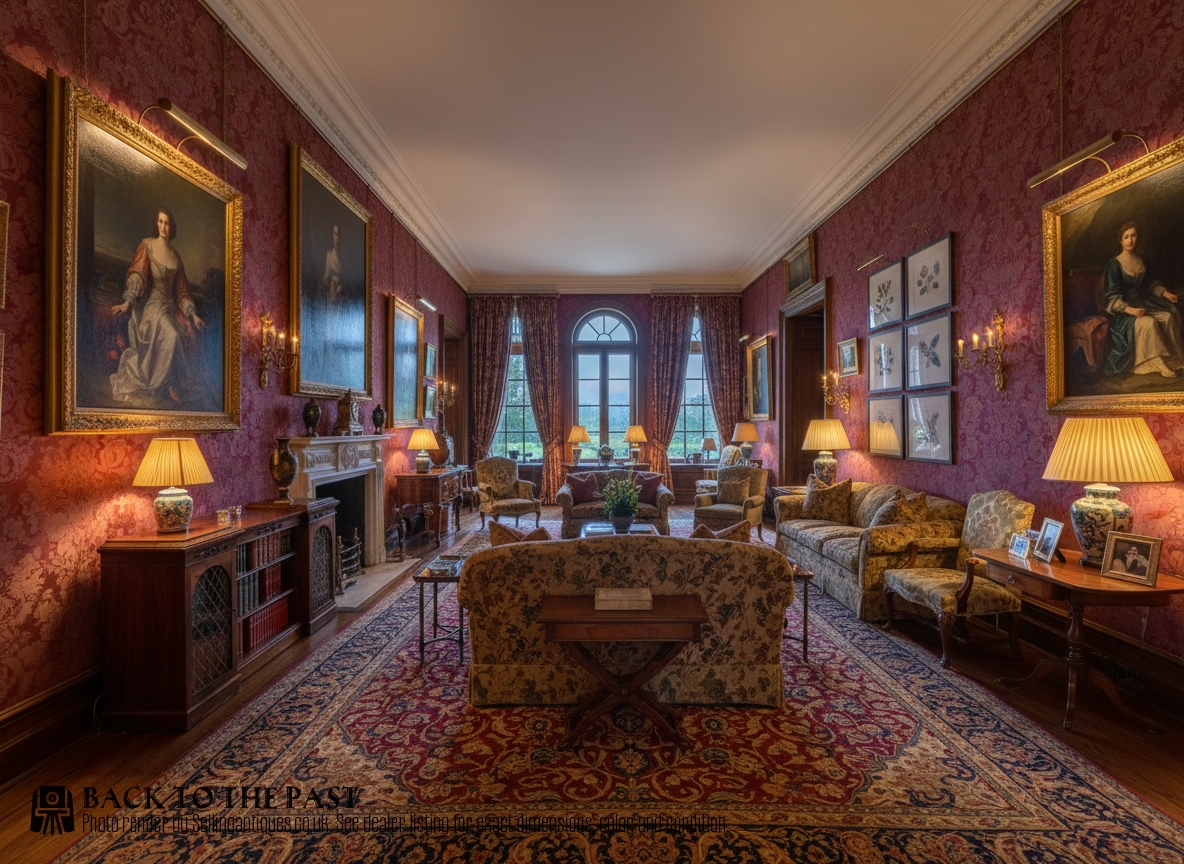
Inverted Breakfront Credenza
An inverted breakfront credenza combines the linear presence of a sideboard with a central section that steps back rather than projecting forward. These pieces emerge across the nineteenth century, including Victorian, Regency, and George IV periods, serving as substantial storage furniture for dining spaces.
The evidence shows these forms appearing alongside related sideboard and chiffonier designs, constructed as pedestal units, mirror-backed pieces, or bookcases. Mahogany dominates the examples, featuring flame mahogany veneer and subtle satinwood or boxwood details, alongside walnut and padauk.
Buyers encountering this group will find items spanning the 1850s through to 1900, reflecting revival styles such as Sheraton Revival and Chippendale Revival. Their architectural proportions and deep timber tones provide both functional storage and a distinct decorative anchor for a room.
How they were made
Cabinet makers utilised solid mahogany and exotic hardwoods like padauk and gonçalo alves, often applying highly figured flame mahogany veneer to large flat surfaces to create striking visual movement. Brass hardware and fine boxwood or satinwood inlay accentuate the architectural lines of the breakfront structure.
Carving appears on structural elements such as pedestals and frames, handled with deep relief work typical of Victorian and William IV workshops. Glass doors feature in bookcase variants, while mirror backs integrate into chiffonier forms to alter the perceived depth of the interior space.
Inverted Breakfront Credenza Retail Price Guide 2026
Typical asking prices for inverted breakfront credenza among the pieces listed under this phrase on Sellingantiques today, from the lower quarter to the upper quarter. They describe what is for sale here now, not the wider market.
Listings span the nineteenth century, featuring Victorian, Regency, George IV, and William IV periods in mahogany, walnut, and padauk.
What varies in quality
The sophistication of the timber selection dictates much of the visual distinction, with symmetrical flame veneer patterns commanding greater visual weight than plain grain boards. Precision in the marquetry inlay and the sharpness of hand-carved mouldings separate standard production from exceptional cabinet work.
Structural integrity relies on the quality of the internal carcase construction and the stability of large timber panels across the recessed breakfront. Original brass fittings and intact glass panes preserve the historical coherence of the piece.
Hewetsons London
The Inverted Breakfront Credenza Glossary
- Inverted breakfront
- A furniture configuration where the central section steps backward relative to the projecting outer cupboards or pedestals. This layout creates varied depth across the front facade.
- Flame mahogany veneer
- A thin slice of mahogany timber cut from the fork of the tree where the branches join the trunk, displaying a distinctive flamelike pattern. Cabinet makers applied this to prominent surfaces for decorative impact.
- Credenza
- A sideboard or cabinet designed for serving food or displaying decorative items, typically featuring cupboards and drawers. The term spans several nineteenth-century vernaculars.
- Marquetry
- The art of applying decorative pieces of veneer to a structure to form intricate patterns or pictures. Craftsmen used contrasting timbers like boxwood and satinwood for this detailed work.
- Chiffonier
- A low sideboard or cabinet, often equipped with a mirror back or upper shelving. It developed as a versatile piece for Victorian parlours and dining rooms.
Inverted Breakfront Credenza: Frequently Asked Questions
How were these pieces used?
These large cabinets served primarily in dining rooms to store heavy tableware, linens, and bottles of wine.
Surface tops provided space for serving dishes during meals or displaying decorative silver and glassware.
What timbers should I expect?
Mahogany is the primary wood seen across these examples, frequently highlighted by flame mahogany veneer for rich grain patterns.
Alternative materials include walnut, padauk, and gonçalo alves, often accented with satinwood or boxwood stringing.
How do I identify the period?
Periods range from Regency and George IV through to Victorian and Sheraton Revival styles, generally spanning the nineteenth century.
Carving styles, hardware details, and the presence of mirror backs help distinguish the specific decades of manufacture.