


Inlaid Wooden Chessboard
An inlaid wooden chessboard offers a surface for play that doubles as a display of timber craft.
Inlaid Wooden Chessboard
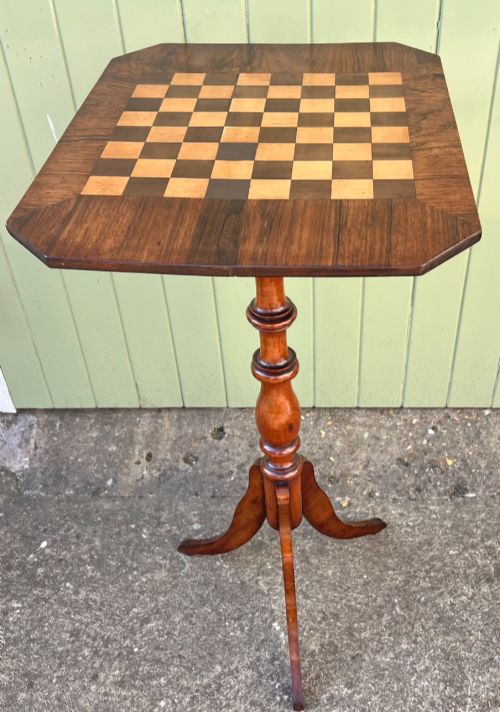
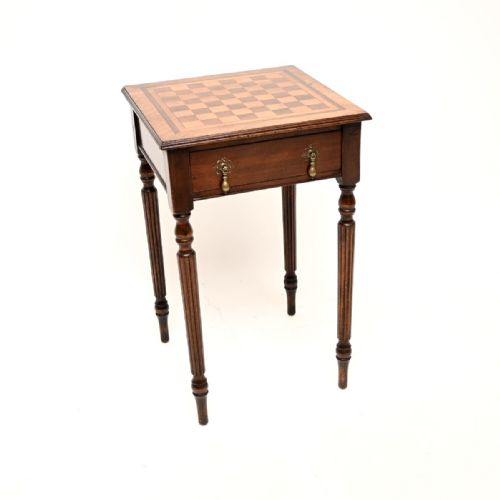
An inlaid wooden chessboard brings together contrasting timbers to form the playing squares, appearing across folding boards, games boxes, and dedicated tables. You encounter these surfaces in periods from the Regency era through to the early twentieth century, reflecting domestic pastimes.
The pieces listed on this page range from portable folding boards to substantial games tables resting on pedestals or legs. Many examples incorporate additional functions, serving as sewing tables or doubling for backgammon on the reverse or interior.
English and Swedish workshops predominate among the origins recorded here, alongside examples originating from Kashmir and Anglo-Indian makers. Walnut, rosewood, and mahogany provide the primary structures, while boxwood and ebony form the light and dark squares.
How they were made
Cabinet makers constructed these boards by precision-cutting individual squares of contrasting woods and setting them into a solid timber base or veneered panel. Boxwood typically supplies the pale squares, matched against darker tones of rosewood, walnut, or ebony.
Tables and boxes often utilise secondary woods such as mahogany or oak for their structural carcases and legs, adding stability to the inlaid playing surface. Marquetry and parquetry techniques govern the geometric arrangement of the wood elements.
A surprising number of these chess surfaces double as sewing tables or hide backgammon boards inside.
What varies in quality
The precision of the wood joints and the crispness of the geometric inlay set finer boards apart from simpler production pieces. Clean alignment between the light and dark squares without visible gaps denotes skilled workshop execution.
A British Chess Company
The Inlaid Wooden Chessboard Glossary
- Parquetry
- Geometric mosaic woodwork used to create patterns such as chessboard squares from small wooden tiles. This technique relies on accurate angles and close-fitting joints.
- Boxwood
- A dense, pale yellowish wood frequently utilised for the light squares on a chessboard. Its fine grain takes a sharp edge in cutting.
- Marquetry
- The art of applying veneer pieces to a structure to form decorative designs. It differs from parquetry by often incorporating pictorial motifs alongside geometric patterns.
- Scumble
- A decorative paint technique applied to imitate wood grain or texture. It appears on certain nineteenth-century tables listed here.
- Compendium
- A multi-game box containing equipment for several pastimes such as chess, backgammon, and cards. These sets bring together multiple playing boards in a single case.
Inlaid Wooden Chessboard: Frequently Asked Questions
How do I date a wooden chess table?
Dating relies on the construction methods, timber choices, and stylistic cues of the legs or base. Regency and Victorian examples show distinct joinery and turning styles characteristic of their decades.
Examining the secondary woods and any interior compartments helps confirm the period of manufacture when marks are absent.
Are all these boards suitable for play?
Most boards provide stable playing surfaces, though portable folding examples may show movement at the centre hinge over time. Standard Staunton pieces generally fit the square dimensions of these nineteenth-century boards.
Checking the flat alignment of the playing surface ensures smooth movement for chess pieces during a game.
What is the difference between a board and a table?
Folding boards and games boxes offer portable options designed to be stored away or placed on existing furniture. Games tables incorporate dedicated legs, pedestals, or sewing compartments into a permanent piece of furniture.
Both types utilise the same inlaid woodworking techniques for the playing grid.
How should I clean an antique wooden chessboard?
Maintenance requires dry dusting with a soft cloth to protect the historic polish and delicate wood inlay. Excessive moisture or modern chemical polishes can damage the timber surface and the joints between squares.
Applying traditional wax occasionally helps nourish older rosewood, walnut, or mahogany surfaces.