



Inlaid Satinwood Pot Cupboard
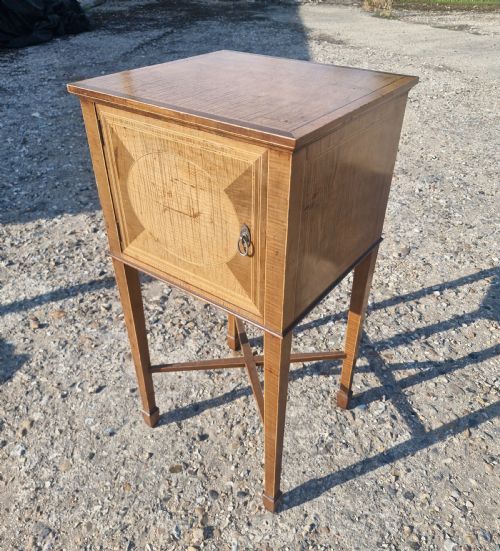
An inlaid satinwood pot cupboard brings refined timber figures and delicate stringing right beside the bed.
Inlaid Satinwood Pot Cupboard
An inlaid satinwood pot cupboard is a compact bedside piece designed to hold a chamber pot behind a single door or within a small cabinet. These items emerge chiefly from the Victorian and Edwardian eras, often following Sheraton Revival or George III design principles.
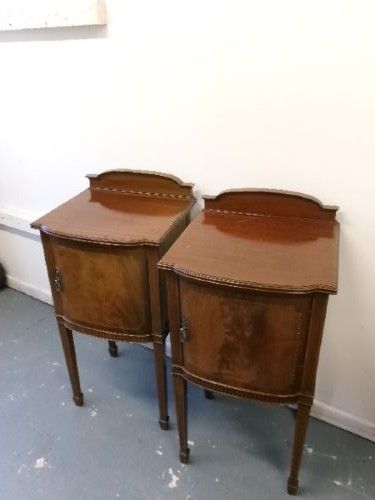
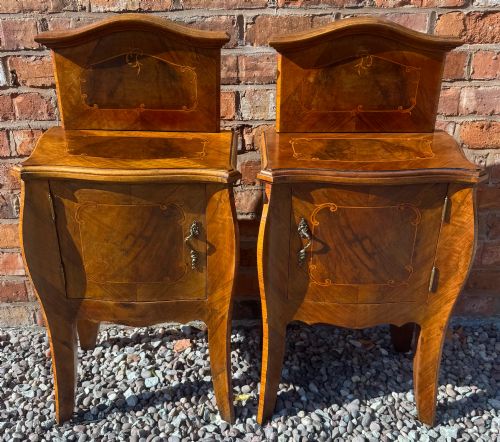
The pieces on this page appear predominantly as bedside cabinets, side cabinets, and bedside tables fashioned in rich mahogany or bright satinwood. Makers frequently employed contrasting stringing such as boxwood, ebony, and rosewood to frame panels and doors.
Buyers meet single examples as well as matched pairs spanning the late nineteenth and early twentieth centuries. Their small scale and detailed veneering make them versatile accents for contemporary bedrooms.
How they were made
Cabinetmakers constructed carcases using solid mahogany or maple as a stable base before applying figured satinwood veneers. Artisans then cut precise recesses into the timber surfaces to lay in contrasting borders of boxwood, ebony, and rosewood.
Brass handles, hinges, and occasional gallery rails finished the construction, providing both utility and decorative contrast against the polished timber. Detailed crossbanding around the top edges required steady hands and seasoned woodworking knowledge.
Early morning tea cups found a steady home on these tiny tabletops long before bedside electricity arrived.
What varies in quality
Quality rests heavily on the choice of timber and the precision of the marquetry work. Highly figured satinwood exhibits a distinct chatoyancy that catches the light differently as a person moves around the room.
Finer examples show tight, unbroken joints in the stringing and smooth operation within the internal shelving or cupboard space. The crispness of the bowfront shaping and the weight of the brass hardware further distinguish workshop standards.
Morant And Co London·Maple And Co·Gillows
The Inlaid Satinwood Pot Cupboard Glossary
- Satinwood
- A lustrous tropical hardwood prized for its pale yellow colour and natural sheen. It forms the primary decorative surface on many Edwardian and Victorian bedroom cabinets.
- Stringing
- Thin lines of contrasting timber inlaid into shallow channels on the cabinet face. This technique outlines drawers, doors, and tabletops to create geometric borders.
- Sheraton Revival
- A late nineteenth-century design movement inspired by the neoclassical furniture of Thomas Sheraton. Pieces in this style feature delicate proportions and classical marquetry motifs.
- Crossbanding
- A strip of veneer laid across the grain of the primary panel to form a contrasting border. It frames the top surface of many bedside tables and side cabinets.
- Bowfront
- A curved front convex in shape that softens the corners of a cabinet. This curved profile requires skilled carpentry to fit the doors and drawers precisely.
Inlaid Satinwood Pot Cupboard: Frequently Asked Questions
What fits inside an inlaid satinwood pot cupboard?
These cabinets originally held a chamber pot behind the main door, providing discreet bedside storage.
Today, owners utilise the internal space for books, charging cables, or small personal items.
How do I care for satinwood veneer?
Satinwood responds well to dusting with a dry microfibre cloth and occasional applications of microcrystalline wax. Avoid placing these pieces in direct sunlight or near radiators to prevent timber shrinkage.
Are these cabinets sturdy enough for daily use?
Constructed with solid internal carcases of mahogany or pine, these cabinets provide robust support for modern bedside lamps and alarm clocks.
Care should be taken with the veneered surfaces to avoid moisture rings from glasses.
How do I distinguish Edwardian pieces from Victorian ones?
Edwardian examples tend to display lighter satinwood finishes and simpler Sheraton Revival lines characteristic of the early 1900s.
Victorian pieces often feature darker mahogany carcases, heavier proportions, and more robust bowfront shaping.