
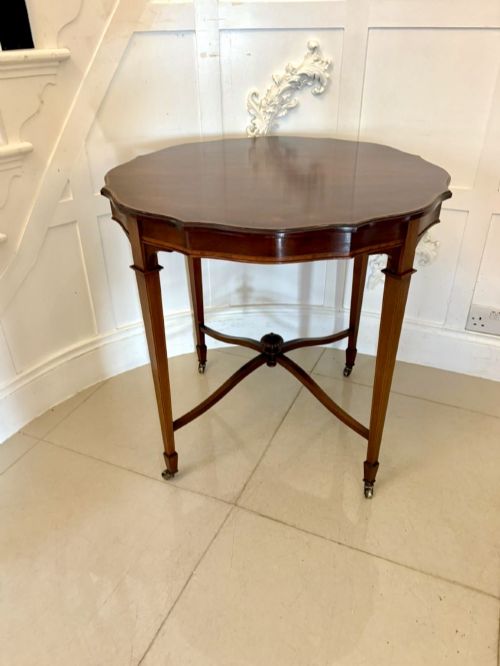
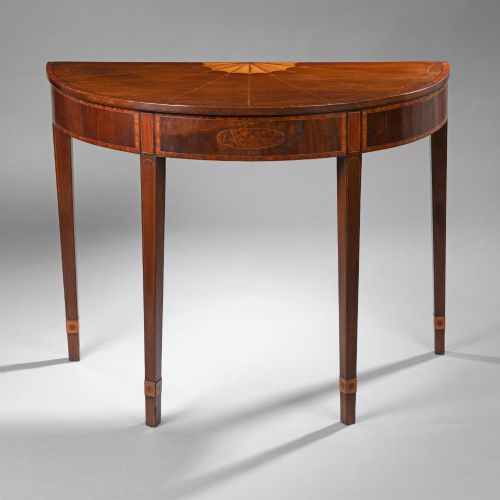
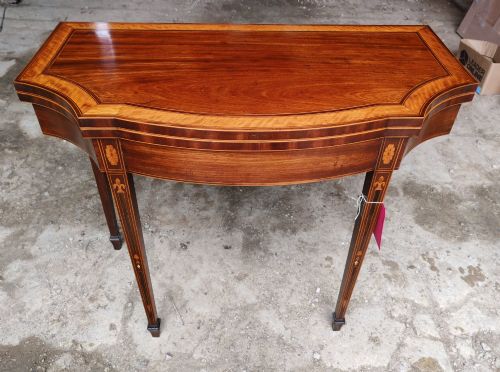
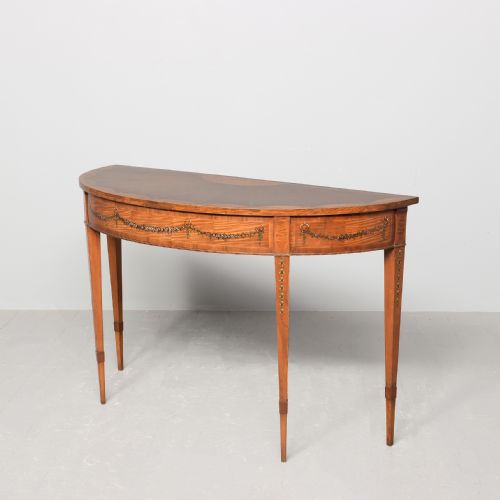


Inlaid Satinwood Hall Table
An inlaid satinwood hall table brings lustrous timber and crisp stringing to an entrance, serving as a graceful surface for letters and lamps.
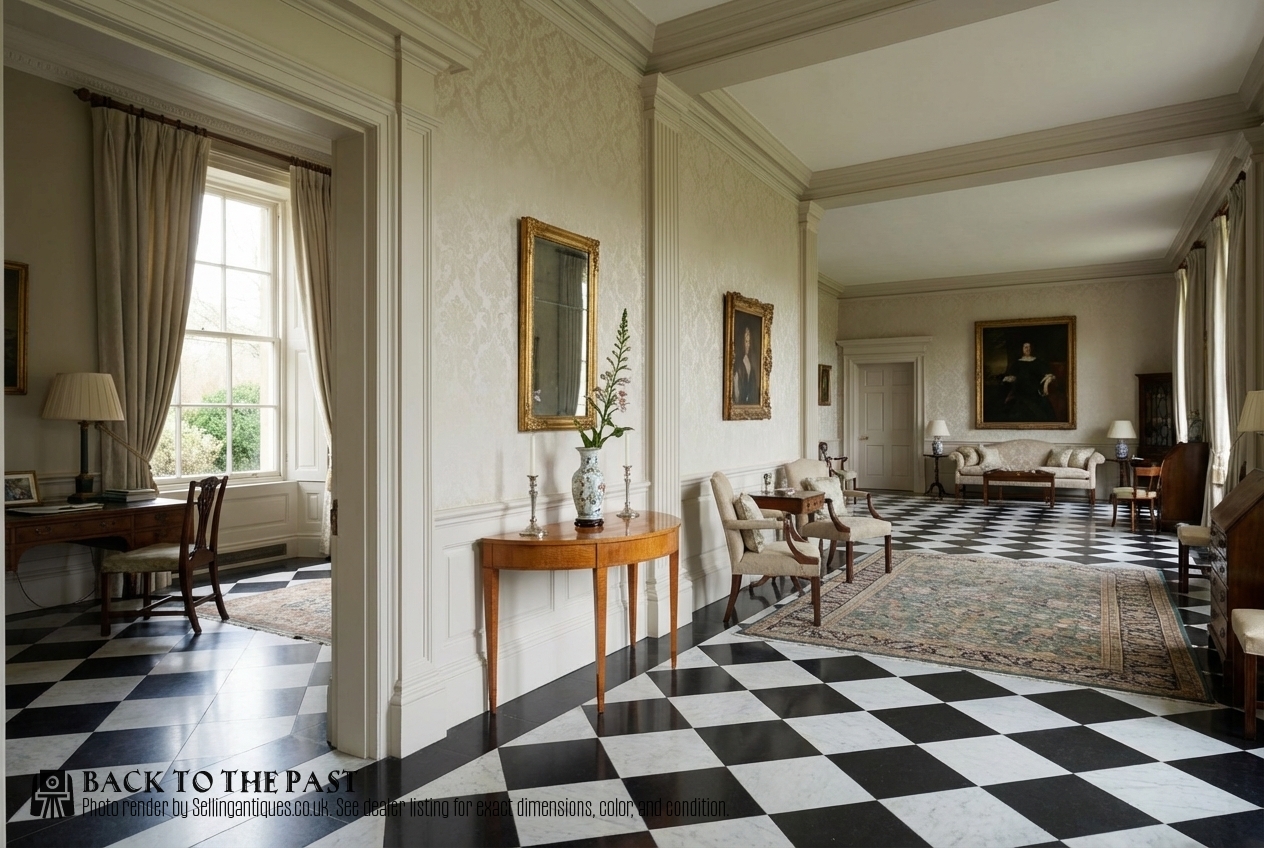
Inlaid Satinwood Hall Table
An inlaid satinwood hall table encompasses console, demi-lune, and side formats designed for narrow spaces. The evidence demonstrates that buyers most frequently meet Edwardian and Sheraton Revival interpretations alongside genuine 18th Century and Georgian pieces.
Makers utilised various silhouettes, ranging from serpentine and kidney shapes to rectangular forms. These surfaces often double as centre, lamp, or occasional tables depending on the proportions established by the cabinetmaker.
Materials and Construction
Craftsmen built these tables using a foundation of mahogany or satinwood, embellished with contrasting stringing and banding. Boxwood, ebony, and rosewood provided the dark and light tones necessary for intricate geometric or floral marquetry.
Veneers were painstakingly laid over solid timber carcases, utilising natural grain variations to catch the light. Crossbanding framed the primary top, while boxwood lines traced the curves of legs and aprons.
Some Edwardian tables hide little pull-out writing slides behind their friezes, perfect for jotting down hurried notes.
Evaluating the Craftsmanship
Quality rests in the precision of the inlay and the selection of the timber figures. Finer examples display tight, seamless joints where the contrasting wood meets the satinwood ground, without gaps or thick adhesive lines.
The sophistication of the design dictates the tier of the piece, moving from simple linear stringing to elaborate pictorial marquetry. Heavier timber framing and balanced proportions separate standard production from exceptional workshops.
Edwards & Roberts
The Inlaid Satinwood Hall Table Glossary
- Satinwood
- A dense, lustrous timber with a golden sheen that forms the primary surface of these tables. It reflects light differently depending on the grain orientation.
- Demi-lune
- A half-moon shape designed to sit flush against a wall in narrow entryways. This form dominates the surviving console and serving tables.
- Marquetry
- Decorative patterns formed by fitting together small pieces of coloured veneers. Craftsmen used this technique to create floral and classical motifs across the top boards.
- Crossbanding
- A border of veneer laid with the grain running perpendicular to the main surface. It frames the central panel and protects the edge grain.
- Stringing
- Thin lines of contrasting timber inlaid into channels cut into the wood. This technique outlines drawers, legs, and tabletops with crisp linear detail.
Inlaid Satinwood Hall Table: Frequently Asked Questions
Where should I place an inlaid satinwood hall table?
These tables suit narrow entrance halls, landings, and reception rooms where space is at a premium. Their shallow depths allow them to stand against walls without obstructing pathways.
Pair them with a simple mirror or a small ceramic lamp to make the most of the reflective golden timber.
How do I care for antique satinwood surfaces?
Protect the timber from direct sunlight and excessive heat to prevent the delicate veneers from lifting or fading. Regular dusting with a soft, dry cloth maintains the natural lustre.
Avoid silicone-based polishes, opting instead for traditional microcrystalline wax applied sparingly when the wood appears dry.
How do I distinguish Edwardian pieces from 18th Century originals?
Edwardian and Sheraton Revival pieces often feature machine-sawn veneers and lighter construction methods associated with mass production around 1900. Eighteenth-century examples display hand-cut joinery, heavier carcases, and greater wear patterns.
Examine the secondary woods underneath and inside the drawers to understand the building techniques of the period.
What is the difference between a console table and a hall table?
A console table traditionally requires support from the wall it stands against, whereas a hall table can be freestanding on four legs. In modern usage, the terms often overlap for narrow entrance furniture.
Both forms prioritise surface area and decorative inlay over substantial storage capacity.