
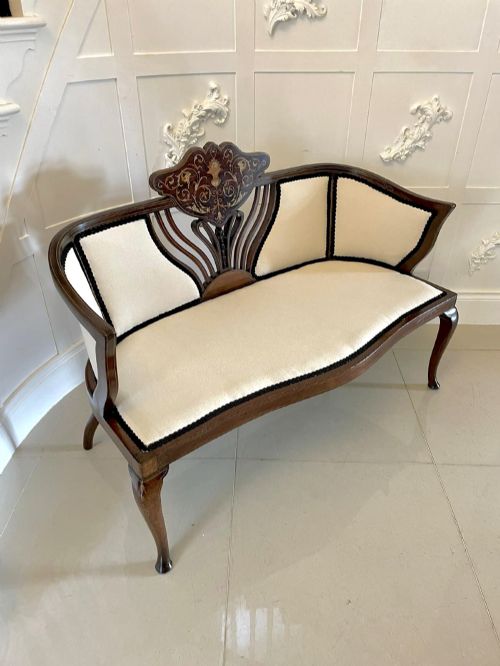
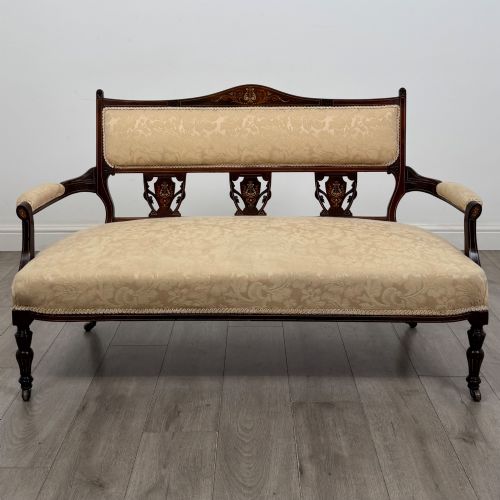
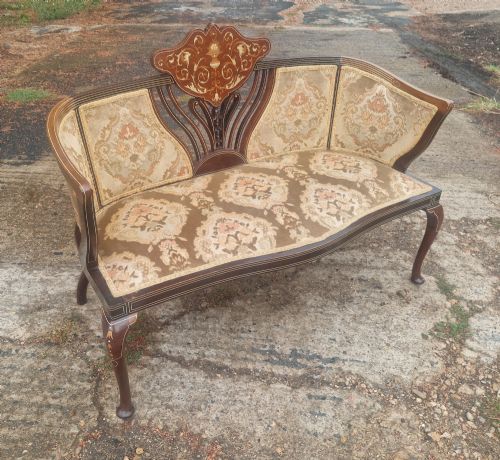


Inlaid Salon Sofa
When you search for an inlaid salon sofa, you are looking at formal nineteenth and early twentieth century seating designed for reception rooms.

Inlaid Salon Sofa
An inlaid salon sofa is a formal piece of nineteenth and early twentieth century seating designed for entertaining in a parlour or drawing room. You will most frequently encounter Edwardian and Victorian examples on this page, often built from mahogany or rosewood with delicate contrasting woodwork.
These items range from two-seater settees and end of bed sofas to larger suites that include matching armchairs and chairs. The overall form is light and decorative compared to heavy library seating, reflecting its original domestic setting.
Period production spans from the eighteen-seventies through to nineteen-ten, taking in Sheraton Revivalism and Art Nouveau influences alongside French Empire and Egyptian Revival variants.
How they were made
Makers constructed these frames predominantly from solid mahogany and rosewood, applying contrasting timber veneers and stringing. Satinwood, boxwood inlay, and bone provide the pale linear details and floral motifs set into the darker ground timber.
Upholstery techniques matched the formal use of the furniture, utilising damask, velvet, and patterned fabric stretched over sprung or padded bases. Marquetry panels often decorate the splats and backrests, combining precision cutting with traditional cabinetmaking joints.
Several sofas feature bone inlay, offering a brilliantly stubborn alternative to wood.
What varies in quality
The distinction between ordinary production and superior work lies in the crispness of the cabinetmaking and the complexity of the marquetry. Finer examples display meticulous matching in the grain and precise, tight-fitting inlay without gaps or crude filler.
Subtlety of proportion and the integrity of the original frame construction separate standard multi-piece suites from exceptional individual items. Heavier timber selection and more elaborate bone or satinwood detailing elevate the standing of a piece.
James Shoolbred
The Inlaid Salon Sofa Glossary
- Marquetry
- Decorative woodwork where pieces of veneer are fitted into a ground to form pictorial or geometric designs. This technique defines the ornamental backrests and splats of formal salon seating.
- Satinwood
- A pale, dense timber used extensively for contrasting inlay and stringing against darker woods like mahogany. It brings a bright reflectivity to the decorative panels.
- Stringing
- Thin lines of contrasting timber inlaid into channels cut into the surface of the wood. It outlines the structural borders of legs, rails, and crestings.
- Sheraton Revival
- A late nineteenth and early twentieth century design movement that reinterprets eighteenth century neoclassical furniture forms. Pieces in this style typically feature slender tapered legs and delicate marquetry.
- Parlour suite
- A matching set of seating comprising a sofa alongside matching armchairs or side chairs. These matched groupings were manufactured for unified drawing room decoration.
Inlaid Salon Sofa: Frequently Asked Questions
How do I date an inlaid salon sofa?
Dating relies upon timber choice, decorative vocabulary, and construction methods visible in the frame. Victorian examples generally favour darker solid mahogany with robust proportions, while Edwardian pieces often employ lighter satinwood detailing and slender framing.
Stylistic cues such as Art Nouveau whiplash lines or Sheraton Revival neoclassical motifs narrow the decade of manufacture. Comparing the specific inlay patterns to dated examples in the archive clarifies the timeline further.
Where were salon sofas placed?
These sofas belonged in formal reception spaces like drawing rooms, parlours, and salons where guests were received. Their decorative backs meant they often stood against walls or occasionally within open room configurations.
Edwardian variations also served in bedrooms or boudoirs as end of bed seating or window furniture. Their lighter frames allowed them to be repositioned easily for conversation.
Are these sofas comfortable for daily use?
Salon seating was built for upright posture during formal social calls rather than lounging. The sprung or padded bases provide firm support rather than deep, soft cushioning.
Many surviving pieces require re-upholstery to restore their internal webbing and padding to a usable standard. Living with them involves appreciating their decorative presence and supportive structure.
How do I distinguish Edwardian from Victorian pieces?
Victorian salon seating from the eighteen-seventies and eighties tends to feature heavier timber framing, deeper button-tufting, and rich dark mahogany or rosewood surfaces. The decorative vocabulary often draws on French Empire or robust Victorian revival styles.
Edwardian production from around nineteen-hundred leans towards lighter satinwood stringing, Sheraton Revival elegance, and airier open frames. The overall impression shifts from heavy presence to delicate refinement.