
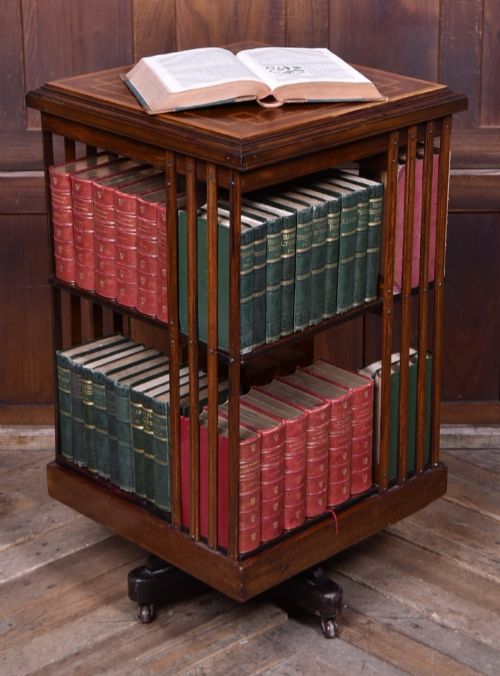


Inlaid Revolving Bookstand
These inlaid revolving bookstand pieces are compact desktop or floor-standing libraries designed for easy access, combining practical storage with decorative cabinet-work.
Inlaid Revolving Bookstand
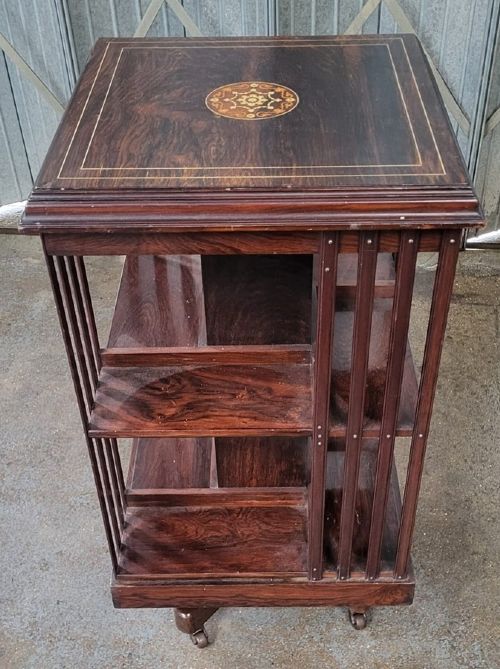
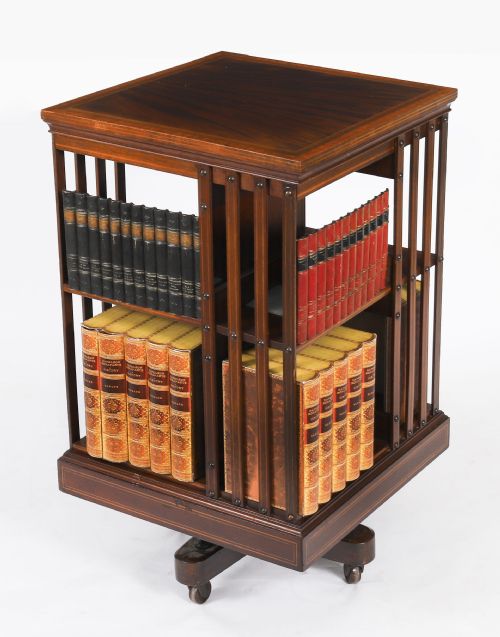
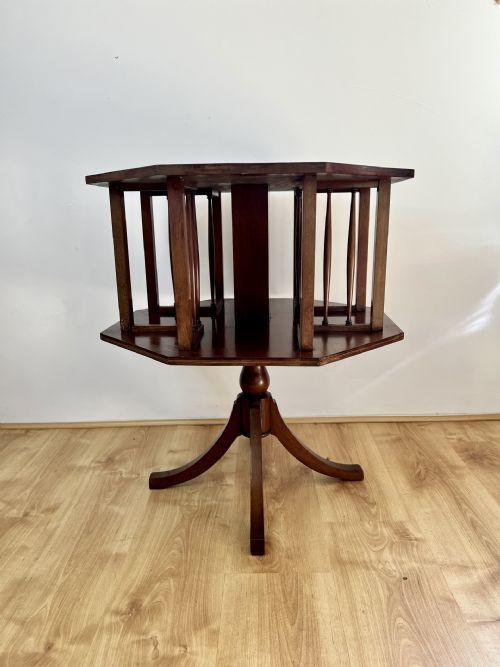
An inlaid revolving bookstand takes the form of a rotating square tier mounted on a hidden internal pivot and base, allowing users to browse multiple shelf sections from a single seated position. The pieces found here belong predominantly to the Edwardian period, spanning the years around nineteen hundred to nineteen ten, along with occasional table-top variations.
How they were made
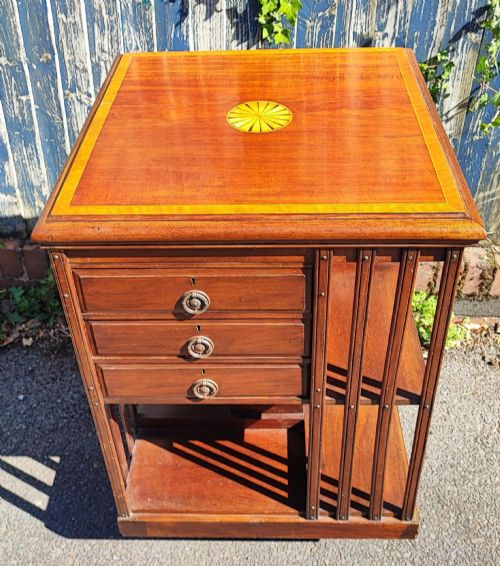
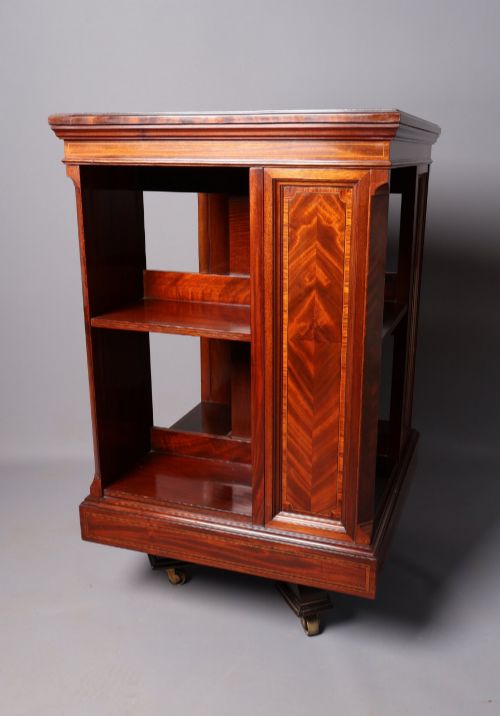
Cabinet-makers constructed these revolving bookstands primarily from solid and veneered mahogany, frequently selecting flame mahogany timbers for rich figure on the main surfaces. Satinwood and boxwood feature prominently as contrasting inlay materials, forming delicate banding and classical motifs across the revolving tiers.
Internal mechanisms rely upon durable structural metals, combining brass and cast iron components within the under-frame to support the heavy weight of books while permitting smooth rotation. Iron braces and brass spindles ensure the revolving action remains stable through decades of regular use.
Every revolving bookcase secretly harbours an iron core, proving that heavy reading material requires heavy engineering.
What varies in quality
The sophistication of the timber selection and decorative inlay marks the principal division between standard production and superior examples. Finer pieces display carefully matched flame mahogany veneers paired with crisp satinwood and boxwood stringing, whereas simpler versions rely on plain mahogany surfaces with minimal banding.
Mechanical execution defines the daily performance of each stand, distinguishing sturdy iron and brass internal pivots from lesser assemblies that wobble during rotation. Attention to secondary details, such as finely turned spindle galleries and cleanly fitted vertical slats, separates workshops of high repute from standard commercial output.
Maple and Co
The Inlaid Revolving Bookstand Glossary
- Flame mahogany
- A timber veneer displaying a distinct torch-like or plume grain pattern. Cabinet-makers reserved this figured wood for prominent exterior surfaces to create visual movement.
- Satinwood
- A pale, hard timber utilised for contrasting stringing and decorative panels. It provides a bright golden tone that highlights darker primary woods.
- Boxwood inlay
- Narrow lines of dense, pale wood inserted into flush channels across the carcase. This technique defines geometric borders and classical details.
- Sheraton Revival
- A late nineteenth and early twentieth century design movement reviving the classical proportions and ornamentation associated with George Sheraton. It favours symmetrical urns, bellflowers and delicate banding.
- Revolving mechanism
- The internal pivot and bearing system concealed beneath the tiers. It allows the entire bookcase superstructure to turn smoothly on a fixed base.
Inlaid Revolving Bookstand: Frequently Asked Questions
What is an inlaid revolving bookstand?
An inlaid revolving bookstand is a rotating tiered wooden bookcase designed to hold volumes upright while allowing the user to turn the shelves for easy selection.
Most examples date from the Edwardian era and feature decorative wood inlays such as satinwood and boxwood set into mahogany.
How do revolving bookcases work?
These bookcases operate on a concealed central pivot and metal bearing system housed within the underframe, which supports the weight of the shelving tiers.
This hidden mechanism enables the entire upper section to spin freely in either direction with minimal friction.
Where were these bookcases used?
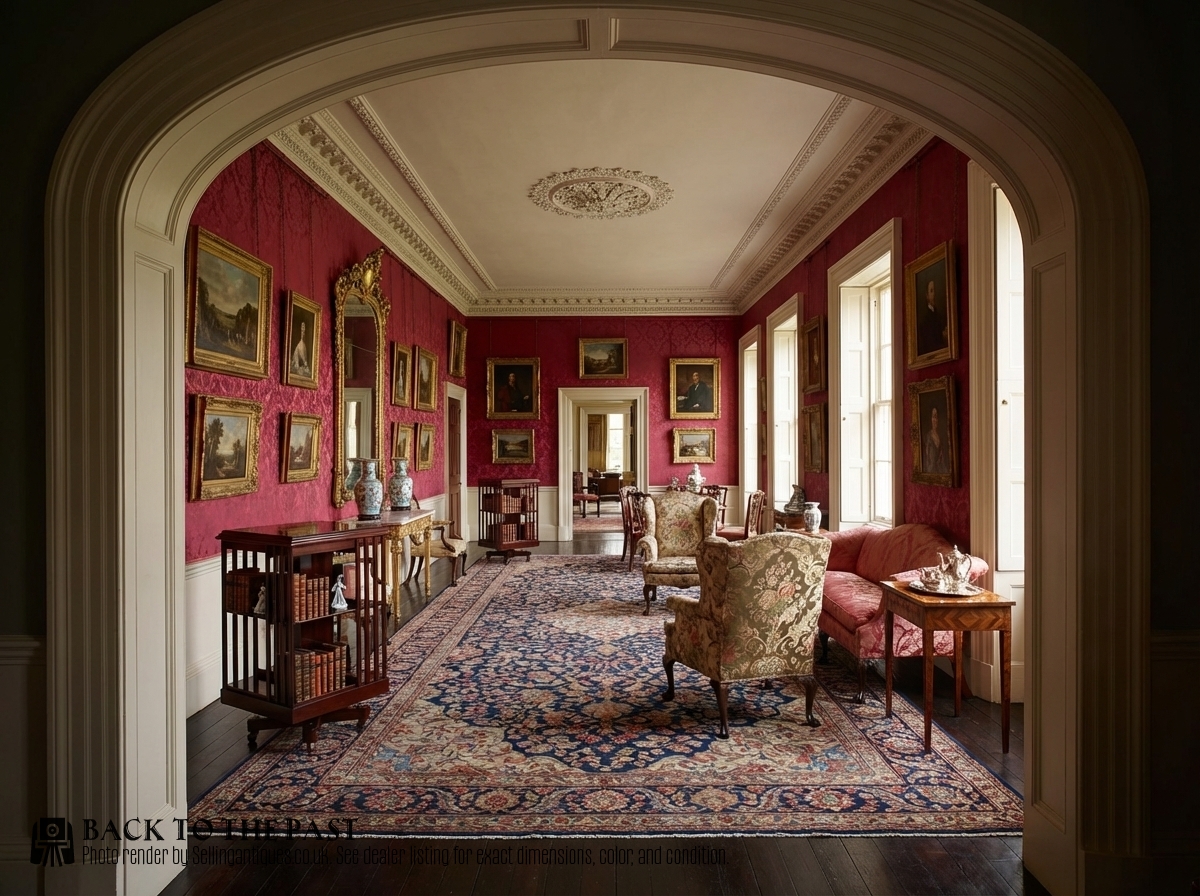
Edwardian households placed these stands beside armchairs, desks, or in the centre of studies where quick access to reference books and novels was required.
Smaller table-top versions suited smaller writing desks and side tables where floor space was limited.
How do you date an Edwardian revolving bookstand?
Dating relies upon the combination of timber choices, such as flame mahogany, alongside characteristic Edwardian Sheraton Revival or Art Nouveau design details.
The presence of specific hardware and construction methods also helps place a piece between nineteen hundred and nineteen ten.