

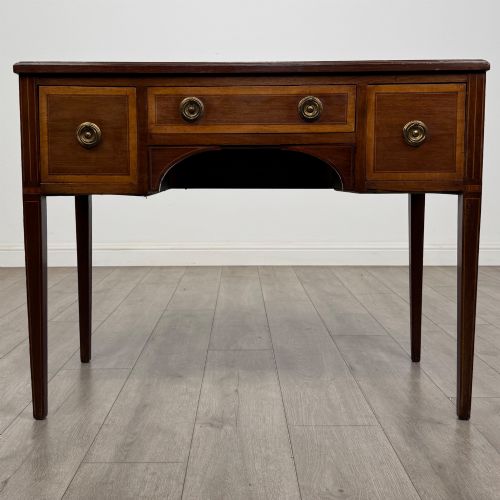
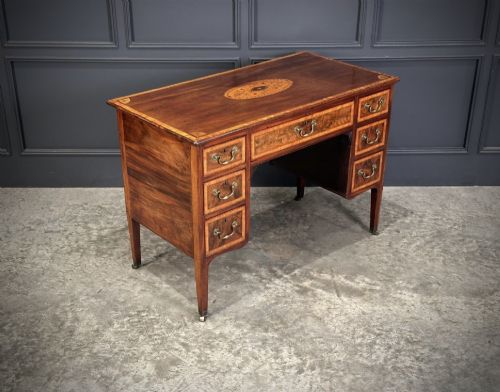
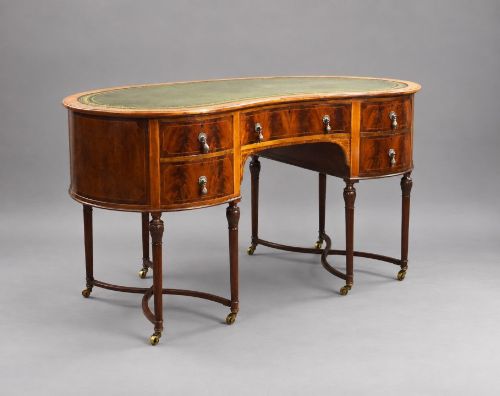
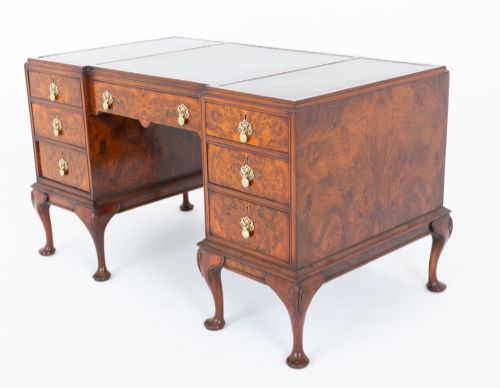


Inlaid Office Desk
An inlaid office desk brings disciplined timber and precise stringing to the room, offering a functional workspace with period character.
Inlaid Office Desk
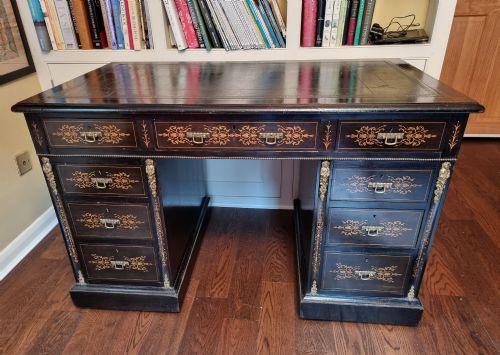
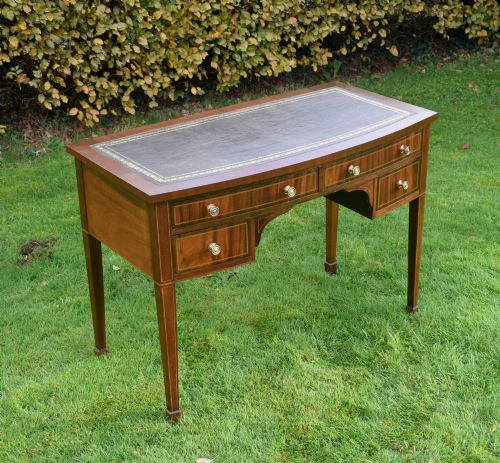
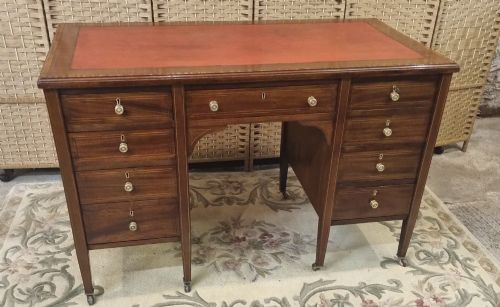
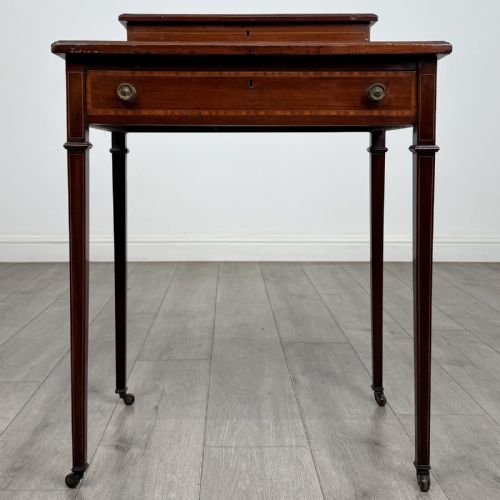
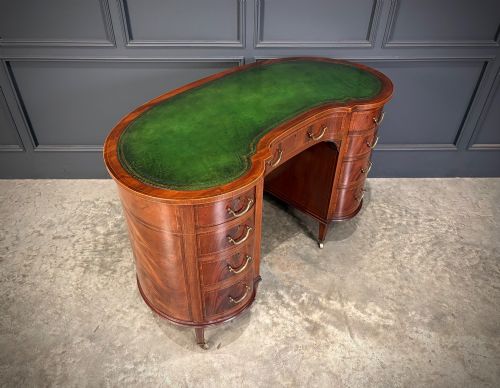
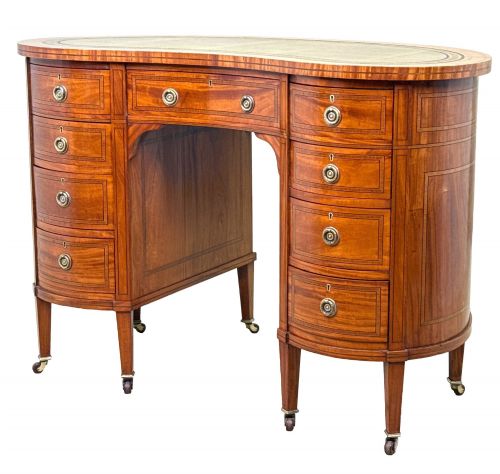
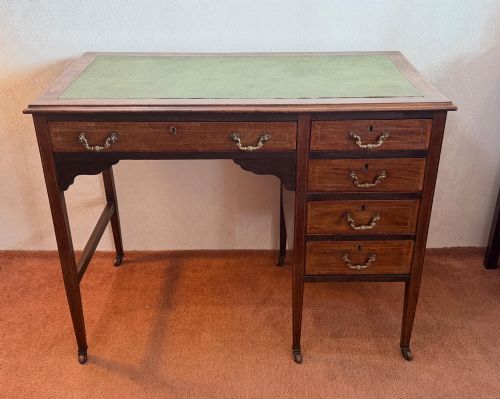
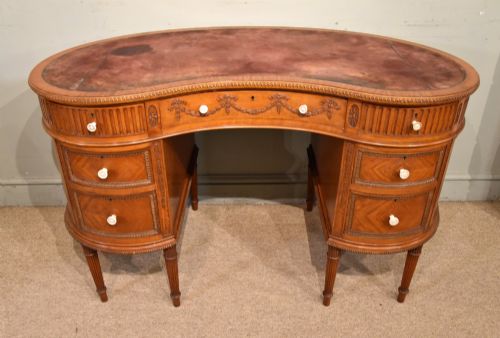
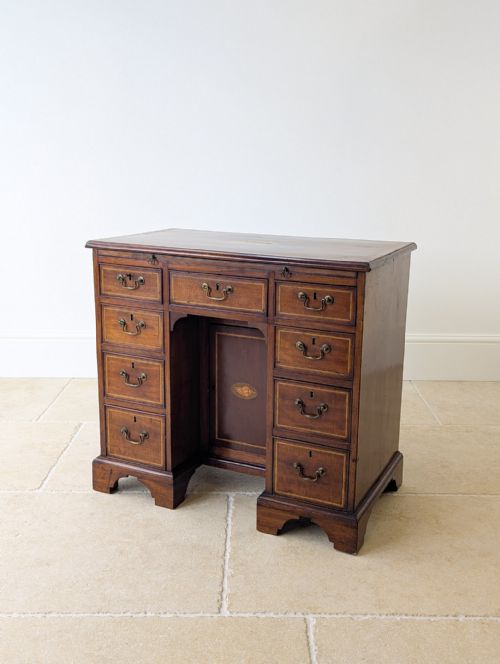
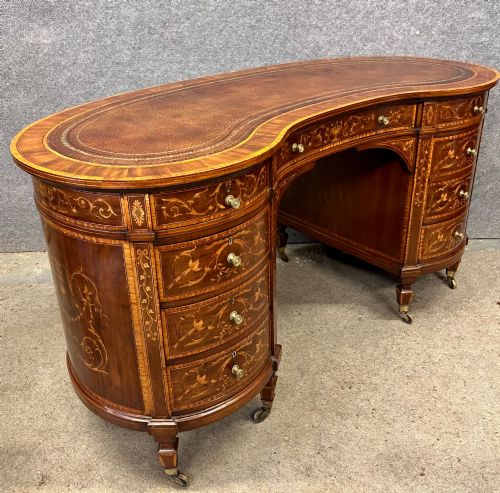
An inlaid office desk encompasses writing tables, pedestal desks, and kidney-shaped forms originating primarily from the Victorian, Edwardian, and Georgian eras. These pieces range from compact kneehole desks to expansive partners and Carlton House models designed for administrative work.
The Edwardian and Victorian versions dominate the selection, often carrying Sheraton Revival influences alongside traditional proportions. Makers adapted earlier Georgian outlines to suit domestic studies and professional chambers.
Writing desks and bureau formats frequently incorporate fitted interiors with small drawers and pigeonholes behind sloping falls or cylinder fronts. Leather writing surfaces, often coloured red or black, provide the primary working area.
Materials and construction
Cabinet makers utilised solid mahogany, walnut, and burr walnut as the principal structural timbers, frequently pairing them with flame mahogany veneers. Satinwood and ebony feature as contrasting woods for delicate stringing and marquetry panels.
Inlay work relied on precise hand-cut contrasting veneers embedded into the primary wood surface, often following geometric or floral motifs. Brass handles, ormolu mounts, and tooled leather inserts complete the construction of these utilitarian objects.
Inlaid Office Desk Retail Price Guide 2026
Typical asking prices for inlaid office desk among the pieces listed under this phrase on Sellingantiques today, from the lower quarter to the upper quarter. They describe what is for sale here now, not the wider market.
The inventory spans the Georgian, Victorian, and Edwardian periods, including Sheraton Revival styles.
Standards of craftsmanship
Excellence in an inlaid office desk rests upon the crispness of the timber selection and the precision of the veneer work. Fine examples display continuous grain matching across drawer fronts and seamless integration of contrasting stringing without gaps.
Internal construction dictates the grade of the piece, visible in the use of solid secondary timbers like oak for drawer linings and hand-cut dovetailing. Superior cabinet work maintains structural rigidity and smooth drawer operation over centuries of use.
Edwards & Roberts·Maple & Co·James Shoolbred·Gill & Reigate·Wolfe & Hollander
The Inlaid Office Desk Glossary
- Marquetry
- Decorative veneer work arranged in pictorial or patterned designs using various coloured woods. This technique adorns the top surfaces and drawer fronts of high-status writing tables.
- Kneehole desk
- A pedestal desk featuring a central recess for the user's legs, flanked by vertical stacks of small drawers. This compact form became popular during the Georgian period.
- Stringing
- Thin lines of contrasting timber inlaid into channels cut into the primary surface. It outlines panels and drawers on Sheraton Revival and Edwardian pieces.
- Crossbanding
- A border of veneer laid around the edges of a desktop or drawer front with the grain running perpendicular to the central panel. This frames the primary timber visually.
- Pedestal desk
- A heavy freestanding desk comprising two independent drawer pedestals supporting a wide top. They often feature inset leather writing surfaces.
Inlaid Office Desk: Frequently Asked Questions
How do I identify a Sheraton Revival desk?
Sheraton Revival desks typically date from the late Victorian or Edwardian periods and emulate the lighter, neoclassical furniture of the eighteenth century. They display tapered legs, satinwood stringing, and delicate floral marquetry.
Unlike their heavier Georgian prototypes, these later interpretations prioritize elegance and refined proportions. They often utilise mahogany or satinwood as the primary carcase timber.
What is a Carlton House desk?
A Carlton House desk is a distinctive writing table featuring a curved superstructure of small drawers and compartments wrapping around the back and sides of the writing surface. Originally designed in the eighteenth century, they reappeared in Victorian revival pieces.
These desks offer exceptional organisation for stationery and correspondence within a compact footprint. The raised superstructure frequently incorporates leather-lined writing slopes and secret compartments.
How do I care for a leather writing surface?
Leather writing surfaces require gentle cleaning with a slightly damp cloth and occasional treatment with appropriate leather dressings to prevent cracking. Avoiding excessive moisture and direct sunlight preserves the gold tooling and colour.
Many antique desks retain their original or period-replacement skivers, which develop a natural patina over decades of use. Proper maintenance protects this vulnerable central working area from wear.