

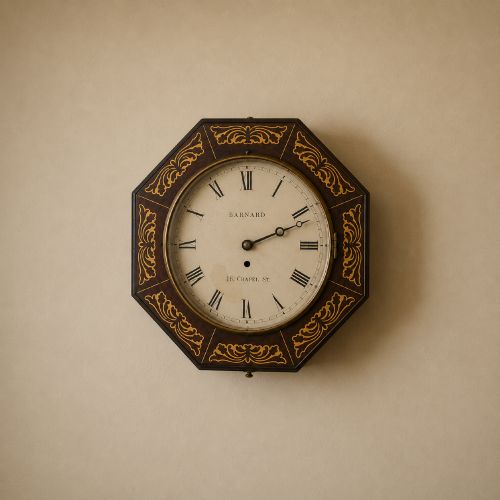


Inlaid Octagonal Clock
An inlaid octagonal clock brings sharp geometry and rich timber grain to a wall, combining reliable fusee movements with crisp brass or mother-of-pearl detail.
Inlaid Octagonal Clock
An inlaid octagonal clock combines a geometric eight-sided surround with contrasting stringing, brass inlay, or mother-of-pearl ornamentation. These pieces primarily take the form of wall clocks and drop-dial wall clocks, alongside occasional mantel clocks originating from Regency, Victorian, and Georgian periods.
Makers housed these timepieces in substantial timber cases, predominantly utilising rosewood and mahogany, sometimes set with ebonised wood or boxwood details. English and French workshops produced the majority of these examples, ranging from compact domestic timepieces to larger regulator wall clocks.
Materials and construction
Craftsmen built these cases around solid timber frames veneered in figured rosewood or mahogany, incorporating brass wire, metal wire, and mother-of-pearl to form geometric or floral inlay. Boxwood stringing frequently outlines the octagonal bezels and lower drop boxes, defining the sharp angles of the timber.
Movements rely on fusee mechanisms designed to maintain even tension as the mainspring unwinds, with several examples featuring bell-striking functions. Glass protects the painted dials, which sit behind hinged bezels fitted with brass bezels and secure catches.
Inlaid Octagonal Clock Retail Price Guide 2026
Typical asking prices for inlaid octagonal clock among the pieces listed under this phrase on Sellingantiques today, from the lower quarter to the upper quarter. They describe what is for sale here now, not the wider market.
Several clocks bear the names of regional West Country and Scottish watchmakers who calibrated hours long before the railway timetable standardised British time.
Distinctions in quality
The precision of the timber selection and the crispness of the inlay determine the visual standing of the case. Strong rosewood grain patterns paired with finely executed brass work or mother-of-pearl placement distinguish superior examples from plain variants.
Movement sophistication sets the tier of the clock, where twin fusee and bell-striking mechanisms demonstrate higher workshop capability than standard time-only configurations. Original dial signwriting by recorded makers also elevates the standing of the piece.
Barnard·Halliday and Rich·Kleyser of London·Walker and Hall·James Bell·J Fisher
The Inlaid Octagonal Clock Glossary
- Fusee
- A conical pulley used in clock movements to equalise the power of the mainspring as it runs down. This mechanism ensures consistent timekeeping from a fully wound state to near empty.
- Drop-dial
- A clock case featuring an upper octagonal dial section above a lower enclosed wooden box that houses the pendulum drop. This form allows room for a longer pendulum swing.
- Stringing
- A narrow inlay of contrasting wood or light-coloured timber set into the surface of the case. It creates fine decorative borders around the octagonal frame.
- Ebonised
- Wood treated with a dark stain or finish to imitate ebony. It provides a stark contrast against lighter mother-of-pearl or brass inlay.
- Bezel
- The ring, often made of brass, that holds the glass protecting the dial. It usually hinges open to allow hand-setting.
Inlaid Octagonal Clock: Frequently Asked Questions
What is a fusee wall clock?
A fusee wall clock relies on a chain-driven conical pulley mechanism rather than a standard mainspring barrel, delivering steady power to the escapement for accurate timekeeping.
These movements represent traditional British clockmaking standards and appear frequently in octagonal mahogany and rosewood wall cases.
How do I hang a heavy wall clock?
These timber cases carry significant weight from the movement and glass bezel, requiring secure fixing directly into wall studs or solid masonry using heavy-duty wall plugs and screws.
Avoid hanging them on drywall alone, as the vibration from striking mechanisms can loosen fixings over time.
How do I tell Regency from Victorian clocks?
Regency pieces typically display restrained brass inlay, simpler dial surrounds, and rich mahogany or rosewood grains dating from the early nineteenth century. Victorian examples often incorporate heavier mouldings, mother-of-pearl details, and bolder drop-dial proportions.
Examining the internal movement construction and backplate mounting provides further context for dating.
Do these clocks strike the hour?
Certain examples feature bell-striking or twin fusee mechanisms that sound the hours, while others function purely as timepieces without strike trains.
Listings specify whether a clock includes a striking function and whether it rings on a bell or a gong.