
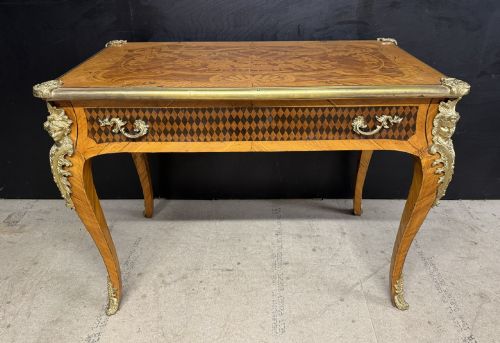
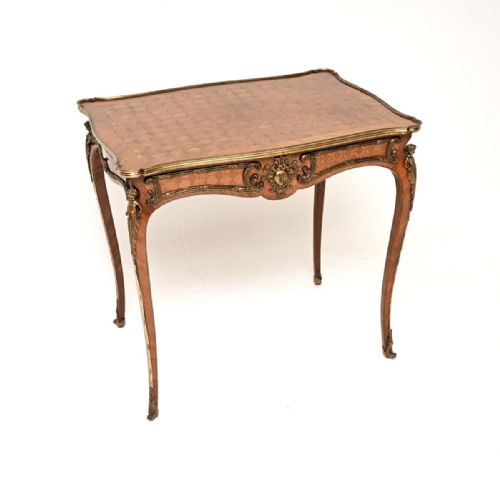
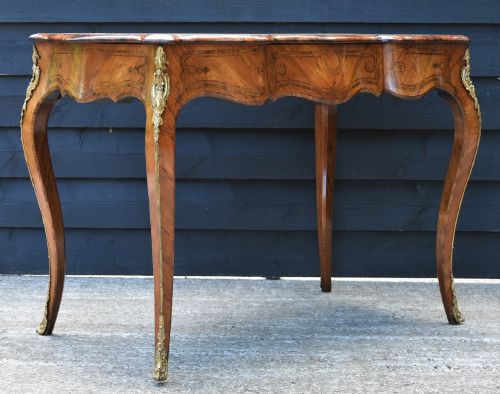
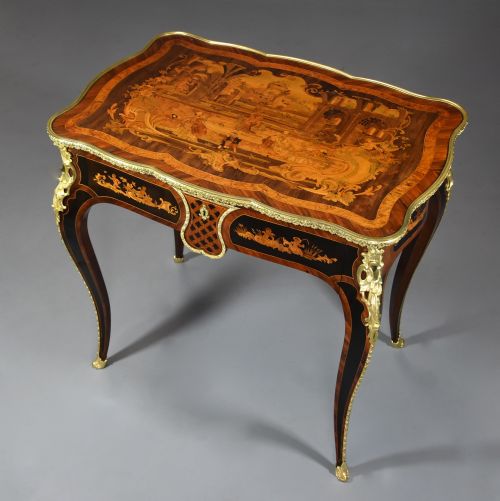
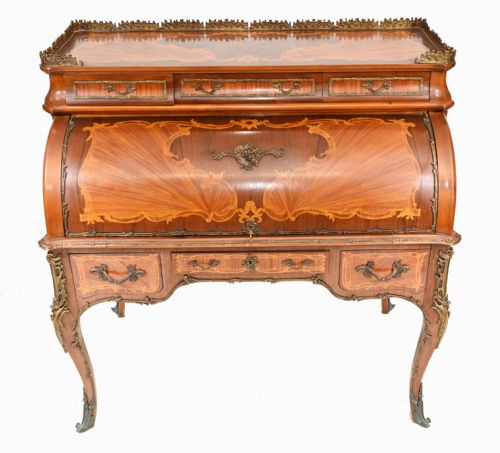
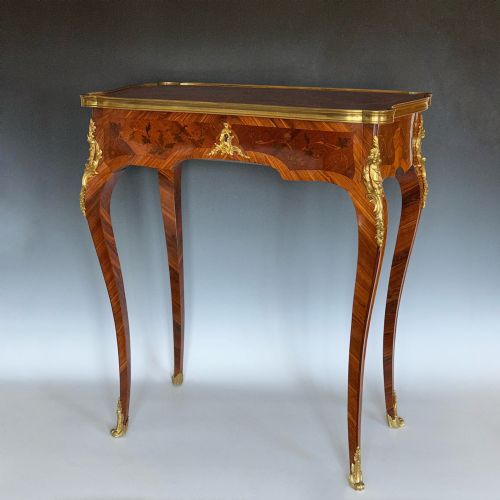

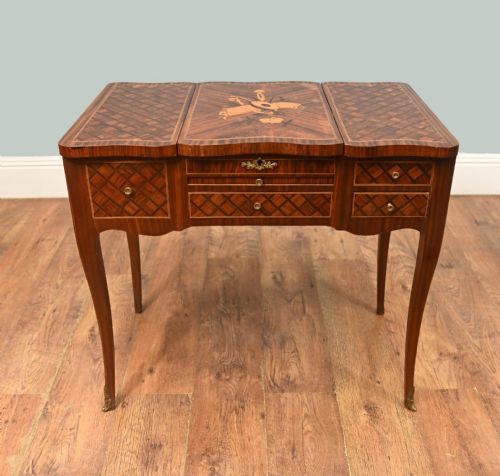


Inlaid Kingwood Writing Desk
An inlaid kingwood writing desk brings French revival elegance and intricate floral marquetry to a room.
Inlaid Kingwood Writing Desk
An inlaid kingwood writing desk is primarily a French creation spanning the nineteenth and early twentieth centuries, appearing in forms such as the bureau plat, bonheur du jour, and bureau de dame. These tables and desks serve both functional writing purposes and decorative centrepiece roles within a domestic interior.
The versions most frequently met on this page date from the nineteenth century and the Edwardian era, often following Louis XV and Louis XVI revival styles. They combine compact writing surfaces with serpentine fronts, marquetry patterns, and occasional superstructure compartments for correspondence.
Makers working in these historical styles produced pieces ranging from simple writing tables to elaborate partner desks and kidney-shaped variants. Buyers encounter variations in scale, from intimate ladies' dressing tables to substantial freestanding desks designed for a central room placement.
What varies in quality
Quality rests upon the precision of the marquetry cutter and the crispness of the cast ormolu mounts applied to the frame. Superior examples display finely detailed floral motifs in varied timbers without shrinkage gaps, alongside substantial, well-chased gilt metal mounts secured to the carcass.
Construction details beneath the surface also distinguish tiers of craftsmanship, notably the choice of secondary timbers like oak for drawer linings and the fluid shaping of serpentine rails. Pieces associated with notable workshops demonstrate superior joinery and harmony of proportion between the wood veneer and metal mounts.
Listings feature periods spanning the eighteenth century through the Edwardian era, incorporating kingwood, walnut, and ormolu.
Maison Millet·Millet
The Inlaid Kingwood Writing Desk Glossary
- Kingwood
- A dense, heavy Brazilian timber displaying rich violet-brown tones with darker streaks, utilised extensively for high-end French veneer work. It provides the characteristic dark ground against which lighter marquetry woods stand out.
- Marquetry
- The art of forming decorative patterns by fitting together thin slices of wood veneer, shell, or ivory onto a structural carcass. Floral and pictorial arrangements are assembled by hand before application.
- Bureau Plat
- A flat-topped freestanding writing table fitted with one or more drawers in the frieze, designed to stand in the centre of a room rather than against a wall.
- Ormolu
- Gilt bronze applied to furniture mounts and decorative hardware, cast and hand-chased to achieve sharp definition. It frames the contours of revival writing desks.
- Bonheur du Jour
- A small, light lady's writing desk featuring a raised superstructure of small drawers, pigeonholes, or a cupboard above the main writing surface.
Inlaid Kingwood Writing Desk: Frequently Asked Questions
What is a bureau plat?
A bureau plat is a freestanding writing table featuring a rectangular top, often inset with leather, and drawers set into the frieze below. These desks were designed to sit in the middle of a room.
Unlike traditional wall-facing desks finished only on the front, a bureau plat possesses finished decoration on all four sides so it can command a central position.
How do I date a kingwood desk?
Dating relies on examining the revival style, construction methods, and secondary timbers used inside the drawers. Nineteenth-century examples often follow Louis XV or Louis XVI revival aesthetics.
Later Edwardian interpretations tend to incorporate distinct crossbanding and alternative secondary woods like oak. The crispness of the ormolu mounts and the wear patterns on the veneer also offer clues to age.
Where should I place a centre table?
Centre tables and freestanding writing desks suit open floor plans, hallways, or the middle of a reception room where their finished backs and sides remain visible. They function effectively as writing surfaces or display areas.
Because these tables are finished all round, positioning them away from walls allows the marquetry and ormolu mounts to catch the light from multiple angles.
What is the difference between marquetry and parquetry?
Marquetry involves cutting and fitting diverse veneers to create pictorial or floral compositions, such as bouquets and scrolling foliage. It requires intricate hand-sawing of multiple timber types.
Parquetry forms geometric or symmetrical patterns, such as cubes, chequers, or lozenges, using regularly shaped blocks of wood veneer. Both techniques appear frequently across French revival furniture.