
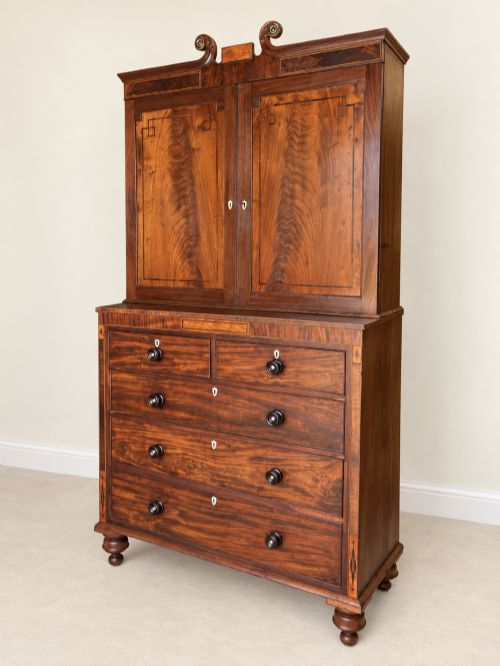
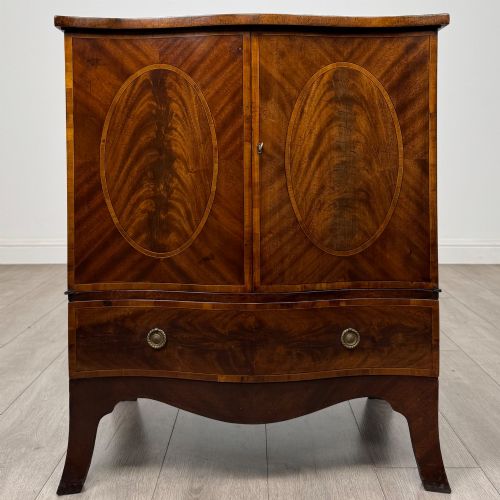
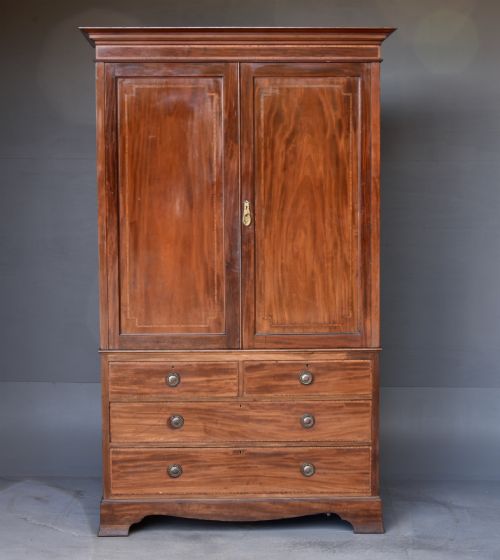
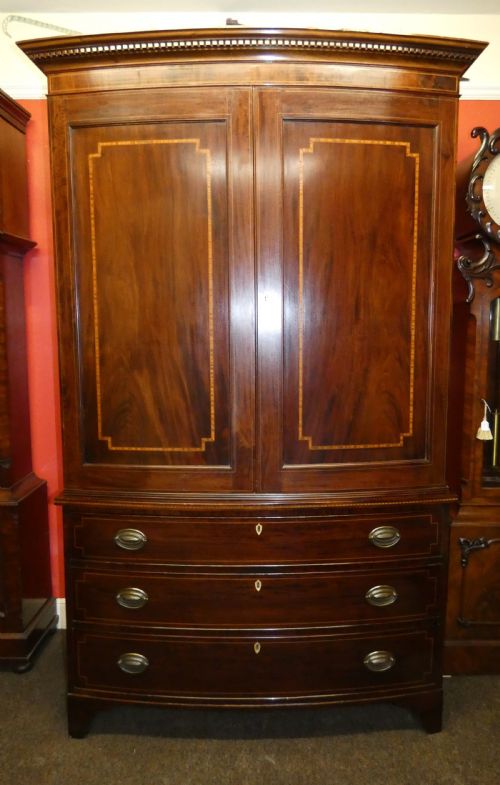


Inlaid Flame Mahogany Press
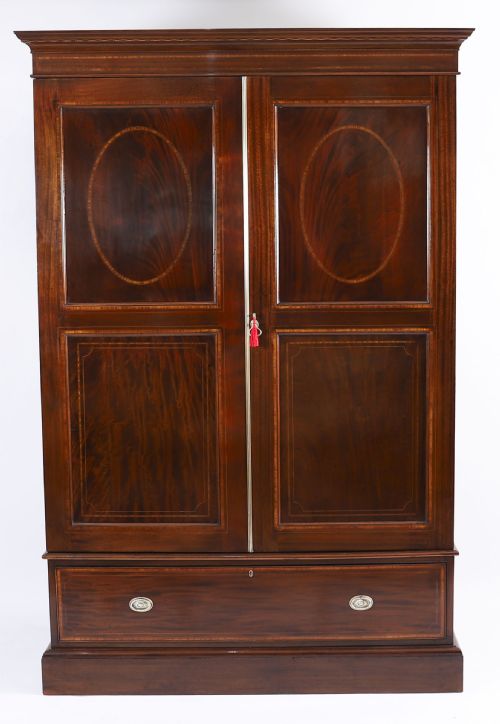
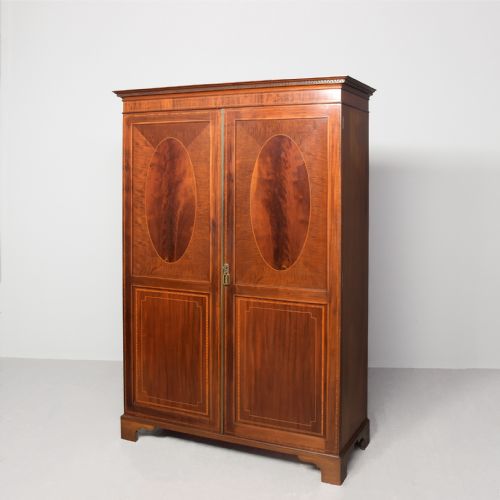
An inlaid flame mahogany press offers deep timber grain and precise stringing, bringing architectural weight and generous storage to any bedroom.
Inlaid Flame Mahogany Press
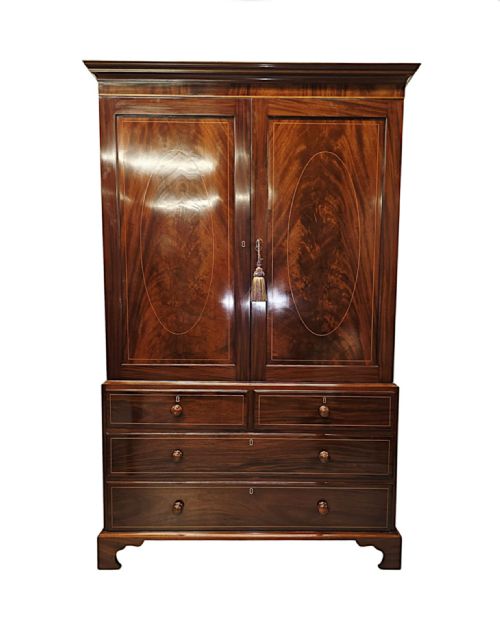
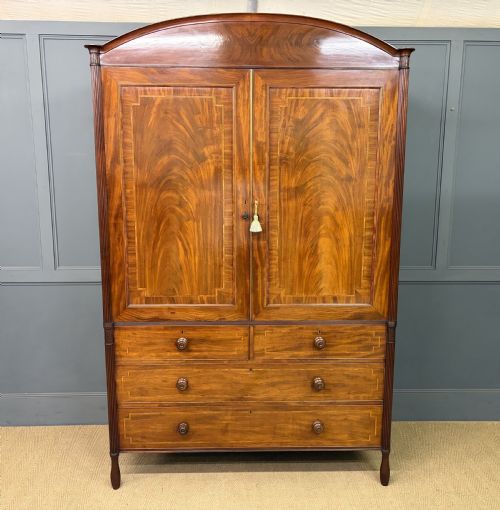
An inlaid flame mahogany press combines large wardrobe or cupboard storage with integrated chest drawers, designed to hold linens and garments. These tall cabinet forms date principally from the Georgian, Regency and Edwardian periods.
The most common formats on this page include linen presses with panelled upper doors and bowfront chests below, alongside larger breakfront and double wardrobe variations. The timber figuring provides strong visual movement across the double doors.
Originating as practical storage for household linen, many examples now function as primary bedroom wardrobes. The upper section often encloses sliding trays rather than hanging space, reflecting earlier domestic habits.
How they were made
Cabinet makers applied figured mahogany veneers over secondary timbers such as oak, cutting the wood to create mirrored flame patterns. They integrated contrasting lighter strips of satinwood and boxwood inlay to define the edges and panel borders.
Structural elements incorporated solid mahogany and brass fittings for handles, escutcheons and door retaining bolts. The carcase construction relied on heavy dovetailed drawer boxes and frame-and-panel doors to prevent warping.
Listings span the 18th Century, Georgian, Regency and Edwardian periods, utilising mahogany, satinwood inlay and brass.
What varies in quality
The sophistication of the timber selection dictates the visual impact, with symmetrical veneer matching commanding higher regard. Finely executed stringing and crossbanding require precise hand-cutting that separates standard workshop production from accomplished cabinet work.
Proportion and architectural detailing, such as swan-neck pediments and well-defined cockbeading around drawers, determine the visual balance of the piece. The integrity of the internal slides and the smoothness of the timber runners reflect the original maker's standard of construction.
maples & co
The Inlaid Flame Mahogany Press Glossary
- Flame mahogany
- A veneer figure produced from wood taken from the fork of the tree, displaying rolling, flame-like patterns. This timber was prized for principal door panels and drawer fronts.
- Linen press
- A tall piece of furniture featuring upper doors enclosing sliding trays, positioned above a chest of drawers. It was originally built for storing folded household linens.
- Bowfront
- A convex curved cabinet front that swells outward in the centre. This shape softens the mass of large mahogany storage pieces.
- Inlay
- A technique where contrasting woods such as satinwood or boxwood are fitted into recesses carved into the primary surface. It creates geometric borders and decorative motifs.
- Breakfront
- A cabinet design where the central section projects forward from the flanking outer sections. This architectural form adds depth and shadow to large wardrobes.
Inlaid Flame Mahogany Press: Frequently Asked Questions
What fits inside an inlaid flame mahogany press?
Many examples contain wooden pull-out sliding trays behind the upper doors, originally intended for folded textiles. Other variants feature full hanging space converted for modern clothing.
The lower section typically consists of a chest of drawers, offering compartmentalised storage for smaller garments and accessories.
How do I tell a Georgian press from a later revival?
Georgian pieces display period construction methods, including hand-cut dovetails, oak secondary timbers and traditional patination built up over centuries. Timber thickness and hardware fixings often assist in confirming the age.
Revival pieces, such as those from the Edwardian period, utilise more uniform machine-sawn elements and different internal framing techniques while imitating earlier styles.
Can these presses be dismantled for moving?
Most large presses separate into distinct modular sections, such as a corniced upper cupboard, a central chest base and separate feet. This sectional construction was essential for transporting heavy furniture between rooms.
Professional installation is recommended due to the weight of the solid timber carcase and panelled doors.
How do I care for flame mahogany veneer?
Keep the timber away from direct sunlight and strong heat sources to prevent the polished veneer from fading or drying out. Applying a traditional wax polish periodically maintains the moisture and lustre of the surface.
Avoid excessive moisture during cleaning, using a soft dry cloth for routine dusting.