
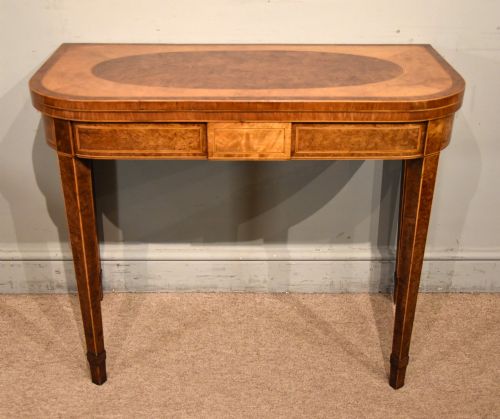

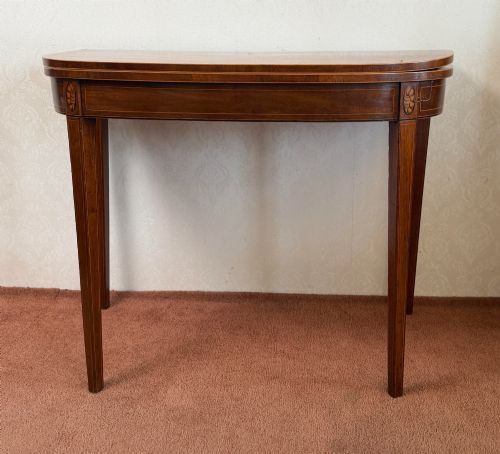
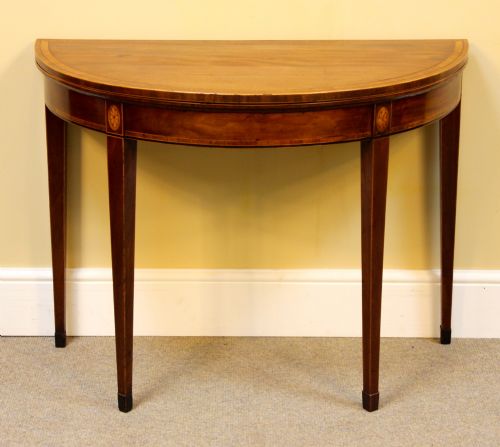
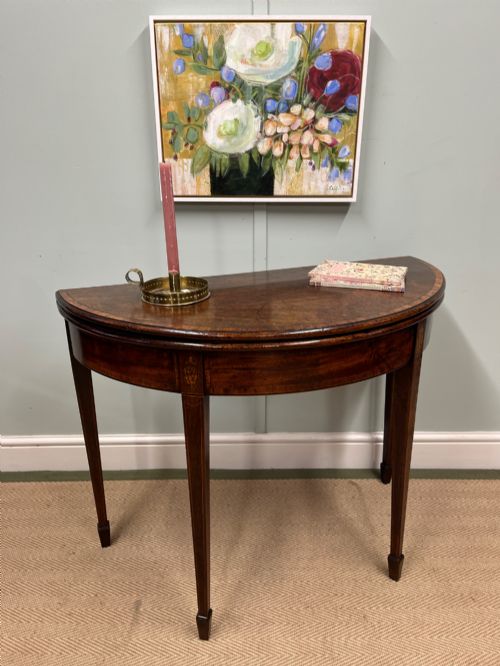


Inlaid Demilune Side Table
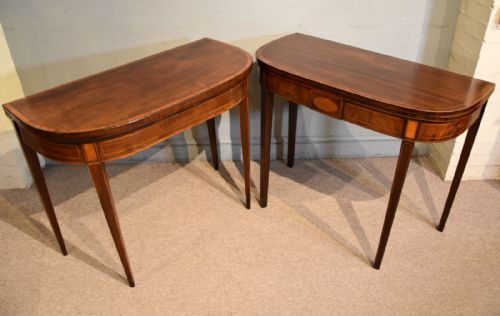
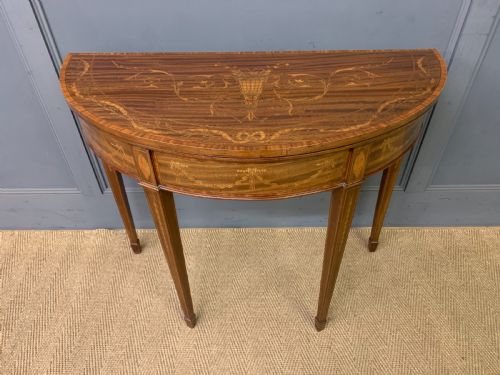
An inlaid demilune side table offers a semicircular profile designed to sit flush against a wall, combining elegant curves with compact proportions.
Inlaid Demilune Side Table
An inlaid demilune side table represents a semicircular form engineered to maximise floor space while providing a decorative surface for a hallway, drawing room or parlour. Buyers seeking this specific shape encounter console tables, tea tables, and card tables spanning the Georgian, Regency, Edwardian, and Victorian periods.
The version most commonly met on this page is the Georgian or George III mahogany tea table or console, frequently featuring folding tops or delicate crossbanding. These pieces often originate from the eighteenth and early nineteenth centuries, though later Edwardian and revival interpretations also appear regularly.
Makers utilised the half-moon shape to fit neat against interior walls where rectangular furniture protruded too far into passageways. Such items frequently served multiple domestic functions, doubling as card tables or serving surfaces when unfolded.
How they were made
Cabinet makers built these tables using primary timbers such as mahogany, satinwood, walnut, and padouk, often selecting Honduras mahogany or burr yew wood for its distinctive figured grain. Solid frames supported veneered surfaces that allowed artisans to arrange timber figures symmetrically.
Decoration relied heavily on boxwood inlay, satinwood inlay, and general wood inlay, creating sharp contrasts against darker field woods. Brass mounts and crossbanding were applied to edges and borders to frame the curved perimeters precisely.
Object forms span console tables, tea tables, card tables, and washstands sharing the characteristic semicircular profile.
What varies in quality
The standard of execution in timber selection and inlay precision separates standard domestic items from superior examples. Master workshops deployed finer veneers and more intricate botanical or geometric marquetry, whereas simpler pieces relied on plain mahogany with minimal borders.
Structural integrity of the folding mechanisms and the smoothness of the pivot hinges indicate the original skill of the joiner. Superior tables maintain flush joints and stable leaves even after centuries of expansion and contraction in timber.
Edward and Roberts
The Inlaid Demilune Side Table Glossary
- Demilune
- A half-moon shape or semicircular form used primarily for tables designed to stand flat against a wall. This profile became especially popular during the Georgian and Regency eras.
- Crossbanding
- A strip of veneer applied to the border of a tabletop with the grain running perpendicular to the main surface. This technique creates a distinct visual framing effect.
- Marquetry
- Decorative patterns formed by fitting together small pieces of coloured wood, shell, or ivory into a veneered surface. Floral and geometric motifs appear frequently on later revival pieces.
- Foldover
- A hinged tabletop design that opens to double its surface area, converting a slim console into a card table or tea table. The pivoting leaf often rests on a swinging rear leg.
- Satinwood
- A hard, durable timber featuring a lustrous golden-yellow sheen, highly prized for contrasting inlay work and decorative banding.
Inlaid Demilune Side Table: Frequently Asked Questions
How were demilune tables used originally?
These pieces functioned primarily as decorative console surfaces in hallways or against drawing room walls. When constructed with hinged tops, they converted easily into card tables or tea tables for social gatherings.
Their compact semicircular footprint allowed them to sit out of the way of foot traffic while providing a stable surface for lamps, porcelain, or games.
What is the difference between George III and Edwardian examples?
George III pieces date from the late eighteenth or early nineteenth centuries, relying on dense solid timbers, subtle boxwood lines, and hand-cut joinery. Edwardian examples, produced around the early twentieth century, often incorporate lighter satinwood grounds and more elaborate marquetry.
While both share the characteristic semicircular shape, the later revival items generally display brighter coloration and machine-assisted veneer slicing.
How do I care for antique veneer?
Maintain stable indoor humidity levels and keep wooden surfaces away from direct heat sources to prevent the underlying glue from drying and the veneer from lifting. Clean surfaces using a soft, dry cloth rather than modern chemical polishes.
Occasional application of traditional beeswax helps nourish old timber and protects the polished finish from moisture.
Are all demilune tables folding tables?
Many surviving examples feature a foldover mechanism designed for card games or tea service, but fixed-top console tables and pier tables also share the same semicircular outline. Non-folding variants often incorporate solid or marble tops supported by slender legs.
Examining the underside of the frame reveals whether the top was built to lift or remain stationary.