

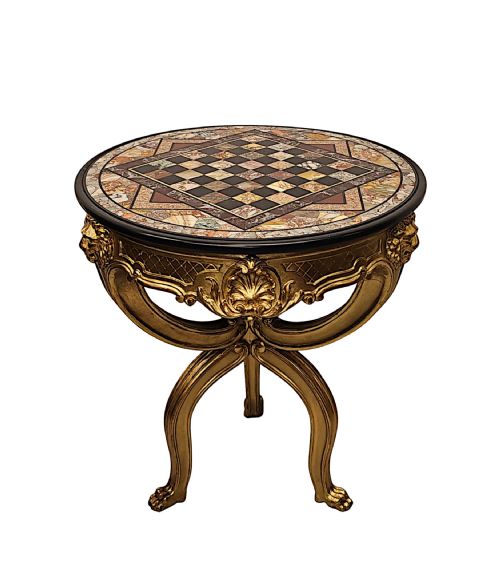


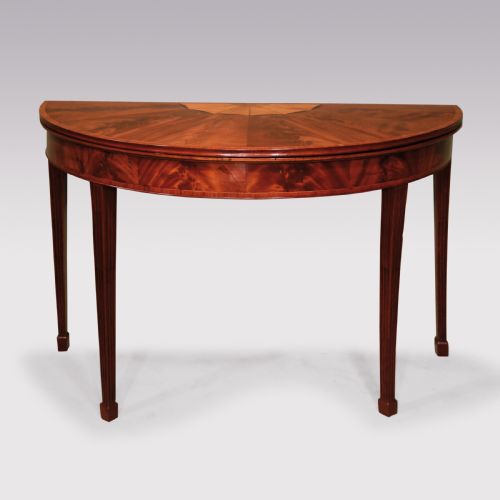
Inlaid Circular Games Table
An inlaid circular games table brings sociable cleverness into a room, offering a fitted top for play.
Inlaid Circular Games Table
An inlaid circular games table brings together practical furniture and pastimes, appearing across the Georgian, Regency, Victorian, and Edwardian periods. Buyers searching for an inlaid circular games table encounter forms spanning card tables, chess tables, and occasional tables with dedicated boards.
The evidence shows these pieces surface frequently in mahogany, satinwood, and walnut, often taking semi-circular, demi-lune, or round formats. Workshops executed these designs in styles ranging from George III and Sheraton to William IV and Edwardian.
Many examples function as dual-purpose items, doubling as console tables, tea tables, or pier tables when closed. This versatility makes them enduringly popular for drawing rooms and reception spaces.
Materials and construction
Cabinetmakers relied heavily on rich timbers such as mahogany, walnut, satinwood, and rosewood for the primary carcases and surfaces. These woods provided stable, decorative bases for intricate decorative work.
Inlay and marquetry defined the tops, utilising boxwood, brass, and specialised boxwood inlay to create chess boards, decorative motifs, and geometric borders. Artisans carefully fitted segmented tops and folding mechanisms to allow the tables to transform between uses.
Inlaid Circular Games Table Retail Price Guide 2026
Typical asking prices for inlaid circular games table among the pieces listed under this phrase on Sellingantiques today, from the lower quarter to the upper quarter. They describe what is for sale here now, not the wider market.
Listings feature mahogany, satinwood, and walnut timbers across Georgian, Regency, Victorian, and Edwardian periods.
Judging the standard of execution
Quality rests in the crispness of the marquetry and the precision of the timber grain matching across the folding leaves. Finer pieces demonstrate careful selection of figured satinwood or mahogany that enhances the geometric or floral patterns.
The mechanical joints and pivoting mechanisms dictate the daily usability of the piece, separating standard workshop output from superior cabinet work. A well-constructed table operates smoothly without sagging when extended.
The Inlaid Circular Games Table Glossary
- Demi-lune
- Half-moon shape. This format allows the furniture to sit flat against a wall when closed as a console table.
- Marquetry
- Veneer patterns forming pictures or designs. Cabinetmakers used contrasting timbers like boxwood and satinwood to create elaborate tabletop scenes.
- Chess board
- A checkered playing surface. These are frequently inlaid directly into the circular or folding tops of tables designed for strategy games.
- Console table
- A table supported against a wall by brackets or legs. Many folding tables double in this role when their leaves are closed.
- Segmented top
- A surface divided into distinct wedge sections. This construction technique highlights the grain direction and aids stability in circular designs.
Inlaid Circular Games Table: Frequently Asked Questions
What games were played on these?
These pieces accommodated pastimes like chess, card games, and golf-themed pastimes depending on the specific board layout inlaid into the surface. The versatile tops allowed households to transition easily from social gaming to ordinary room use.
Many examples feature dedicated marquetry surfaces such as chequer-boards, whilst others used baize-lined folding leaves for card playing.
How do I date an inlaid table?
Dating relies on observing the prevailing style, timber choices, and construction methods associated with periods like George III, Regency, or Edwardian. Makers shifted from Georgian mahogany and Sheraton satinwood towards Victorian walnut and Edwardian marquetry over time.
Comparing the edge profiles, leg shapes, and inlay materials against documented examples helps narrow down the decade of production.
Can these be used daily?
These tables adapt well to modern living as occasional pieces, side tables, or console surfaces in hallways and sitting rooms. Their folding leaves and compact half-moon shapes make them practical for smaller spaces.
Care should be taken with historical polish and veneered surfaces, avoiding excessive moisture or direct sunlight to preserve the delicate boxwood and satinwood inlay.