




Industrial Wooden Bench
An industrial wooden bench brings raw utility and weathered character into a modern interior.
Industrial Wooden Bench
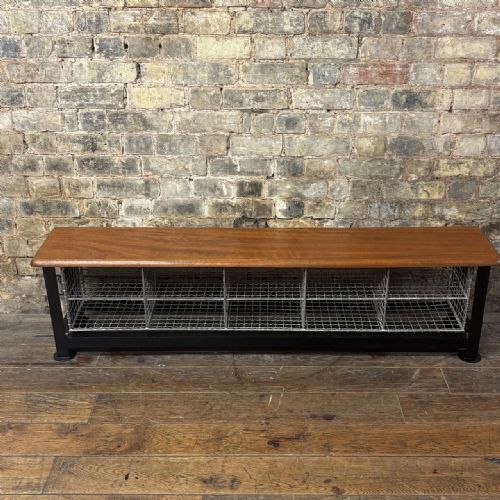
When you search for an industrial wooden bench, you encounter sturdy seating and work surfaces originally built for functional trades, schools, and railways rather than domestic comfort. These pieces combine heavy timber tops with robust metal or wood supports, reflecting the practical demands of their origins.
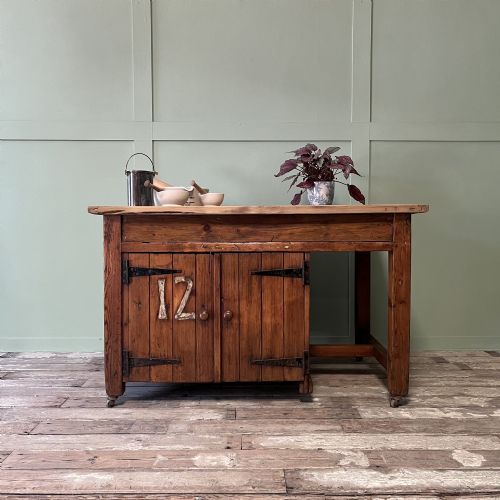
The selections available here lean heavily towards workshop benches, bakers prep tables, and station seating dating from the nineteenth and early twentieth centuries. Pieces span eras such as the Victorian period, Edwardian times, and the 1920s, featuring forms like the folding bench stand and the railway flip over bench.
Origins vary across British, French, Swedish, and Canadian workshops, showing how different regions adapted pine, oak, and hardwood to heavy daily use. Whether configured as a long hall seat or a compact luggage stand, each item carries the marks of its working past.
How they were made
Makers constructed these benches using robust timbers such as pine, pitch pine, oak, and general hardwood for the primary surfaces and structural frames. Planks were selected for thickness and durability to withstand heavy loads, hammering, and continuous foot traffic in stations and workshops.
Metal components in iron, cast iron, steel, and wire mesh provided essential reinforcement, visible in functional vices, folding mechanisms, and heavy brackets. Carpenters and metalworkers joined wood and metal with straightforward mechanical fasteners designed for maximum strength rather than hidden elegance.
Materials documented across the inventory include iron, pine, oak, cast iron, hardwood, steel, timber, and wire mesh.
What varies in quality
Quality in these pieces rests upon the integrity of the original construction and the degree of honest wear accumulated over decades of service. Superior examples retain their original operational elements, such as working vices, functional flip over mechanisms, and sturdy folding frames that still move smoothly.
The character of the timber surface also determines distinction, where deep patination, untouched grain, and original manufacturer stamps outweigh sanded or heavily restored uniformity. Well-preserved maker details or hardware stamps add historical weight to the piece.
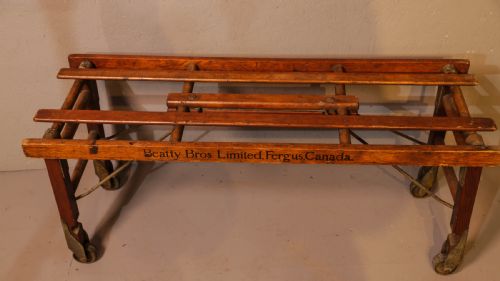
Beatty Bros Fergus Canada
The Industrial Wooden Bench Glossary
- Prep table
- A low or counter-height wooden table used in food preparation or baking, typically fitted with a thick top and drawers or lower shelves for utensils.
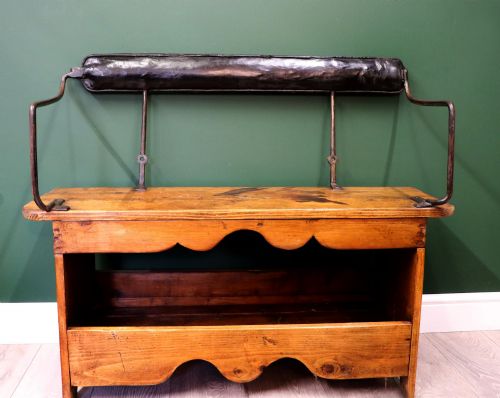
- Flip over bench
- A dual-purpose seating design featuring a reversible backrest that pivots to face either direction, commonly utilised on railway platforms.
- Vice
- A mechanical screw apparatus attached to a workbench to hold material securely in place during cutting or shaping.
- Luggage stand
- A low raised platform or bench designed for holding travel trunks and bags, often featuring folding legs for compact storage.
- Pitch pine
- A durable resinous softwood sourced from pine trees, valued historically for its strength and resistance to heavy wear.
Industrial Wooden Bench: Frequently Asked Questions
What is an industrial wooden bench?
An industrial wooden bench is a heavy-duty seat or work surface originally created for commercial, railway, or workshop environments. They are defined by utilitarian construction, combining thick wooden tops with iron or steel framing.
Today, these benches serve as distinctive architectural seating or statement console surfaces in homes and commercial spaces.
How were railway benches used?
Railway benches provided platform seating for waiting passengers at nineteenth and early twentieth-century stations. Many featured ingenious flip-over backs so travellers could face whichever direction they preferred.
Their robust timber construction allowed them to withstand constant public use and exposure to changing weather conditions on open platforms.
How do I identify a workbench?
Workbenches are recognised by their exceptionally thick wooden tops, integrated vices for holding timber, and utilitarian lower shelving. French and Swedish examples often show deep gouges and tool marks from artisanal trades.
Unlike standard household tables, every element of a workbench was engineered purely for physical labour and mechanical stability.
Can I use an industrial bench outside?
While these pieces were built strongly, most antique industrial benches utilise timbers and iron hardware that react poorly to sustained dampness and rain. Keeping them indoors protects the aged patina and prevents the wood from warping or splitting.
Covered porches or boot rooms can work if the piece is treated carefully and kept away from direct standing moisture.
How do I date an antique bench?
Dating relies on examining the specific construction methods, nail types, hardware styling, and the overall wear patterns on the wood. Pieces associated with specific railway companies or documented eras like the Edwardian period or the 1920s offer clear historical benchmarks.
Maker stamps and regional workshop styles also help narrow down the exact decade of manufacture.