
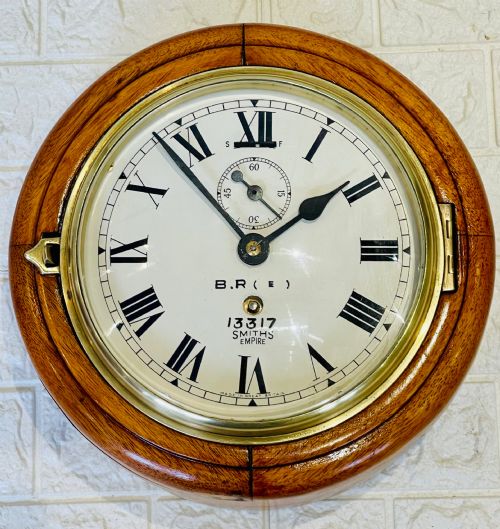
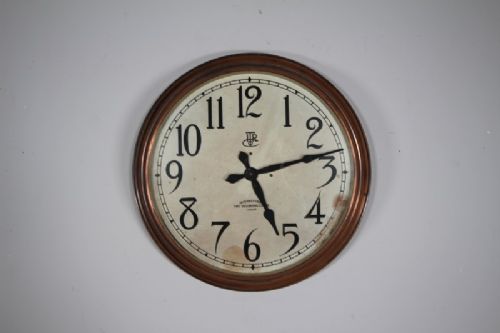



Industrial Station Wall Clock
An industrial station wall clock brings commanding scale and honest timekeeping to a room, driven by heavy-duty movements and robust dials.
Industrial Station Wall Clock
When you search for an industrial station wall clock, you encounter heavy functional timepieces built for transport networks, public offices and large factories. The selection spans robust British railway examples, French tower clock faces and utilitarian institutional designs.
You are most likely to meet wall clocks and clock dials originating from the Edwardian era through to the mid twentieth century. These pieces combine utilitarian metal, glass and wood construction with clear, legible dials designed to be read from across a platform or large room.
The inventory covers diverse iterations from railway companies and municipal buildings, showing how public time was kept across Britain and France. Whether housed in mahogany, oak, brass or green metal, each object carries the practical design language of its working environment.
How they were made
Cases and dials utilise durable industrial materials including iron, brass, copper and heavy glass, protected by wooden surrounds in oak or mahogany where placement demanded a smarter finish. Bakelite also appears in later twentieth century iterations.
Movements rely on reliable mechanical engineering, notably fusee systems designed to maintain consistent tension as the mainspring unwinds. Dials feature enamelled iron or painted metal surfaces built to withstand decades of heavy use in public spaces.
Many of these clocks spent decades watching steam trains pass before finding a quiet second life indoors.
What varies in quality
Quality rests in the legibility and originality of the dial, alongside the integrity of the original movement and case materials. Pieces bearing specific railway or factory provenance carry greater historical weight than generic alternatives.
The precision of the engineering and the preservation of original metalwork and glass separate standard utilitarian items from exceptional surviving examples by known makers.
JOYCE WHITCHURCH·John Walker·Smiths
The Industrial Station Wall Clock Glossary
- Fusee dial
- A clock face connected to a conical pulley that equalises the pull of the mainspring. This mechanism ensures steady timekeeping throughout the running period.
- Turret clock
- A large clock designed for placement in a tower or high architectural setting. These dials often measure considerable diameters to ensure outdoor visibility.
- Bakelite
- An early form of synthetic plastic used for clock surrounds and housings in the mid twentieth century. It provides a durable, heat-resistant finish.
- Architectural salvage
- Elements recovered from buildings slated for demolition or renovation. This category includes large wall clock dials rescued from industrial sites.
Industrial Station Wall Clock: Frequently Asked Questions
What is a fusee dial clock?
A fusee dial clock is a timepiece featuring a conical pulley inside the movement that regulates the power delivered by the mainspring. This clever mechanical design ensures the clock maintains consistent accuracy as the spring runs down.
Such movements are commonly found in British railway and post office clocks where precise timekeeping was essential for daily operations.
How do I date an industrial wall clock?
Dating relies on examining the materials, case construction, lettering style on the dial, and any company markings or railway ciphers present. Edwardian models often feature deep wooden surrounds, while mid twentieth century examples incorporate metal and Bakelite housings.
Reference numbers or station acronyms stamped on the dial or movement also help establish the period and operational history of the piece.
Are these clocks suitable for domestic interiors?
Their strong visual presence and large scale make them striking focal points in modern kitchens, living rooms, and hallways. The clean typography of station dials complements both contemporary and traditional interior schemes.
Consider the ticking volume and room proportions before placing a large railway or factory clock in a quiet bedroom or small study.