
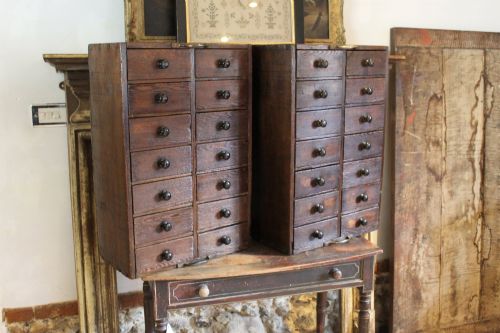
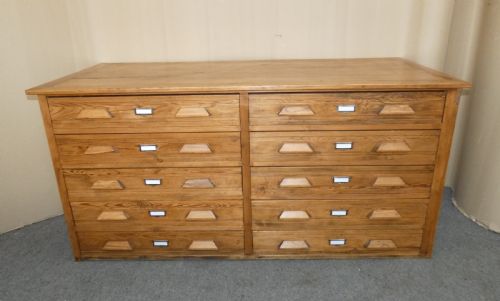

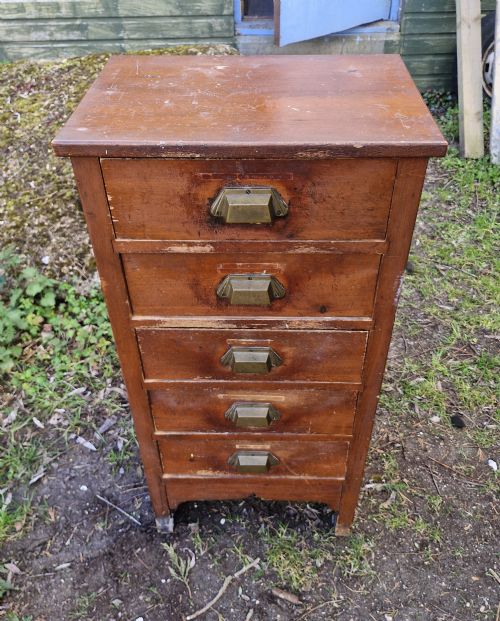


Industrial Pine Storage Drawers
Industrial pine storage drawers are utilitarian utility and commercial pieces built for workshops and shops, offering robust storage for the modern home.
Industrial Pine Storage Drawers
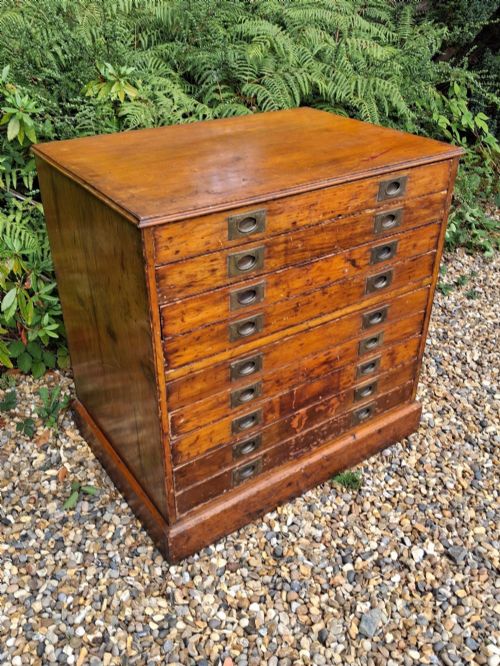
When buyers search for industrial pine storage drawers, they are looking at heavy-duty utilitarian furniture originating from commercial, workshop and retail settings. These functional pieces include banks of multiple drawers, haberdashers' counters, shop fittings, plan chests and carpenters' chests dating from the nineteenth and early twentieth centuries. Such items were originally constructed for rigorous daily use in ironmongers, drapers, watchmakers and offices rather than domestic parlours.
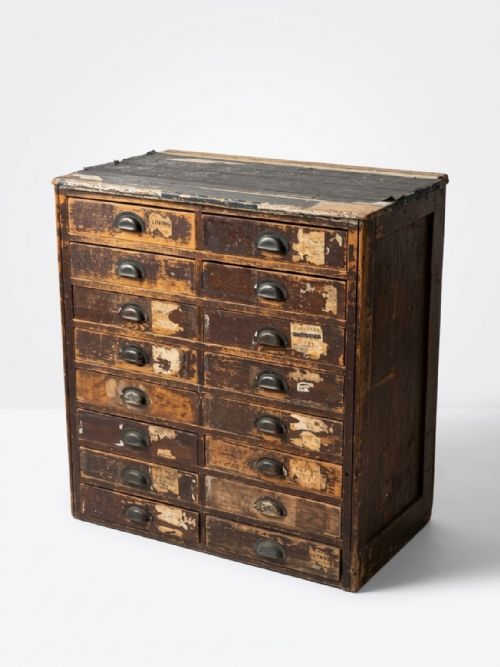
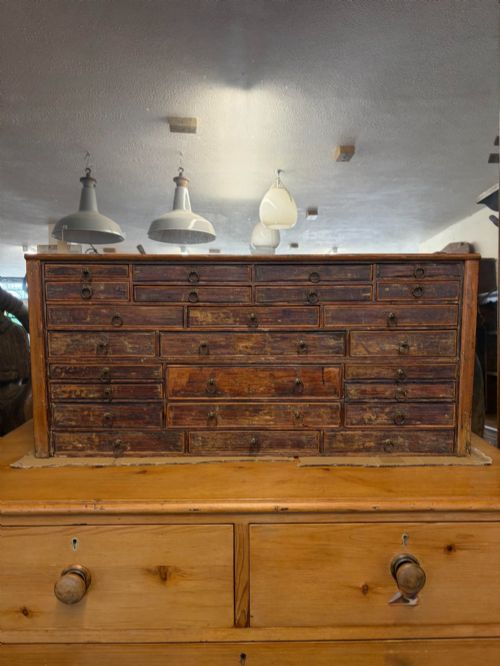
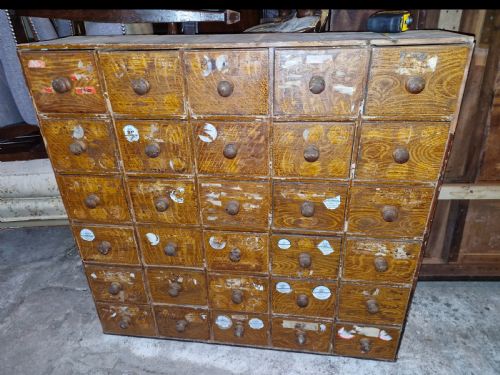
On this page, buyers are most likely to meet large banks of drawers, shop fittings and multi-drawer cabinets spanning the Victorian and Edwardian eras. These pieces typically combine softwoods with metal hardware, offering numerous compartments configured for sorting and organising stock or tools. The forms range from tall watchmakers' banks to wide plan chests and painted shop counters.
The aesthetic of industrial pine storage drawers derives directly from their working origins, showing decades of wear, paint splashes and historical handling. Buyers choose them to anchor modern interiors with functional utility and honest, unpretentious materials. Each survivor carries the distinct patina of its commercial past into contemporary domestic or studio spaces.
Materials and construction
Constructed primarily from pine and pitch pine, these storage pieces rely on sturdy softwood timbers selected for durability and availability in commercial workshops. Cabinetmakers joined thick planks using robust dovetail joints on drawer carcases to withstand the constant pulling and heavy loads of retail and industrial use. The primary timber is frequently paired with secondary woods for internal dividers and drawer linings.
Metal hardware plays a crucial role in the construction, featuring iron handles, brass pulls, and sometimes metal strapping or card holders on drawer fronts. These fittings were chosen strictly for utility, designed to endure heavy handling in busy environments like drapers' shops and ironmongers. Many pieces retain original coats of paint, varying from light green shop finishes to weathered natural wood surfaces.
Materials recorded across the inventory include pine, pitch pine, iron, brass, and painted surfaces applied to functional commercial forms.
What separates the best from the rest
The primary distinction in quality lies in the scale and complexity of the drawer configuration, such as a large bank of twenty-five drawers or a tall watchmakers' cabinet compared to a standard domestic chest. Intact original hardware, including period brass handles and metal label holders, elevates a piece above those with replacement fittings. The survival of original painted finishes, such as light green shop paint, also adds considerable character and authenticity.
Structural integrity and untouched surfaces separate good workshop survivors from heavily altered examples. Pieces retaining their original configuration of numerous small drawers without mismatched replacements demonstrate superior historical preservation. The presence of identifiable commercial origins, such as maker stamps or specific retail provenances, further distinguishes the top tier of industrial storage.
Luxmore's of Ilfracombe·D Napier and Sons
The Industrial Pine Storage Drawers Glossary
- Bank of drawers
- A multi-drawer cabinet containing numerous smaller compartments built vertically or horizontally for sorting goods. These units were standard fixtures in trade and retail premises.
- Haberdashers' drawers
- Shop display and storage units featuring many shallow drawers, often with glass fronts or pulls, used for selling small textiles and sewing items. They are prized today for organising small collections.
- Plan chest
- A wide, shallow multi-drawer cabinet designed specifically for storing architectural drawings, maps and large paper sheets. Their generous proportions make them suitable for modern studio spaces.
- Pitch pine
- A dense, resinous variety of pine timber known for its durability and strong grain pattern. Cabinetmakers utilised it for heavy-duty commercial furniture that required extra strength.
- Shop fitting
- Custom-built furniture designed specifically for the interior of a retail establishment, such as a counter or drawer unit. These pieces were constructed to withstand heavy public interaction.
Industrial Pine Storage Drawers: Frequently Asked Questions
What were industrial pine storage drawers originally used for?
These multi-drawer units served in commercial environments like drapers' shops, ironmongers, watchmakers' workshops and offices to sort small inventory, tools and documents.
Their robust construction allowed merchants and tradespeople to keep large quantities of varied stock organised and accessible during daily business operations.
How do I fit industrial drawers into a modern home?
Industrial pine storage drawers function effectively as kitchen islands, sideboards, studio storage or hallway console tables due to their substantial depth and numerous compartments.
Their utilitarian aesthetic complements contemporary or rustic interiors by adding practical surface space and texture alongside historical character.
How can I tell a Victorian bank of drawers apart from Edwardian pieces?
Nineteenth-century and Victorian examples often exhibit heavier timber framing, hand-cut dovetails and utilitarian iron or brass hardware associated with traditional workshop production.
Edwardian and early twentieth-century pieces sometimes incorporate pitch pine, standardised metal card holders and slightly lighter carcass proportions reflecting evolving commercial office needs.
Why do many industrial drawers have painted finishes?
Shops and workshops frequently painted their storage fixtures to protect the softwood timbers from constant wear and to match interior colour schemes.
Over decades of use, these painted surfaces acquire chips and layers that contribute to the authentic patina valued by collectors today.