
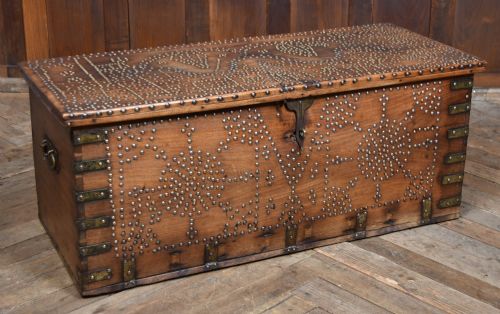
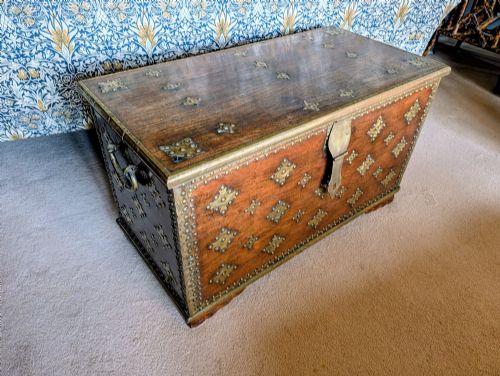
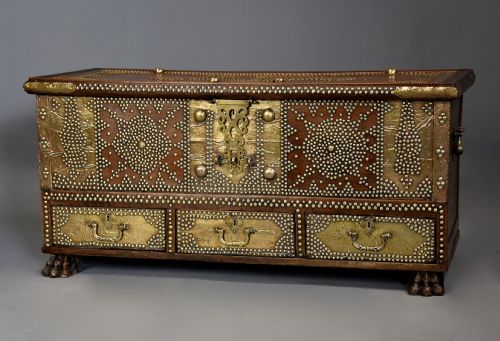
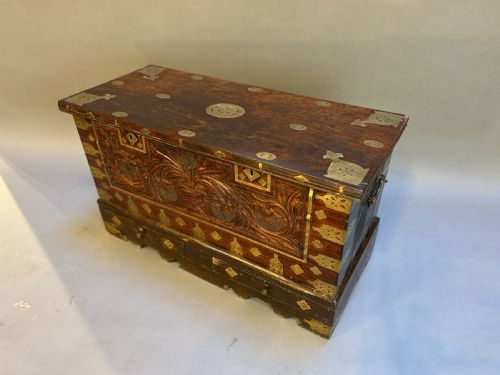
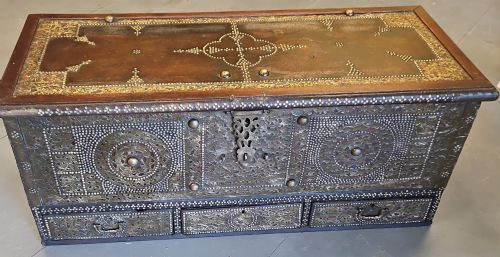


Indian Studded Trunk
These heavy, brass-studded trunks are practical storage chests carrying distinct colonial histories into modern homes.
Indian Studded Trunk
An indian studded trunk brings substantial timber construction and heavy metal ornamentation together in forms originally built for travel and domestic storage. These pieces range from blanket boxes to traders chests shaped by Anglo-Indian and Victorian colonial influences.
The nineteenth century dominates the period range on this page, with dates clustering around eighteen fifty, eighteen ninety, and the wider Victorian era. Visitors most frequently encounter hardwood Zanzibar chests bearing characteristic brass studding alongside iron bound coffers from the same trading routes.
Alternative forms include storage chests and coffers designated under styles such as colonial, Middle Eastern, and Anglo-Indian. Their robust proportions suit contemporary living spaces as functional coffee tables or end-of-bed storage.
Materials and construction
Makers utilised dense tropical timbers including teak, rosewood, hardwood, and padouk wood to withstand demanding maritime and overland journeys. These heavy woods provide the structural integrity required for large storage chests and blanket boxes.
Construction relies upon protective metal elements, principally brass and iron, hammered into place as studs, strapwork, and binding. Copper also appears in smaller quantities to secure corners and edges against heavy wear.
Listings on this page span the nineteenth century, featuring Victorian and colonial periods alongside material variations in brass, iron, teak, rosewood, and padouk.
Assessing quality
Quality rests upon the selection and density of the primary timber, where richly grained rosewood and padouk stand apart from standard hardwoods. The consistency and intricacy of the brass stud decoration also separate utilitarian pieces from finer decorative works.
The integrity of the original hardware, including hinges, clasps, and corner brackets, defines the calibre of a survival. Superior examples retain their complete metal armature and structural joinery without heavy timber replacement.
The Indian Studded Trunk Glossary
- Zanzibar chest
- A distinct form of heavy storage chest originating from or influenced by East African trading networks, typically constructed from dense tropical hardwood. These pieces are heavily decorated with brass studwork and strapwork.
- Padouk
- A durable, richly coloured tropical hardwood utilised by makers for its strength and fine finish. It resists moisture and wear effectively.
- Coffer
- A chest or box traditionally used for holding valuables, distinguished by a sturdy box construction and often reinforced with metal bindings. They served as secure containers during transit.
- Anglo-Indian
- A descriptive term for furniture made in India during the British colonial period, combining European forms with local materials and craftsmanship. These objects frequently blend distinct cultural design elements.
Indian Studded Trunk: Frequently Asked Questions
What is an indian studded trunk?
These are heavy wooden storage containers reinforced with metal studs, bindings, and straps, originating from nineteenth-century colonial trade routes. They combine robust utility with decorative metalwork.
Most examples seen here date from the Victorian era and utilise dense timbers like teak, rosewood, and padouk wood.
How were these trunks used?
Traders, travellers, and households utilised these sturdy chests for transporting and storing textiles, documents, and valuables across maritime and overland journeys. Their heavy construction protected contents from moisture and rough handling.
Today, buyers repurpose them as living room coffee tables or practical bedroom blanket boxes.
How do I care for padouk or teak?
Maintain these dense tropical hardwoods by keeping them away from direct heat sources and sudden humidity changes to prevent timber movement. A simple application of appropriate natural wax preserves the timber finish.
Avoid harsh chemical cleaning products on both the wood and the surrounding brass studs.
How can I tell the period?
Dating relies on timber selection, construction methods, and the style of the brass or iron bindings characteristic of the nineteenth century. Pieces often correspond to specific Victorian manufacturing decades or colonial periods.
Examine the joinery and interior surfaces for signs of hand tools and age-related wear.