




Impressionist Winter Artwork
Impressionist winter artwork captures cold weather scenes through loose brushwork, predominantly appearing here in oil paint and watercolour from the nineteenth and early twentieth centuries.
Impressionist Winter Artwork
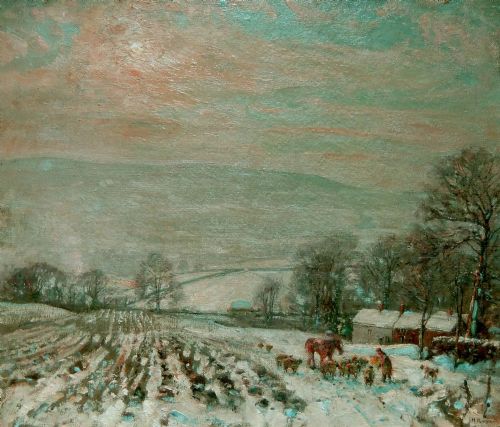
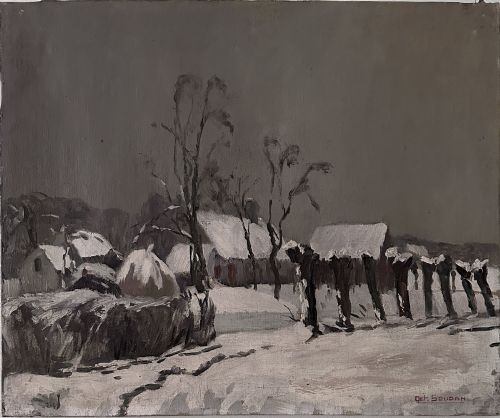
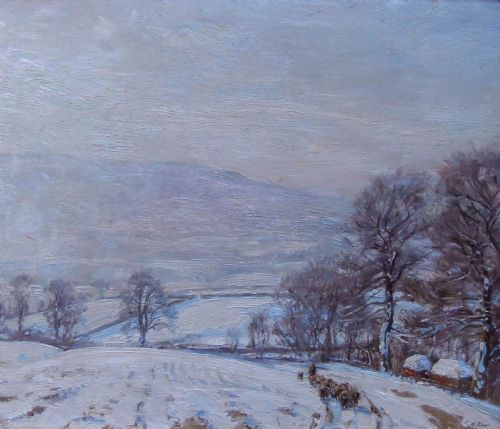
Impressionist winter artwork comprises paintings, pastels and watercolours depicting snowy landscapes, frost-covered pastures, rural villages and city streets. These pieces record shifting seasonal light across British, French and Dutch scenes during the nineteenth and twentieth centuries.
You will most frequently encounter works executed in oil on canvas or board, alongside watercolours and pastels on paper. Subjects range from Yorkshire dales and Wharfedale snowscapes to French school cityscapes and pastoral views.
The selection draws from periods spanning the nineteenth century through the 1960s, capturing the transition from early impressionist methods towards post-impressionist and twentieth-century regional styles.
Evaluating quality and handling
Quality rests in the economy of touch and the artist's ability to render the specific glare of winter light without excessive detail. Stronger examples demonstrate confident handling of pigment or watercolour washes that suggest freezing temperatures through tone rather than laboured drawing.
The integration of the support into the final image, whether canvas weave or paper texture, distinguishes more confident works from stiffer compositions. Provenance tied to recognised regional painters or established continental schools further elevates individual pieces.
Listings feature works spanning the 1900s to the 1960s, employing canvas, oil paint, watercolour, paper, wood, and glass.
Herbert Royle·Gaston Cornil·Fred Lawson·Arthur Winter Shaw·W. Tatton Winter·William Tatton Winter·Ernest Higgins Rigg·William Greaves·Emily M. Paterson·Anthonij Anton Mauve·Matthew Hale·Angus Rands·William Cave Day·A. McDonald
The Impressionist Winter Artwork Glossary
- British Impressionism
- A style adopted by British painters from the late nineteenth century onwards, focusing on contemporary scenes and natural light using looser brushwork inspired by French developments.
- Gouache
- An opaque water-based medium often combined with watercolour on paper to add solid highlights of snow and pale winter skies.
- Pastel
- A dry medium of powdered pigment pressed into sticks, used on paper to create soft colour transitions suited to atmospheric winter mists.
- Post-Impressionism
- A subsequent development spanning the early twentieth century where artists pushed beyond pure impressionist observation towards heightened colour and form.
- Provenance
- The documented history of ownership and origin that confirms an artwork's attribution to a specific painter or period.
Impressionist Winter Artwork: Frequently Asked Questions
What periods do these winter artworks date from?
The works span from the nineteenth century through the 1950s and 1960s, with a strong concentration of pieces originating in the early decades of the twentieth century.
This range encompasses late Victorian watercolours alongside impressionist and post-impressionist oils created across Britain and continental Europe.
What surfaces were used for these paintings?
Artists utilised stretched canvas, wooden boards, and various heavy papers for watercolours and pastels.
Oils appear frequently on both canvas and board, while delicate watercolours and gouache compositions rely on paper supports.
How should I care for an antique watercolour?
Watercolours on paper require protection from direct sunlight to prevent fading of the delicate pigments used to render snow and winter light.
Displaying them away from moisture and ensuring they are mounted behind glass with acid-free materials preserves the paper over time.
What subjects are most common in these winter scenes?
Common subjects include rural Yorkshire dales in snow, pastoral sheep feeding, frost-laden farming valleys, and European city streets.
Artists frequently captured working rural life during colder months, alongside quieter architectural studies of winter rooftops and harbours.