


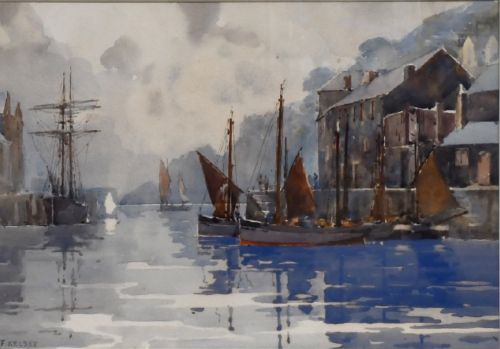


Impressionist Ship Painting
Impressionist ship painting captures maritime motion through loose brushwork, offering buyers a window into historic harbours and coastal scenes from the nineteenth and twentieth centuries.
Impressionist Ship Painting
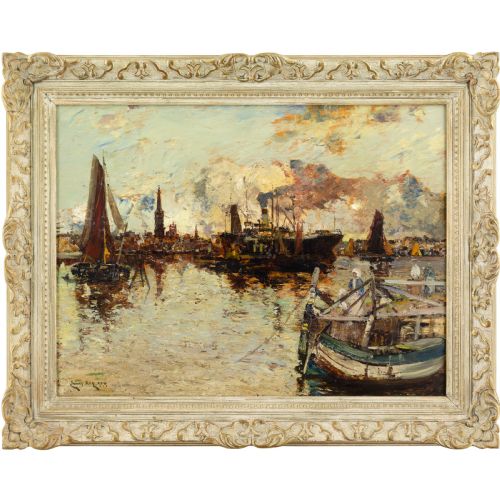
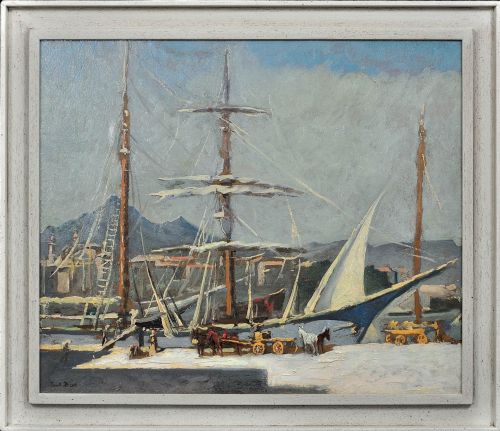
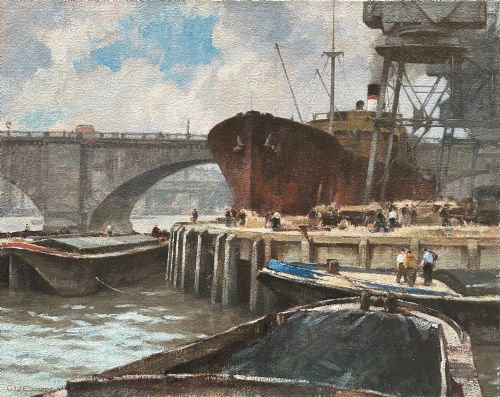
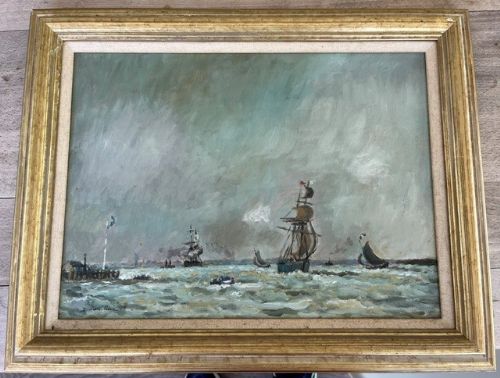
An impressionist ship painting brings together maritime subjects and the atmospheric techniques of British Impressionism, Impressionism, and Post-Impressionism. These works capture harbours, docks, and open waters across periods spanning the nineteenth century, the Edwardian era, and through the 1920s, 1930s, 1950s, and 1960s.
The most common formats you will encounter on this page are oil paintings on canvas or board, alongside occasional watercolours on paper. Subjects range from busy scenes like unloading ships in Palermo harbour to quiet night seascapes and shipyard views in Rye or London.
Materials and methods
Artists executed these works primarily with oil on canvas or oil on board, building texture with viscous pigment applied with brushes or palette knives. Watercolours on paper appear in the selection for lighter, more translucent maritime effects.
Finished works are frequently housed in wooden or gilt wood frames that complement the maritime subject matter. The physical support often includes canvas attached to board or stretched traditional canvas.
Listings feature works from British Impressionism, Scottish Impressionism, and Mid-Century French styles.
Distinctions in quality
The strength of an impressionist ship painting rests in the handling of light on water and the convincing depiction of vessel structures using economical brushstrokes. Works that capture the atmosphere of harbours like Antwerp or Falmouth with confident tonal relationships stand apart.
Framing and preservation also play a role, as original gilt wood frames or stable oil on canvas surfaces maintain the visual integrity of the piece. Signature clarity and documented provenance tie specific works to recognised names in maritime art.
Eugène-Louis Gillot·James Kay RSW·Paul Bret·Cyril Walduck Edwards·Frank Kelsey·Pauwels·Bertram Priestman R.A.·Walter J. Hall·Edward Aubrey Hunt·J.M. Hastings·Henry Scott Tuke·F W Burns
The Impressionist Ship Painting Glossary
- Oil on canvas
- Pigment bound in drying oil applied to a woven fabric support. This traditional method allows for rich texture and blending.
- Watercolour
- A paint consisting of colour suspended in a water-soluble vehicle, typically applied to paper. It yields transparent washes suitable for atmospheric skies and water.
- Gilt wood
- Wood coated with gold leaf or gold paint. Frames utilising this finish are frequently found surrounding marine paintings.
- Maritime Impressionism
- A sub-genre focusing on seascapes, ships, and coastal life rendered through the broken colour and light effects of the impressionist movement.
- Post-Impressionism
- An art movement extending impressionist techniques while emphasising more symbolic content or heavier outlines. Works in this vein show distinct stylistic developments after the core impressionist period.
Impressionist Ship Painting: Frequently Asked Questions
What periods do these paintings cover?
The selection spans from the nineteenth century and the Edwardian period through the 1910s, 1920s, 1930s, 1950s, and 1960s.
Most pieces reflect early to mid-twentieth-century approaches to maritime subjects.
Are all these works oil paintings?
While oil on canvas and oil on board form the majority of the works, watercolours on paper are also present.
Both mediums utilise impressionist techniques to capture light and movement on water.
How were these maritime scenes used?
These paintings were created as fine art wall pieces for domestic and institutional display, recording working ports and coastal vessels.
They served to document busy trade hubs like Southampton and Palermo as well as quiet coastal retreats.
How do I live with an oil painting?
Oil paintings on canvas or board benefit from stable indoor environments away from direct sunlight and extreme humidity fluctuations.
Displaying them in appropriate frames helps protect the edges and surface integrity over time.
Can I identify specific locations in the art?
Many titles and signatures point to real locations such as Antwerp, Palermo, Looe, Littlehampton, Rye, and Falmouth.
Local landmarks and vessel types often provide clues to the exact geographical setting.