



Impressionist Horse Painting
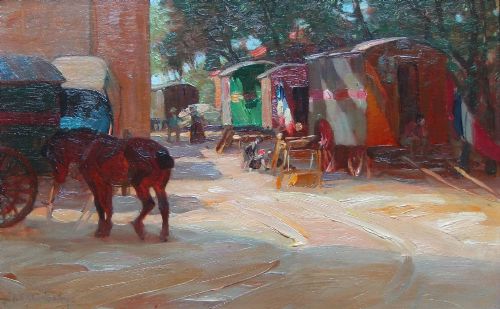
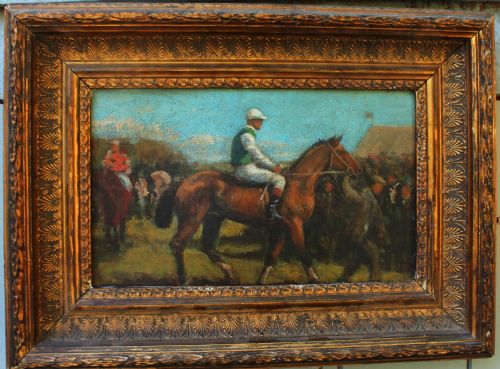
An impressionist horse painting captures the movement and light of working or racing animals through loose brushwork and atmospheric colour.
Impressionist Horse Painting
An impressionist horse painting focuses on equines in pastoral landscapes, stableyards, and urban settings, reflecting the movement and everyday labour of animals during the nineteenth and twentieth centuries. These works emerge from distinct regional traditions including British Impressionism, French Provincial, and the Staithes Group.
The pieces on this page span from the nineteenth century through the mid-twentieth century, capturing subjects like Dartmoor ponies, working carthorses, and race paddocks. Oil on canvas and watercolour on paper form the primary mediums for these compositions.
Materials and technique
Artists built these scenes using oil paint or watercolour applied to canvas, wood panels, or paper supports. The technique relies on rapid brushstrokes and layered pigments rather than tight academic finishes, capturing transient effects of light in fields and city streets.
Framed works utilise timber surrounds that complement the period aesthetic of the paintings, protecting the delicate surfaces of canvas and paper across decades of display.
Periods represented span from the 19th century through the 1960s across British and European schools.
Assessing quality and execution
Quality rests in the sureness of the brushwork and the artist's ability to convey equine anatomy and movement without relying on rigid outlines. Stronger pieces demonstrate confident handling of light and atmosphere, particularly in complex outdoor settings like harvest fields or racecourses.
Compositional balance and the integration of the horse within its surrounding landscape distinguish finer examples from standard decorative studies. The sensitivity with which the artist captures the texture of a coat or the strain of working animals elevates the piece.
Albert Ludovici Jnr·Charles Walter Simpson·Harry Freckleton·Raimond Louis Lecourt·Charles James Lauder·John Atkinson·James William Booth·Arthur Winter Shaw·Eduard Leon Cortes·Herbert Royle·Rowland Henry Hill·Frederick William Jackson·Ernest Higgins Rigg·Maurice Wagermans·J. F. Slater
The Impressionist Horse Painting Glossary
- Impressionism
- A style of painting that emphasises loose brushwork, open composition, and the accurate depiction of light in its changing qualities. This approach allows artists to capture immediate visual impressions rather than detailed realism.
- Watercolour
- A painting method in which the paints are made of pigments suspended in a water-based solution. It is typically applied to paper to create luminous, translucent washes.
- Provenance
- The chronology of the ownership and custody of a historical artwork. Clear documentation helps establish authenticity and historical context.
- Pastoral
- A genre of art depicting rural life and landscapes, often featuring livestock and agricultural labourers. These scenes romanticise country living and farming traditions.
Impressionist Horse Painting: Frequently Asked Questions
What subjects appear in these paintings?
These works feature horses in various settings including agricultural fields, stableyards, and race paddocks, alongside working scenes with carts and ploughs.
The compositions often document rural labour and provincial life across Britain and Europe during the nineteenth and early twentieth centuries.
How do I care for these paintings?
Keep canvas and paper works away from direct sunlight and high humidity to prevent fading and warping of the support materials.
Display them in stable indoor environments and consult a professional conservator for cleaning painted surfaces or repairing antique frames.
How are periods identified?
Dating relies on recorded artist lifespans, stylistic markers of specific regional movements, and framing techniques characteristic of particular decades.
Examine signatures, inscriptions on the reverse, and the material composition of the canvas or paper for clues to the creation date.
Where were these artists active?
The creators worked across diverse regions including British counties like Yorkshire and Devon, alongside French and Belgian provincial locations.
Artists often gathered in regional artists' colonies or urban centres such as Paris and London to paint daily life.