



Impressionist Coastal Watercolour Artwork
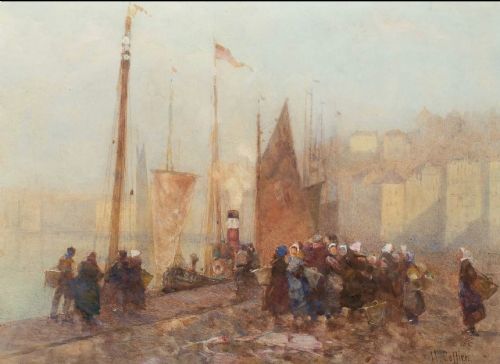
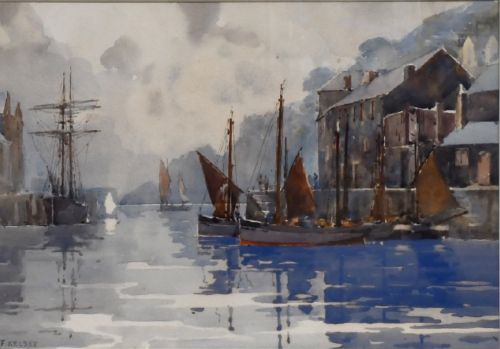
Impressionist coastal watercolour artwork captures maritime scenes through loose brushwork and fluid pigments, bringing historic seaside atmosphere directly into your home.
Impressionist Coastal Watercolour Artwork
When you search for impressionist coastal watercolour artwork, you encounter paintings capturing harbours, fishing fleets, and coastal villages across Britain and continental Europe. These pieces date from the Victorian era and the nineteenth century through to the mid-twentieth century, encompassing periods such as the Edwardian era, nineteen-hundred, nineteen-ten, nineteen-twenty, nineteen-thirty, nineteen-forty, and nineteen-fifty.
The subjects focus heavily on maritime life, featuring bustling ports like St Ives, Whitby, Newlyn, and Boulogne, alongside quiet estuaries and open seas. You regularly meet framed paintings on paper depicting harbour walls, returning fishing boats, and coastal towns under changing light.
Styles range widely across regional traditions and individual approaches, including British Impressionism, Newlyn School associates, and Modern British Impressionism. Artists working in these modes prioritised atmospheric effect and immediate observation over rigid academic detail.
Materials and technique
Artists painted primarily with watercolour pigment upon paper, occasionally combining gouache with watercolour to build opacity and highlights on breaking waves or sails. The porous nature of the paper demanded swift, confident application, as corrections were difficult to achieve once the pigment settled into the fibres.
Makers mounted these works behind glass within timber frames, frequently enclosed by gilt wood moulding that complemented the tones of the composition. The protective glass preserved the delicate water-soluble pigments from atmospheric moisture and dust over decades of display.
The documented paintings record coastal scenes from Cornish harbours to Yorkshire fishing ports, alongside continental European views in France and Italy.
Quality and execution
Quality rests upon the artist's command of medium and light, distinguishing masterly handling of translucent washes from flat or overworked applications. Superior pieces capture the transient movement of water and atmosphere with apparent ease, using minimal brushstrokes to convey complex reflections and cloud formations.
The strength of the composition and the definition of the coastal topography further separate ordinary decorative pieces from works by established regional and national figures. Stronger watercolours demonstrate confident draughtsmanship beneath the pigment, ensuring the architectural elements of harbours and vessels remain structurally convincing.
William Banks Fortescue·Hector Caffieri·Frank Kelsey·William Lee Hankey·Edward Seago·Arthur Tucker·James Watson·Frederick William Hattersley·Sir Herbert Hughes-Stanton·Ernest F Hill·Frederick Stuart Richardson·William Tatton Winter·Ralph Todd·Rowland Henry Hill·Frank Wasley·Hirst Walker·Eugene Boudin·S J Lamorna Birch·Cuthbert Crossley·Robert Leslie Howey·Fred Stead·Charles Eyres Simmons·Edward Aubrey Hunt·Henry Scott Tuke
The Impressionist Coastal Watercolour Artwork Glossary
- Newlyn School
- An artist colony based in Cornwall during the late nineteenth and early twentieth centuries. Painters associated with this group focused on naturalistic depictions of local fisherfolk and coastal life in the open air.
- Gouache
- An opaque watercolour paint made by mixing pigment with a binding agent and adding white filler. Artists utilised this material alongside transparent washes to add solid highlights to water and foam.
- Staithes Group
- A collection of northern artists inspired by French impressionism who worked together in the Yorkshire fishing village. Their paintings emphasised bright palettes and energetic brushwork applied to coastal subjects.
- Wash
- A thin, fluid layer of watercolour pigment spread evenly across the paper to create skies, sea, or atmospheric haze. Mastery of the wash determined the luminous quality of the finished painting.
Impressionist Coastal Watercolour Artwork: Frequently Asked Questions
How should I frame and hang antique watercolours?
Keep watercolours out of direct sunlight to prevent the pigments from fading over time. Use conservation-grade mounts and glass that blocks ultraviolet radiation.
Ensure they hang on interior walls away from damp spaces like kitchens or unventilated bathrooms. Proper framing protects the delicate paper from humidity fluctuations.
How do I distinguish between Victorian and mid-century coastal watercolours?
Victorian watercolours often employ tighter detail, heavier framing styles, and narrative elements focusing on the daily toil of fisherfolk. The palette tends towards restrained, earthy tones.
Mid-century pieces, including those from the nineteen-thirties and nineteen-fifties, generally feature looser brushwork and bolder use of unpainted paper. The focus shifts towards pure atmospheric effect and simplified coastal forms.
What is the difference between British Impressionism and French Impressionism?
British Impressionism retained a stronger attachment to narrative subject matter and tonal harmony, particularly in coastal and rural landscapes. Artists often balanced modern brush techniques with traditional British watercolour methods.
French Impressionism pushed further into pure optical experiments with light and unblended colour. British practitioners adapted these ideas at a more measured pace, maintaining recognizable local topography.
Why are so many of these watercolours painted in Yorkshire and Cornwall?
Coastal villages like St Ives, Newlyn, Whitby, and Staithes offered affordable living, dramatic scenery, and vibrant maritime communities that attracted artists seeking plein-air subjects. The bustling fishing ports provided endless scenes of boats, tides, and working life.
These regions developed dedicated artist colonies and schools, drawing painters who influenced one another. The distinct light and rugged topography made them enduring hubs for marine art.