
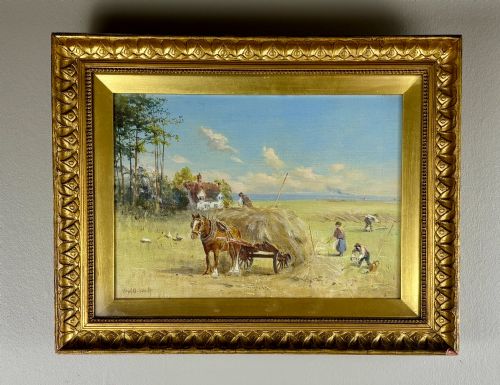


Impressionist Agricultural Art
Impressionist agricultural art captures rural labour and harvest scenes through loose brushwork and natural light, offering a window into early twentieth-century farming life.
Impressionist Agricultural Art
Impressionist agricultural art represents rural working life, focusing predominantly on haymaking, harvesting, and farm hands at work. When searching for impressionist agricultural art, buyers encounter pastoral oil paintings and watercolours that record early twentieth-century country scenes.
The pieces on this page span the nineteenth century through to the nineteen-thirties, encompassing British Impressionism and French Provincial traditions. Subjects range from working horses at troughs to figures gathered in fields during hay time.
Most works adopt landscape formats to emphasise wide skies and open fields. These paintings document traditional agricultural labour before mechanisation altered the rural landscape permanently.
Materials and methods
Artists painted primarily with oil paint on canvas or watercolour on paper, applying pigments with visible, expressive brushstrokes. Wood panels also support oil compositions, providing a rigid surface for thicker paint application.
Watercolours utilise fluid washes to capture atmospheric light over fields and hayricks, while oil works build texture through layered paint. Framing historically accompanies many of these canvases, often utilising French Provincial or period wooden mouldings.
Several canvases immortalise horses pausing mid-labour at water troughs.
Assessing quality
Quality rests in the artist's ability to render light and movement within agricultural scenes rather than strict photographic detail. Superior brushwork creates a convincing sense of atmosphere, wind, and heat during harvest tasks.
Compositional strength dictates the visual success of each piece, distinguishing hurried sketches from fully realised paintings. Stronger works balance human figures and working horses harmoniously within the broader landscape.
Raimond Louis Lecourt·Herbert Royle·John Atkinson·James William Booth·George Soper·Arthur Winter Shaw·Rowland Henry Hill·Frederick William Jackson·Ernest Higgins Rigg·Owen Bowen·George Graham·William Kay Blacklock
The Impressionist Agricultural Art Glossary
- Impressionism
- A nineteenth-century painting style focused on capturing the visual impression of a moment, especially regarding shifting light. It relies on unblended brushstrokes and bright colour palettes.
- Watercolour
- A painting method where water-soluble pigments are suspended in a water-based solution on paper. It creates luminous, translucent washes.
- Oil painting
- A medium consisting of pigments suspended in drying oils, valued for its rich colour depth and versatility. It allows for both smooth blending and thick impasto textures.
- French Provincial
- A style originating from regional France, frequently associated with rustic yet refined decorative arts and framing. It reflects traditional countryside aesthetics.
- Hayrick
- A large stack of hay piled in the open air to dry and cure. This agricultural structure appears frequently as a central motif in rural landscape art.
Impressionist Agricultural Art: Frequently Asked Questions
What subjects appear in these paintings?
These artworks depict rural labour, including hay cutting, harvesting, milking time, and working horses in fields.
Scenes focus on the daily rhythms of farm life across British and French countryside locations.
Which materials were used?
Artists worked primarily with oil paint on canvas or watercolour on paper. Some compositions utilise wood as a painting support.
Frames are typically constructed from wood, matching the period aesthetic of the artwork.
How do I date these works?
Dates range from the nineteenth century through the nineteen-thirties, encompassing Edwardian and early twentieth-century periods.
Stylistic markers and artist signatures often help narrow down the exact decade of production.
How should I display them?
Paintings look best hung in well-lit spaces away from direct sunlight to protect pigments from fading over time.
Matching the frame style to your interior decor helps integrate these historic rural scenes into modern homes.