


Horse Cart Landscape Picture
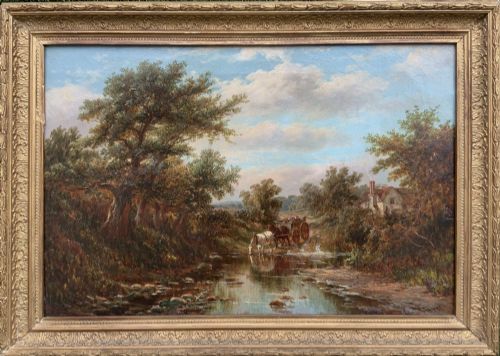
These horse cart landscape picture examples capture rural labour and scenic views across Victorian and Edwardian Britain.
Horse Cart Landscape Picture
A horse cart landscape picture portrays rural scenes featuring horses and carts within traditional countryside settings, spanning the nineteenth and early twentieth centuries. Buyers seeking this subject matter encounter works executed in watercolour, oil on canvas, and gouache by named British and Italian artists. The pieces range from coastal lowtides to inland harvest fields and village markets.
Most examples date from the Victorian and Edwardian eras, reflecting pastoral themes popular during those periods. Common compositions include figures hauling seaweed, crossing fords, or loading hay into carts under various atmospheric conditions.
Framed paintings dominate the selection, often preserved behind glass within original wood and gilt frames. These artworks document agricultural practices and rural topography through the eyes of artists working between eighteen eighty and nineteen thirty.
Materials and methods
Artists painted these subjects primarily on paper using watercolour or gouache, or applied oil paint directly onto canvas. Watercolour pigments rely on water-soluble binders to achieve transparent washes, while oil paints utilise slow-drying linseed oil vehicles that allow for rich blending and textured brushwork.
Framing forms an integral part of the presentation, utilising wood substrates supplemented by gold leaf and gilt wood mouldings. Glazing protects works on paper from atmospheric moisture and handling damage within wooden frames.
Farmers load carts under stormy skies, near castle walls, and during wartime.
Distinctions in execution
The preservation of the pigment and the originality of the frame contribute significantly to the standing of a piece. Works retaining their period wooden and gilt frames maintain a more cohesive historical integrity than those housed in later replacements.
George Hamilton Constantine·Charles H Poingdestre·Walter Duncan·George Turner·Frank Saltfleet·William Kay Blacklock·Alfred George Stevens·John Baragwanath King·Reginald Mills·Robert Thorne Waite·JE Hood·Lois Wilton
The Horse Cart Landscape Picture Glossary
- Watercolour
- A painting method in which the paints are made of pigments suspended in a water-based solution. These works typically require framing under glass to protect the delicate paper surface.
- Oil on Canvas
- A medium utilising pigments mixed with an oil binder applied to a stretched woven fabric support. This technique permits deep colour saturation and reworked surface textures.
- Gouache
- An opaque water-based paint medium that includes a white pigment filler, producing a heavier and more solid colour block than traditional watercolour. It appears frequently in early twentieth-century works on paper.
- Gilt Wood
- Wood carved and coated with a thin layer of gold leaf or metallic gold paint. It provides traditional decorative framing for nineteenth-century fine art.
- Pastoral
- A genre of art depicting the rural life of shepherds and agricultural labourers in idealized or natural settings. This style underpins many harvest and market cart scenes.
Horse Cart Landscape Picture: Frequently Asked Questions
What periods do these paintings come from?
The available works originate from the late nineteenth century through to the early twentieth century, spanning the Victorian and Edwardian eras. Painters active during this timeframe recorded traditional rural practices using established academic methods.
Dates associated with these pieces typically range from eighteen eighty to nineteen thirty, reflecting the height of British pastoral and watercolour traditions.
How should I display a watercolour safely?
Watercolour paintings require protection from direct sunlight to prevent fading of the pigments on paper. Displaying them away from moisture-prone areas preserves the integrity of both the paper and the wooden frame.
Glazed frames provide a barrier against dust and airborne pollutants, ensuring the delicate paint layers remain undisturbed over time.
What subjects appear in these landscapes?
Common subjects include agricultural activities such as harvest time, hay meadow loading, and seaweed gathering along coastal shores. Figures and horse-drawn carts serve as focal points within broader rural vistas.
Scenes also depict river fords, village markets, and castle backdrops, capturing everyday working life in the British countryside.
Are these works original period pieces?
The inventory consists of original paintings created during the nineteenth and early twentieth centuries rather than modern reproductions. Materials such as traditional paper, canvas, and period wooden frames corroborate their age.
Signatures, dates, and historical records linked to the named artists confirm the authenticity of individual works.