

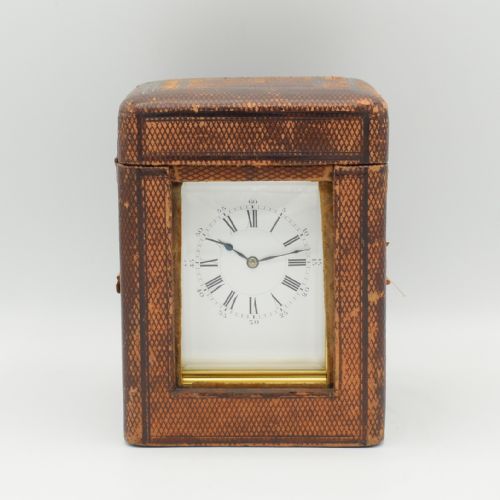


Horological Travel Clock
A horological travel clock is a portable timepiece designed for the journey, offering mechanical precision enclosed in robust brass and glass.
Horological Travel Clock
A horological travel clock encompasses portable mechanical timepieces housed in protective metal and glass cases, frequently termed carriage clocks or desk clocks. When you search for a horological travel clock, you encounter pieces originating from Victorian, Edwardian, and mid-twentieth-century eras, spanning French workshops and Swiss makers.
The most common examples on this page are French brass carriage clocks, often featuring enamel dials and accompanying leather travel cases. These vary from simple timepieces to complex pieces with alarms, repeating mechanisms, and grand sonnerie strikes.
Stylistic expressions range from plain nineteenth-century brass designs to gorge cases and Georgian revival interpretations. Collectors also find more unusual forms, including elliptical dials and large silver-cased versions.
Construction and materials
Makers constructed these clocks using heavy brass and gilt bronze frameworks inset with bevelled glass panels to protect the delicate mechanical movement within. Steel components form the gear trains and springs, while white enamel provides a legible ground for the clock face.
Outer protection often involved stiff leather outer cases fitted to the exact dimensions of the brass frame for transport. Finer examples integrated intricate engraved masks around the enamel dial and decorative cast mouldings on the top and side panels.
Horological Travel Clock Retail Price Guide 2026
Typical asking prices for horological travel clock among the pieces listed under this phrase on Sellingantiques today, from the lower quarter to the upper quarter. They describe what is for sale here now, not the wider market.
Some travel clocks feature patent alarms designed to wake Victorian sleepers while swaying gently in a carriage.
Distinctions in quality
Quality rests upon the complexity of the movement and the reputation of the maker inscribed on the backplate or dial. Pieces with repeating functions, alarms, or grand sonnerie strikes represent a higher tier of horological achievement than basic timepieces.
The crispness of the gilt brass casting and the retention of the original leather travel case elevate an example's desirability. Restored movements and panels alter the original state, whereas untouched signed works by known Parisian horologists command greater interest.
Henri Jacot·Antoine Redier·Brunelot·Drocourt·Holingue·L Epee
The Horological Travel Clock Glossary
- Carriage clock
- A portable spring-driven clock designed for travellers, featuring a rectangular brass case with glass panels and a swing handle. They originated in France during the nineteenth century.
- Gorge case
- A specific style of carriage clock case characterised by stepped mouldings to the top and base. This design is robust and typical of finer nineteenth-century production.
- Grand sonnerie
- A striking mechanism that chimes the hours and the quarters automatically on every quarter hour. It represents a high level of mechanical complexity.
- Repeater
- A mechanism that chimes the last hour or quarter when a button or pendant is pressed. This allowed owners to check the time in the dark.
- Enamel dial
- A clock face made by fusing powdered glass to a metal substrate at high heat. This creates a glossy, durable surface that resists fading.
Horological Travel Clock: Frequently Asked Questions
What is a carriage clock?
A carriage clock is a small, spring-driven mechanical clock designed to be transported easily. They typically feature brass and glass cases with swinging handles on top.
Originally built for officers and travellers in the nineteenth century, they allowed people to carry accurate timekeeping with them on journeys.
How do repeating mechanisms work?
A repeating mechanism sounds the time on gongs or bells when a small lever or button is pressed on the case. This allowed the owner to hear the hour during the night without striking a light.
Clocks with this feature contain extra gear trains and hammers inside the movement.
Are these clocks suitable for daily use?
These mechanical clocks require regular winding and occasional professional servicing to keep accurate time. Many owners run them on desks or mantelpieces rather than carrying them on travels today.
Handling them with care ensures the delicate gear trains and glass panels remain protected.
How do I identify the period?
Stylistic details, case shapes, and maker signatures help date a clock to specific periods like the Victorian or Edwardian eras. Simpler brass frames often indicate earlier nineteenth-century work, while decorative masks and dial layouts provide further clues.
Signatures on the backplate link pieces to documented French and Swiss makers active in specific decades.