
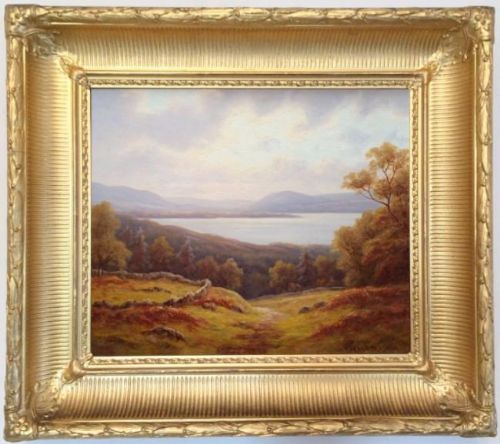


Highland Loch Oil Painting
These highland loch oil painting works capture the vast water and heather of Scotland through nineteenth and twentieth century brushwork.
Highland Loch Oil Painting
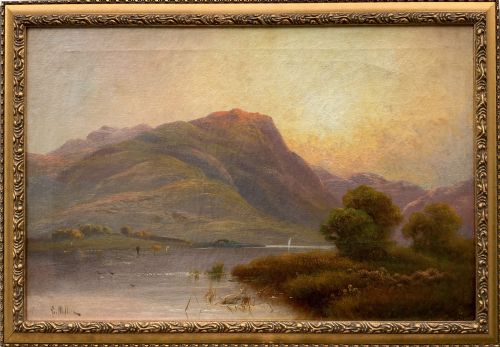
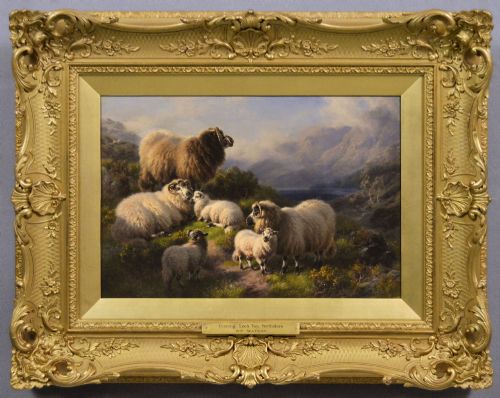
A highland loch oil painting typically presents a wide Scottish lake bounded by mountains, frequently populated by Highland cattle, sheep, stags, or stone bothies. These works emerge predominantly from the Victorian period through to the mid-twentieth century, capturing shifting mists and sunset light over the water.
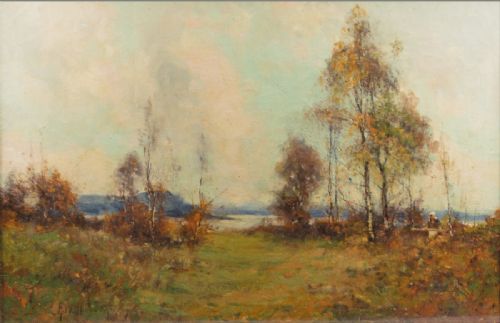
The compositions on this page lean heavily into Scottish Romanticism, Scottish Impressionism, and Victorian Landscape Realism. Buyers encounter named locations such as Loch Tay, Loch Lomond, Loch Etive, and Loch Ness rendered across canvases of varying scales.
Most examples date from the nineteenth century up to the nineteen fifties, reflecting an era when artists travelled north to record the dramatic topography of the Highlands. The standard format involves oil paint applied to canvas, often retained within its period frame.
Materials and Technique
Artists built these scenes using oil paint applied to woven canvas or, occasionally, wood boards. The medium allowed for rich blending of atmospheric light, capturing morning mists and deep evening shadows across the water.
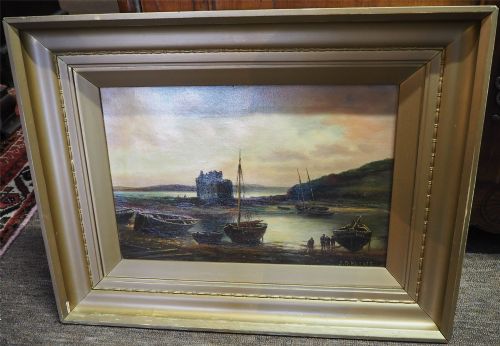
Frames play a structural role in the presentation of these works, utilising carved wood finished with gesso and gilt. These heavy period frames often match the age of the canvas, completing the composition.
Listings feature oil on canvas and wood supports framed in gesso and giltwood, spanning the Victorian period to nineteen fifty.
Evaluating Quality
Quality rests upon the artist's handling of light and atmospheric depth, distinguishing a competent studio record from a masterwork of Scottish landscape painting. The articulation of water reflections and the natural rendering of cattle or sheep add significant weight to the piece.
The condition of the oil paint and the originality of the canvas support higher distinction. Surviving in original, untouched gesso and giltwood frames further elevates the standing of the work.
William Watson Jnr·Alexander Wellwood Rattray·Everett Watson Mellor·Henry Robinson Hall·Henry Hillier Parker·William Miller Frazer·Daniel Sherrin·Alfred de Breanski Snr·George Cole·George Melvin Rennie·F. E. Jamieson
The Highland Loch Oil Painting Glossary
- Gesso
- A plaster-like mixture applied to wood frames before gilding. It provides a smooth base for intricate moulded decoration.
- Giltwood
- Wood that has been coated with gold leaf or a gold-coloured finish. This material defines the ornate frames typical of the period.
- Board
- A rigid flat panel used as a support for painting instead of stretched canvas. Artists occasionally utilised these for smaller field studies.
- Scottish Romanticism
- An artistic movement focusing on the sublime power of nature. It inspired dramatic portrayals of rugged lochs and mountains.
Highland Loch Oil Painting: Frequently Asked Questions
What periods do these paintings come from?
The works span from the Victorian era through the early twentieth century, with many pieces dated between eighteen eighty and nineteen fifty. This reflects the height of British landscape realism and Scottish romantic painting.
Artists during this timeframe repeatedly returned to the Highlands to document the lochs, translating the changing atmospheric conditions onto canvas using traditional oil techniques.
Which specific lochs appear in these works?
The listings frequently feature celebrated Scottish bodies of water including Loch Tay, Loch Lomond, Loch Etive, and Loch Ness. Painters also recorded remote bothies and surrounding mountain peaks such as Ben Lawers.
These locations served as primary subjects for artists associated with the Highland School and Scottish Impressionism, who sought out dramatic vistas.
How should I hang and care for an oil painting?
Keep the canvas away from direct sunlight and fluctuating humidity to protect the oil paint and underlying gesso and giltwood frames. Stable indoor environments preserve the integrity of both the canvas and the historical frame.
Allow sufficient wall space for the heavier, ornate frames typical of nineteenth-century landscape art, ensuring adequate support for their weight.
How do I identify the artist?
Signatures typically appear in the lower corners of the canvas, sometimes accompanied by dates or location inscriptions on the reverse. Researching the recorded exhibition history or stylistic traits helps confirm attribution.
Comparing brushwork, treatment of cattle, and handling of loch reflections against known examples by painters from the period provides further clarity.