
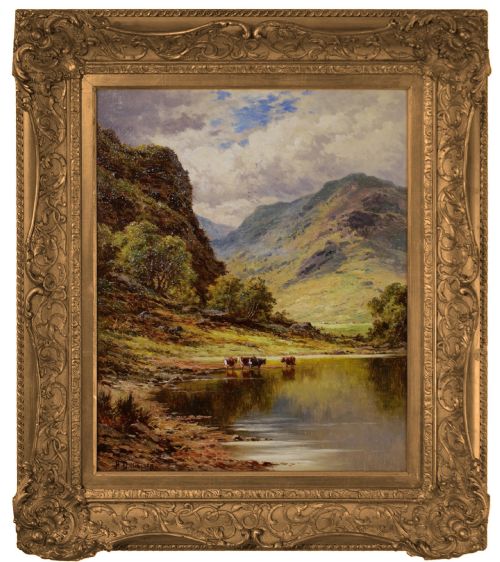
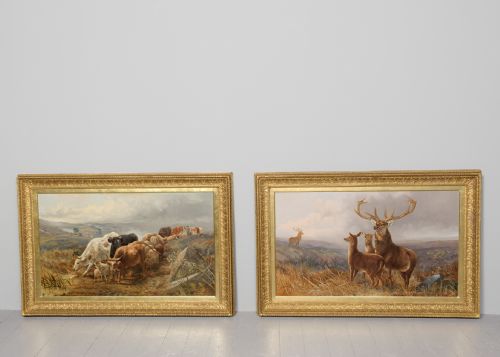


Highland Cattle Wall Art
These highland cattle wall art pieces capture the romance of Victorian and Edwardian Scottish landscapes, offering a window into traditional pastoral life that collectors prize for their atmospheric depth.
Highland Cattle Wall Art
When you search for highland cattle wall art, you encounter oil paintings, fine art paintings, and porcelain wall plaques spanning the Victorian and Edwardian eras. These works typically depict mountainous Scottish river landscapes, lochs at sunset, and pastoral scenes featuring cattle and sheep.
The pieces represented here originate from the late nineteenth and early twentieth centuries, capturing the artistic output of the Highland School and nineteenth century British realism. The forms range from large canvas paintings framed in giltwood to delicate hand-painted porcelain plaques.
You are most likely to meet traditional British oil paintings on canvas depicting misty lochs and shaggy cattle resting in remote glens. These enduringly popular subjects reflect a distinct historical appetite for romanticised Scottish scenery.
How They Were Made
The predominant technique relies on oil paint applied to canvas, capturing rich textures in both the landscape and the dense coats of the cattle. Artists utilised layered glazes to create the atmospheric lighting characteristic of sunset scenes over Scottish lochs.
Many of these works are housed in their original heavy giltwood and gesso frames, which utilise moulded ornamentation to complement the scale of the paintings. Alternative forms, such as the porcelain wall plaques, involve fine ceramic painting under glass.
The construction of these pieces combines traditional canvas stretching and framing with skilled brushwork, demonstrating the craftsmanship typical of Victorian and Edwardian fine art studios.
Shaggy Highland cattle peer patiently from these canvases, seemingly unfazed by the dramatic Scottish weather unfolding around them.
What Varies in Quality
The distinction between standard works and exceptional pieces often rests upon the handling of light, atmosphere, and anatomical precision in the depiction of the cattle. Master artists achieved a palpable sense of weather and moisture in the air that lesser hands missed.
The preservation of the original canvas, oil paint, and giltwood frame strongly influences the integrity of a piece. Finer examples retain their original surface tension and frame gilding without excessive intervention or overpainting.
Scale and composition also dictate standing, with larger, more expansive landscape views commanding greater visual presence than smaller, formulaic studies.
Henry H. Parker·Robert Cleminson·Sidney Yates Johnson·Alfred de Breanski Snr·Milton Drinkwater·Charles Jones·Sidney Richard Percy·Royal Worcester·John W Morris
The Highland Cattle Wall Art Glossary
- Giltwood
- Wood that has been coated with gold leaf or a gold-coloured metallic finish. It forms the decorative border of many traditional picture frames.
- Gesso
- A plaster-like mixture applied to wood frames as a base for moulding and gilding. It allows for intricate relief ornamentation.
- Oil on Canvas
- Pigments bound in an oil medium and painted upon a stretched woven fabric support. This combination offers durability and rich colour depth.
- Highland School
- A regional grouping of artists focused on Scottish landscapes and rural life during the nineteenth century. Their work defined the visual tropes of the Highlands.
- Wall Plaque
- A decorative flat panel designed to be hung directly on a wall. In this context, they are frequently executed in fine porcelain.
Highland Cattle Wall Art: Frequently Asked Questions
What periods do these pieces date from?
The listings span the Victorian and Edwardian eras, with dates ranging from eighteen sixty through to nineteen twenty. This period represents the height of popularity for British realism and pastoral landscape painting.
Most works cluster around the late nineteenth century, reflecting the active years of the Highland School and its prominent painters.
How should I hang heavy giltwood frames?
These substantial frames require secure picture hooks fixed directly into wall studs or masonry using appropriate fixings. Their weight demands robust support rather than standard picture wire on single plaster pins.
Ensure the hanging height allows the painting to be viewed comfortably at eye level, taking into account the natural light in your room.
Are porcelain plaques fragile?
Porcelain wall plaques are rigid and less prone to canvas sagging, but the ceramic body remains vulnerable to sharp impacts. They are best displayed away from busy walkways where they might be accidentally struck.
Cleaning requires only a gentle dusting with a soft, dry brush to protect the delicate painted surface.
How do I identify a Victorian landscape?
Victorian landscapes typically feature romanticised lighting, dramatic weather over lochs, and detailed realism in flora and fauna. The palette often relies on earthy tones contrasted with warm sunset glows.
Signatures, framing styles, and canvas stamps further help confirm the nineteenth-century origins of the artwork.