
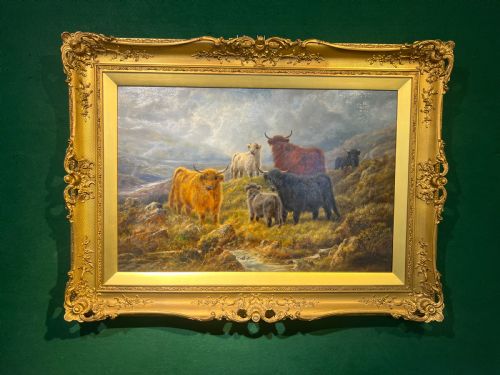
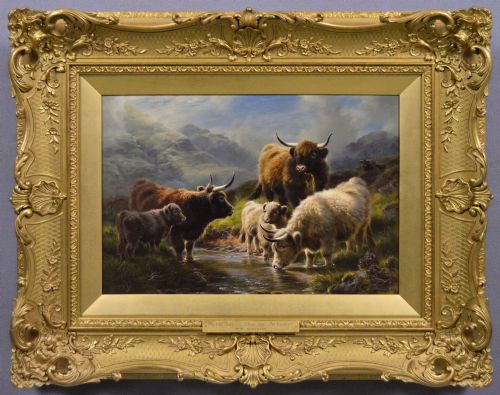
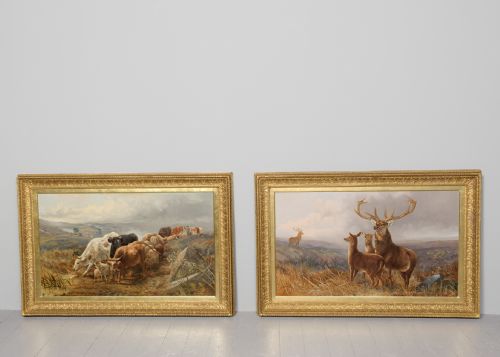


Highland Cattle Artwork Framed
These highland cattle artwork framed pieces bring the dramatic scale of nineteenth-century Scottish pastoral life directly onto your wall.
Highland Cattle Artwork Framed
Highland cattle artwork framed presents traditional British landscapes dominated by longhorned cattle set against lochs, glens, and mountainous backdrops. You will encounter nineteenth-century oil paintings on canvas alongside occasional gouache and watercolour examples from the Victorian and Edwardian eras.
The dominant forms are oil paintings rendered by British artists who specialised in Victorian pastoral and landscape realism. These works frequently depict specific locations such as Loch Tay, Loch Etive, and Ben Lawers under morning mists or evening light.
Most compositions date from the Victorian period through to the early twentieth century, spanning decades from eighteen-sixty to nineteen-twenty. They reflect a nineteenth-century fascination with Scottish scenery and robust rural livestock.
Materials and Technique
Artists painted primarily with oil paint on canvas, building texture and depth to capture the shaggy coats of the cattle and the shifting atmospheric conditions of the highlands. Some works employ gouache or watercolour on paper.
Original framing is an integral part of these pieces, utilising wood structures ornamented with gesso, plaster, and gold leaf. These heavy giltwood frames often match the grand scale and romanticism of the paintings they enclose.
Several canvases capture cattle standing unbothered in deep winter snow, proving that highland beasts possessed true grit.
Quality Variations
The calibre of a piece rests heavily on the fidelity of the animal rendering and the atmospheric depth of the surrounding landscape. Master hands manage light, shadow, and moisture in the air with a convincing realism that lesser brushwork misses.
Frame construction also dictates overall quality, as original gesso and giltwood mouldings that retain their crisp ornament elevate the piece significantly. Pieces featuring well-preserved frames alongside signed canvases by established artists stand at the upper end of the range.
Robert Watson·William Watson Jnr·Robert Cleminson·Henry Robinson Hall·Henry Hillier Parker·Sidney Yates Johnson·Sidney Pike·Charles Jones·George Turner·John W Morris·Daniel Sherrin·Alfred de Breanski Snr·Gustave De Brianski·Henry Birtles·Milton Drinkwater·Louis Bosworth Hurt·Aster Richard Chilton Corbould·Sidney Richard Percy
The Highland Cattle Artwork Framed Glossary
- Giltwood
- Wood carved and coated with gold leaf. This material forms the ornate frames typical of Victorian fine art.
- Gesso
- A plaster-like mixture applied to wood frames and moulded into relief decoration. It provides the base for gilding.
- Pastoral
- A genre of art depicting rural life and domesticated animals in natural landscapes. These scenes romanticise traditional farming and highland environments.
- Realism
- An artistic movement focused on depicting subjects truthfully without artificiality. In these works, cattle and terrain appear as observed in nature.
Highland Cattle Artwork Framed: Frequently Asked Questions
How do I date these oil paintings?
Dating relies on stylistic clues, artist signatures, and framing methods typical of the Victorian and Edwardian eras. Painters often inscribed their names and dates directly onto the canvas or stretcher bars.
Period markers include the heavy use of giltwood gesso frames and the specific romantic realism favoured by British landscape artists between eighteen-sixty and nineteen-twenty.
Where should I hang these large frames?
These substantial oil paintings require robust wall fixings due to the weight of the wood, gesso, and giltwood construction. They anchor a room best when given adequate wall space above a mantelpiece or principal piece of furniture.
Keep them away from direct sunlight and damp environments to protect both the oil paint on canvas and the delicate gold leaf on the frame.
What do the loch backgrounds signify?
Specific Scottish bodies of water like Loch Tay, Loch Etive, and Loch Lubnaig appear frequently to anchor the rural scenes in actual geography. Artists travelled north to capture the dramatic mists and mountainous light unique to these regions.
These topographical details transformed simple livestock paintings into celebrated representations of British landscape realism.
Are sheep common in these scenes?
Sheep frequently accompany highland cattle in pastoral compositions, grazing alongside the longhorns in glens and snow-covered valleys. Artists grouped these animals together to emphasise the working livestock of nineteenth-century rural Scotland.
Such mixed-animal compositions showcase the artist's ability to render varied textures of wool, fur, and hair within a single landscape.