
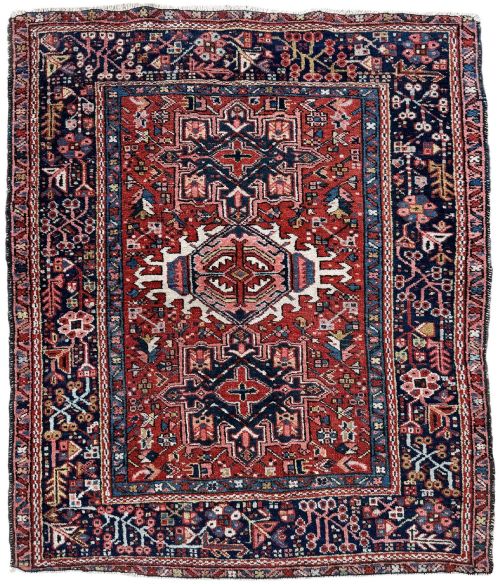


Heriz Style Wool Rug
A heriz style wool rug brings bold geometric motifs and rich regional palettes into a room, grounded in Northwest Persian weaving traditions.
Heriz Style Wool Rug
A heriz style wool rug represents the substantial woven floor coverings originating from Northwest Persia, often spanning the late nineteenth century and the early decades of the twentieth century. These pieces appear primarily as large carpets, square formats, hallway runners, and smaller village rugs such as bag faces.
Buyers encounter regional variations grouped within this aesthetic, including pieces attributed specifically to Heriz, Gorevan, Karaja, Bakshaish, and Sarab. The designs range from large-scale geometric medallion layouts to all-over patterns and village room formats.
The selection reflects traditional Persian tribal and town production, capturing the robust character of Northwest Persian weaving. Pieces date from the nineteenth century through to the 1930s, showing diverse dimensions from compact mats to oversized carpets.
How they were made
These textiles rely on a foundation of cotton warps and wefts supporting a dense hand-knotted wool pile. The materials are worked by hand to create durable floor coverings designed for heavy use in country houses and town residences.
Weavers in Northwest Persian districts employed symmetric knots on cotton foundations, utilising durable local wool for the pile. Natural dyes yielded the characteristic saturated reds, deep indigos, and warm earth tones typical of the period.
Listings span periods from the nineteenth century to the 1930s, featuring wool, cotton, and hand-knotted wool materials in runner, rug, and carpet formats.
What varies in quality
Quality rests upon the fineness of the knotting and the precision of the geometric drawing across the field. Tighter knot density allows for crisper articulation of medallions and sharper botanical motifs.
The choice of wool and the depth of the palette determine the tactile presence and visual resonance of the piece. Superior examples maintain balanced proportions in large formats and preserve the integrity of the original dyes.
The Heriz Style Wool Rug Glossary
- Heriz style wool rug
- A floor covering featuring the geometric medallion layouts and robust palettes associated with the Heriz region of Northwest Persia.
- Bag face
- The functional front panel of a tribal nomadic storage bag, woven in rug technique and preserved as a small decorative hanging or mat.
- Runner
- A long, narrow carpet format traditionally utilised in hallways, corridors, and narrow passageways.
- Medallion
- A large central ornamental design motif placed symmetrically in the middle of the rug field.
Heriz Style Wool Rug: Frequently Asked Questions
Where were these rugs made?
These pieces originate from the Northwest region of Persia, encompassing specific weaving districts and villages such as Heriz, Karaja, Bakshaish, and Sarab.
Production centres in this area developed distinct geometric styles that differ from the curved floral designs of central Persian urban workshops.
How do I place a runner?
Runners suit narrow spaces such as hallways, corridors, and gallery landings where length predominates over width.
Their linear formats help guide movement through a home while protecting timber or stone floors in high-traffic areas.
What is a bag face?
A bag face is the decorative front portion of a nomadic storage sack that was cut and preserved after the utilitarian rear backing wore away.
These smaller textile formats allow collectors to enjoy village weaving and tribal designs on a scale suitable for compact spaces.
How do I distinguish regional types?
Distinctions rely on structural traits, wool texture, and specific variations in the geometric drawing of the field and central medallions.
Village pieces from sources like Bakshaish or Karaja often display looser, more whimsical interpretations compared to formal town carpets.