
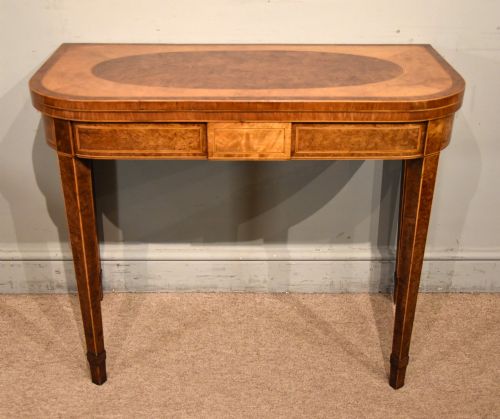
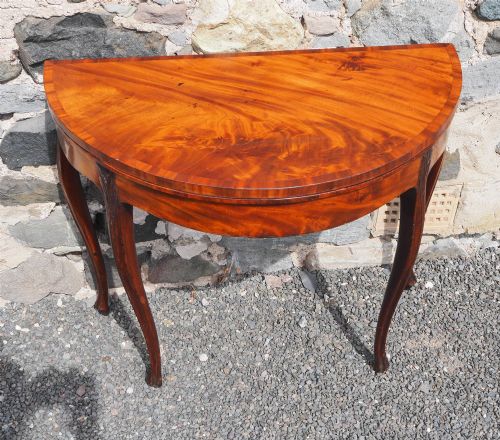
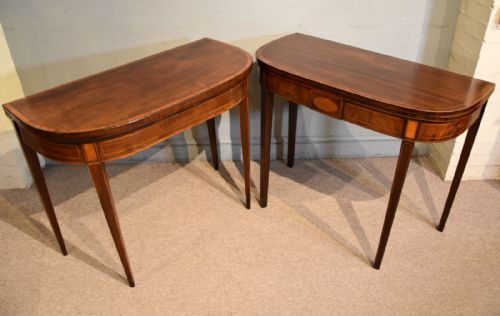

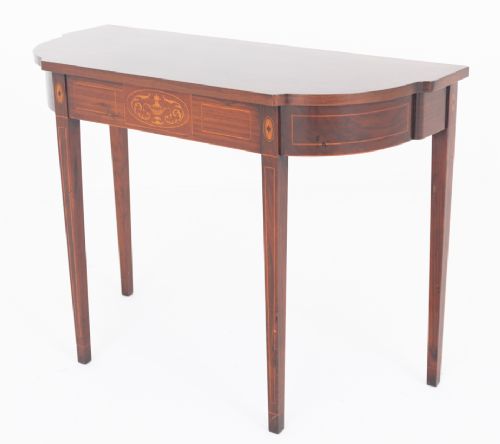

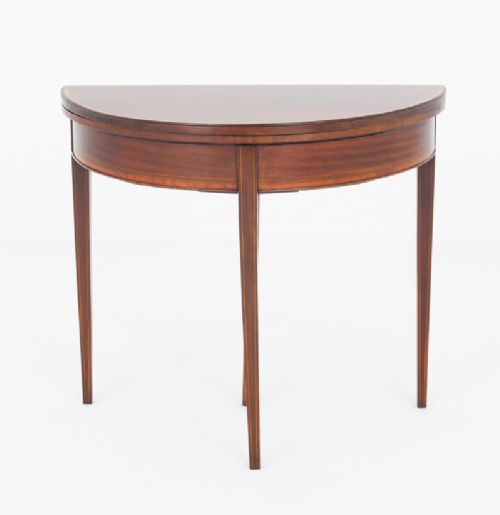


Hepplewhite Style Card Table
A hepplewhite style card table brings architectural grace to a room, offering fold-over surfaces designed for eighteenth-century entertainment.
Hepplewhite Style Card Table
A hepplewhite style card table is primarily encountered in mahogany and satinwood, spanning original Georgian production through to later Edwardian revivals. These dual-purpose items function as console tables against a wall before unfolding to reveal baize-lined surfaces for card games.
The form encompasses demi-lune, serpentine, and rectangular profiles, often incorporating geometric or floral inlay. Pieces range from genuine eighteenth-century examples to revival interpretations made around nineteen hundred.
Makers and cabinetmakers produced these furnishings to adapt to changing domestic interiors, creating versatile occasional pieces that serve as games tables or tea tables.
Materials and construction
Construction relies upon solid timber frames faced with veneers such as flame mahogany, burr yew, and satinwood, contrasted with delicate boxwood stringing. Timber selection dictates the visual depth of the top, while secondary woods provide structural integrity beneath.
Inlay and crossbanding require precise hand-cutting to fit contrasting species into shaped tabletops and friezes. Joinery connects tapered legs to the frame, frequently utilising hinges that allow the folding top to rotate and rest securely when open.
Hepplewhite Style Card Table Retail Price Guide 2026
Typical asking prices for hepplewhite style card table among the pieces listed under this phrase on Sellingantiques today, from the lower quarter to the upper quarter. They describe what is for sale here now, not the wider market.
Listings demonstrate a split between original Georgian pieces and Edwardian revivals utilising mahogany, satinwood, and burr yew.
Distinctions in craftsmanship
Quality rests in the choice and matching of veneers, particularly where flame mahogany or satinwood wraps symmetrically across the fold-over top. The crispness of inlaid stringing and the depth of carving on legs or friezes separate standard production from superior workshops.
Proportion and the integrity of the pivoting mechanism determine the structural success of the table. Examples featuring carefully selected burr yew or elaborate marquetry display a higher degree of artisan investment.
The Hepplewhite Style Card Table Glossary
- Demi-lune
- Having the shape of a half-moon. This curved profile is characteristic of many card and console tables designed to sit flush against a wall.
- Boxwood
- A pale, dense wood utilised for contrasting inlay and stringing lines on mahogany and satinwood furniture. Its fine grain permits intricate geometric patterns.
- Crossbanding
- A strip of veneer applied to the border of a tabletop with the grain running perpendicular to the centre panel. This technique frames the primary wood.
- Serpentine
- Having a gently undulating outline with convex centres flanked by concave curves. This contour appears on the front edges of finer tables.
Hepplewhite Style Card Table: Frequently Asked Questions
How do I use a card table today?
These tables function well as console pieces in hallways or living rooms when closed, positioned against a wall with decorative objects on top.
When guests arrive, the hinged top unfolds to create a stable surface for games, writing, or serving drinks.
How do I distinguish eighteenth century from revival pieces?
Examining the timber characteristics, secondary woods, and construction marks helps determine the period of manufacture.
Eighteenth-century examples display distinct hand-tooling and patination, whereas revival pieces from nineteen hundred often reveal later machining and standardised hardware.
What is the difference between a card table and a tea table?
While many forms served multiple domestic functions, card tables typically incorporate internal compartments for counters or feature baize-lined playing surfaces.
Tea tables focus on plain wooden tops intended for porcelain service, though cabinetmakers frequently utilised similar demi-lune and serpentine frames for both.
How do I care for satinwood and mahogany veneers?
Protecting these surfaces requires avoiding direct sunlight and maintaining stable room humidity to prevent veneer lifting or timber splitting.
Regular dusting with a dry, soft cloth preserves the polish without introducing moisture that harms historic finishes.