

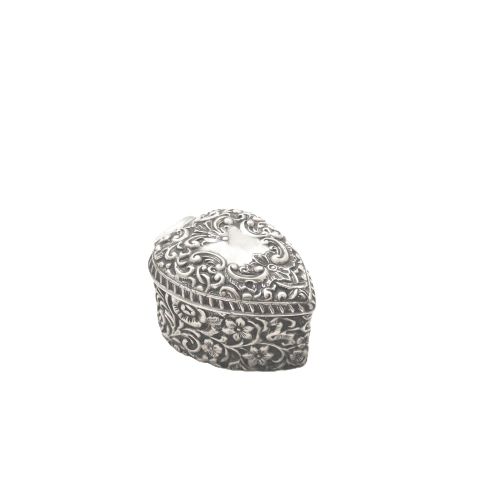
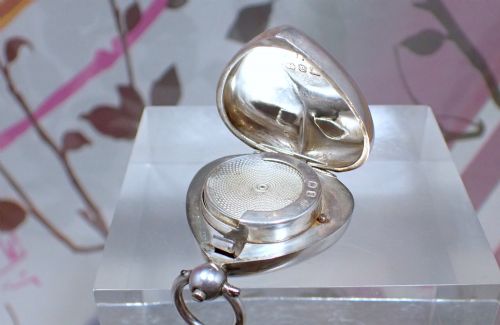
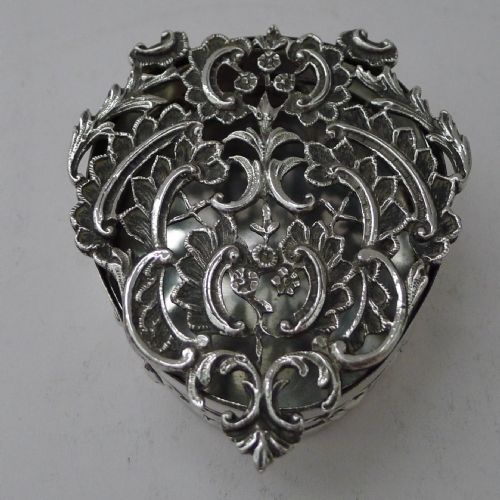
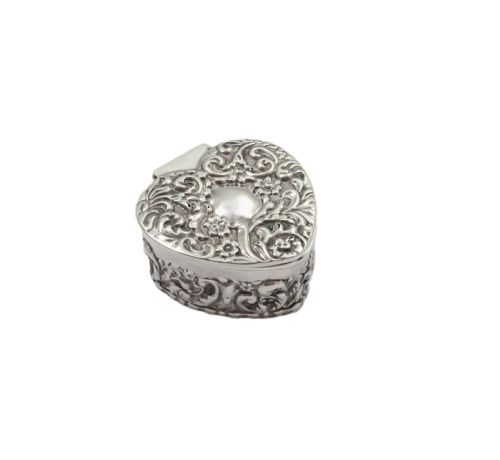


Heart Shaped Silver Box
These heart shaped silver box examples span Victorian and Edwardian periods, offering miniature caskets and pill boxes shaped for sentiment.
Heart Shaped Silver Box
A heart shaped silver box serves small domestic and personal purposes, holding rings, trinkets, pills, or sovereigns. The pieces appearing here range from diminutive late nineteenth century pill boxes to larger Edwardian trinket containers and jewellery caskets.
Victorian and Edwardian examples dominate the record, alongside George V pieces and nineteenth century Anglo-Indian work. The forms span hinged ring boxes with interior linings, pierced decorative pots, and cut glass or crystal vessels fitted with silver lids.
How they were made
Silversmiths utilised sterling silver and silver gilt, often shaping bodies through pressing, embossing, or piercing. Many domestic vessels combine heavy cast or sheet silver mounts with cut glass and cut crystal bases.
Maker marks, town assay offices, and date letters stamped directly into the silver record the origin of British pieces. Detail work relies on hand chasing and applied borders rather than cast uniformity.
Heart Shaped Silver Box Retail Price Guide 2026
Typical asking prices for heart shaped silver box among the pieces listed under this phrase on Sellingantiques today, from the lower quarter to the upper quarter. They describe what is for sale here now, not the wider market.
Listings feature sterling silver, vermeil, cut glass, and cut crystal across Victorian, Edwardian, and George V periods.
What varies in quality
Quality rests in the crispness of the chased or pierced decoration upon the silver lid and the structural integrity of the hinge. A well-fitted lid that closes flush against the base distinguishes finer workshop output from simpler containers.
The weight of the silver and the clarity of the cut glass or crystal body set different grades apart. Maker attribution to notable workshops adds distinction to individual pieces.
William Comyns·Deakin & Francis·Adie & Lovekin Ltd
The Heart Shaped Silver Box Glossary
- Sterling silver
- A silver alloy containing 92.5 percent pure silver by weight, standard for British plate. This composition provides the necessary durability for miniature boxes.
- Vermeil
- Sterling silver plated with a thin layer of gold. This finish appears frequently on the interior and exterior of nineteenth century vinaigrettes and pill boxes.
- Sovereign holder
- A specialised container sized to hold British gold sovereign coins. These small pieces often share the heart outline seen in standard pill boxes.
- Pot pourri box
- A lidded vessel pierced with small holes to allow scented dried plant matter to diffuse. Edwardian examples utilise this technique on miniature silver containers.
- Assay office
- An official body that tested and marked precious metals for purity. Marks from London, Birmingham, and Chester appear routinely on these items.
Heart Shaped Silver Box: Frequently Asked Questions
What were heart shaped silver boxes used for?
These miniature containers served personal rather than formal functions on dressing tables and in pockets. Victorians used them to store pills, rings, trinkets, and small coins.
Larger versions accommodated jewellery or pot pourri, while specialised forms held gold sovereign coins. Their romantic outline made them frequent tokens of affection.
How do I date a silver heart box?
British pieces carry hallmarks that include a date letter indicating the exact year of assay. Additional marks reveal the town assay office and the silversmith's punch.
Stylistic shifts also help distinguish periods, moving from heavy Victorian embossed ornament to lighter Edwardian pierced work and George V simplicity.
Are all heart boxes made entirely of silver?
Many examples pair solid silver lids with bodies formed from cut glass, cut crystal, or occasionally mother-of-pearl and tortoiseshell. Glass-bottomed versions allow light through the base of the trinket container.
Internal compartments often feature velvet or silk linings designed to protect rings and delicate jewellery.
How should I display a silver trinket box?
These small vessels sit well on dressing tables, mantelpieces, or inside glass display cabinets where their detailed lids remain visible. Their miniature scale allows them to group together easily.
Keeping them away from damp environments prevents tarnishing of the silver plate and protects any internal fabric linings.