


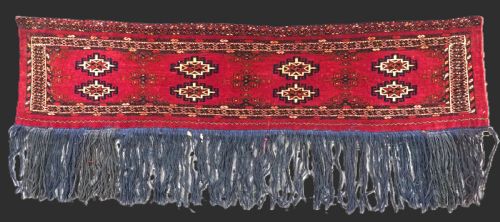


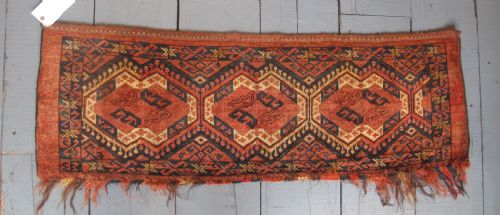

Handwoven Torba Face
These handwoven torba face pieces are tribal wool textiles from Central Asia that bring rich Turkmen patterns into a room.
Handwoven Torba Face
Most examples found here date from the late nineteenth century, spanning the eighteen-seventies through to nineteen hundred. You will frequently encounter distinct tribal attributions in the titles, such as Saryk, Tekke, Yomut and Ersari, each bringing their own distinct visual vocabulary to the weave.
The format is typically horizontal and compact, designed to be viewed hung on a wall or laid out as a flat textile. Pieces range from complete bagfaces retaining their original wool backs to standalone textile panels displaying classical gul motifs.
Materials and construction
Every piece is constructed from wool, utilising traditional handweaving techniques handed down through generations of Turkmen and Central Asian tribal weavers. The structure relies on dense fibre manipulation to create a durable textile capable of withstanding daily nomadic life.
Colour comes from natural dyes, which yield the rich, saturated tones characteristic of nineteenth-century tribal weaving. These organic colourants interact with the wool fibres over decades to develop a soft visual depth.
Handwoven Torba Face Retail Price Guide 2026
Typical asking prices for handwoven torba face among the pieces listed under this phrase on Sellingantiques today, from the lower quarter to the upper quarter. They describe what is for sale here now, not the wider market.
Listings feature nineteenth-century Turkmen tribal pieces dated across four distinct decades from eighteen seventy to nineteen hundred, entirely worked in wool.
Distinctions in quality
Quality rests upon the fineness of the weave and the clarity of execution within the tribal motifs. A very fine weave demonstrates superior technical control by the weaver, resulting in crisp delineation across complex patterns like the kedjebe or gul designs.
The integrity and vibrancy of the natural dyes further separate examples, alongside the preservation of the wool surface. Strong design attribution, such as recognisable Salor guls woven by Saryk or Tekke makers, adds another layer of distinction.
The Handwoven Torba Face Glossary
- Torba
- A small Turkmen storage bag used in nomadic households for holding household goods. These pieces represent the decorative face of such a container.
- Gul
- A primary medallion or repeating motif found across Turkmen tribal rugs and textiles. The word translates as flower or rose in various Turkic languages.
- Kedjebe
- A specific wedding procession camel tent decoration design featuring lattice patterns. It appears frequently as an intricate design scheme on fine bagfaces.
- Kepse gul
- A traditional geometric medallion design associated with Yomut weaving. This motif provides a structured rhythm across the textile field.
- Natural dyes
- Organic colourants derived from plants, insects and minerals used before the advent of synthetic dyes. They produce the characteristic gentle patina seen on nineteenth-century wool.
Handwoven Torba Face: Frequently Asked Questions
What is a torba face?
A torba face is the decorative front panel of a traditional Turkmen storage bag, woven by nomadic groups in Central Asia during the nineteenth century. These panels were cut from functional household containers to be preserved as flat tribal textiles.
They display dense geometric patterns and medallions using wool and natural dyes, reflecting the specific tribal identity of the weavers.
How were these bags used?
Nomadic families used these bags inside their yurts or tents for storing bedding, clothing and small household possessions. They hung against the lattice walls or served as functional containers during migration.
Over time, collectors began removing and preserving the decorative front panels as standalone textile art due to their intricate designs.
How do I hang a textile?
Textiles of this size are well suited for wall display using a variety of non-damaging mounting methods. A conservation-grade Velcro strip stitched to a cotton sleeve along the top edge distributes the weight evenly.
Alternatively, a professional framer can mount the piece behind UV-filtering glass to protect the wool fibres from light damage and dust.
How do I date these pieces?
Dating relies on stylistic analysis, material composition and structural characteristics seen in nineteenth-century weaving. Pieces on this page typically date from between eighteen seventy and nineteen hundred.
Indicators include the specific tribal gul designs, the palette of natural dyes, and the tight consistency of the wool weave.