


Hand Knotted Kirman Rug
A hand knotted kirman rug brings centuries of Persian weaving tradition straight to the floor, offering warmth and complex floral artistry.
Hand Knotted Kirman Rug
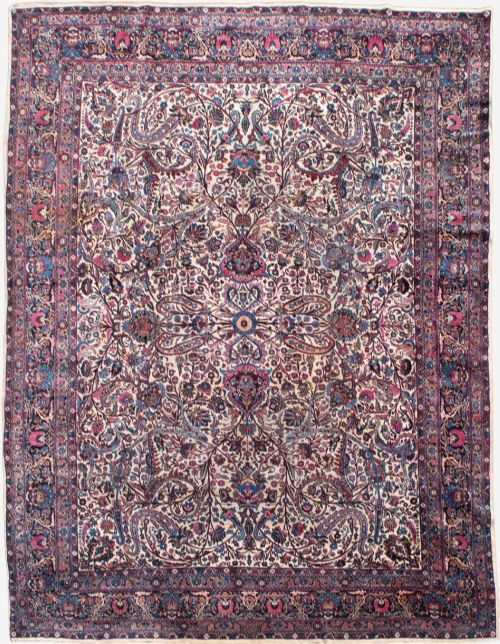
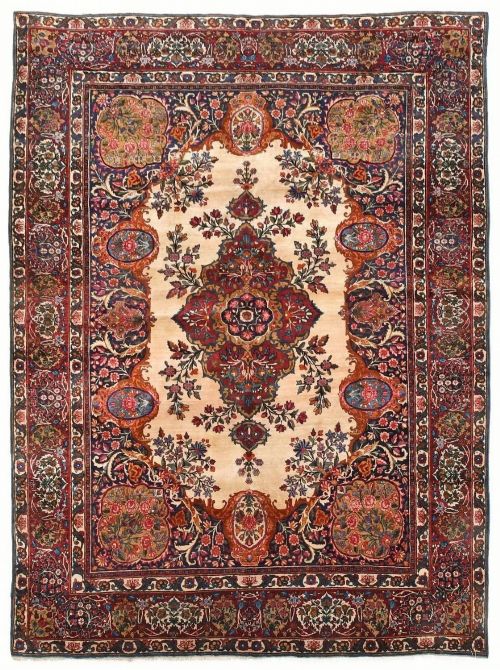
When searching for a hand knotted kirman rug, collectors encounter floor coverings originating from Persia, spanning from the mid-nineteenth century through to the mid-twentieth century. The selection ranges from small scatter rugs and long narrow runners to room-size carpets and oversized examples.
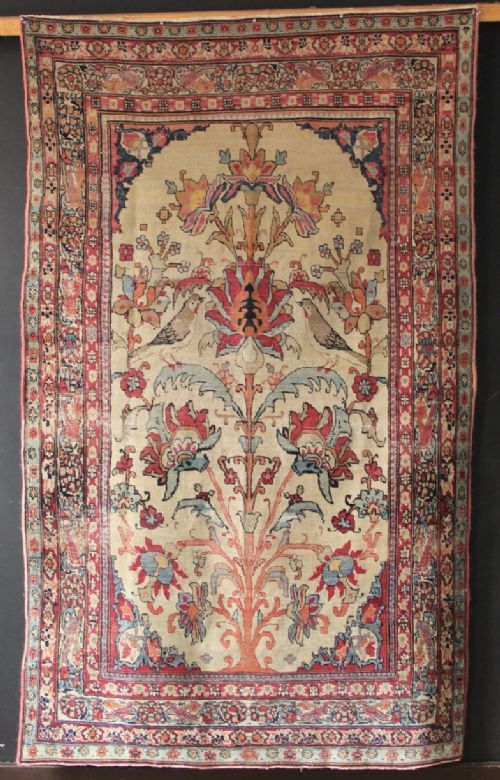
Most pieces seen here belong to the broader Persian tradition, frequently designated as Persian Kirman or Kirman Lavar. They appear in diverse formats, including floral boteh designs, millefleurs prayer rugs, and large room-size carpets created for grand interiors.
How they were made
These carpets and rugs are constructed using traditional techniques, employing hand-knotted pile methods on dependable foundations. The primary materials recorded in the evidence are wool and cotton, utilised together to provide both surface plushness and structural stability.
Weavers executed intricate patterns, such as repeat floral boteh designs and millefleurs prayer layouts, entirely by hand. This meticulous hand-knotting process allowed for the dense pile and fine detail characteristic of nineteenth- and early twentieth-century Persian workshops.
One exceptionally long narrow runner breaks all standard rules of proportion, proving that nineteenth-century weavers loved a very long hallway.
What varies in quality
Quality in these floor coverings rests upon the fineness of the knotting and the ambition of the scale, moving from standard room sizes up to exceptionally fine oversized carpets and very long narrow runners. Finer examples display greater density in the wool pile, which preserves intricate floral motifs with sharper definition.
The overall preservation of the piece alters its character, distinguishing uniform surfaces from distressed antique examples that show the softening effects of age and wear. The ambition of the design, such as a complex millefleurs prayer layout or a fine Lavar attribution, separates standard production from the finest surviving specimens.
The Hand Knotted Kirman Rug Glossary
- Kirman Lavar
- A specific designation often associated with finer woven carpets originating from the Kirman region in Persia. These pieces are frequently noted for their exceptional knot density and delicate floral ornamentation.
- Boteh
- A traditional almond-shaped motif with a curved upper end, frequently seen repeating across Persian carpet fields. This ancient symbol appears in various forms throughout nineteenth-century weaving.
- Millefleurs
- A decorative style translating to a thousand flowers, describing fields densely packed with tiny botanical motifs. In prayer rugs, this creates a rich, garden-like background behind the central arch.
- Runner
- A long and narrow carpet format specifically proportioned for corridors, hallways, or alongside large beds. The evidence records examples of exceptionally long narrow proportions from the early twentieth century.
Hand Knotted Kirman Rug: Frequently Asked Questions
How do I clean an antique rug?
Antique pile carpets require gentle treatment to preserve the wool fibres and natural dyes. Professional specialist cleaning is strongly recommended rather than domestic washing methods.
Regular light vacuuming without a rotating brush helps remove embedded dust without stressing the hand-knotted foundation.
Are these carpets suitable for heavy traffic?
Many room-size and oversized examples were originally built to endure daily use in large reception rooms. Wool construction provides natural resilience against standard foot traffic in domestic settings.
Placing a suitable underlay beneath the piece helps absorb friction and prevents slipping on hard floors.
How can I tell the age of a carpet?
Dating relies on stylistic clues, structural characteristics, and material wear recorded across nineteenth- and twentieth-century production. Comparing knot density and design layouts helps establish the likely period of manufacture.
Evidence from dated pieces shows shifts from mid-nineteenth-century formats through to 1930s and 1940s room-size variations.
Where were these rugs made?
These floor coverings originate from Persia, specifically associated with the historic weaving traditions of the Kirman region. They reflect the established techniques of Persian workshops active during the nineteenth and early twentieth centuries.
Makers utilised local materials like wool and cotton to produce everything from small scatter rugs to grand oversized carpets.