


Hand Carved Wooden Elephants
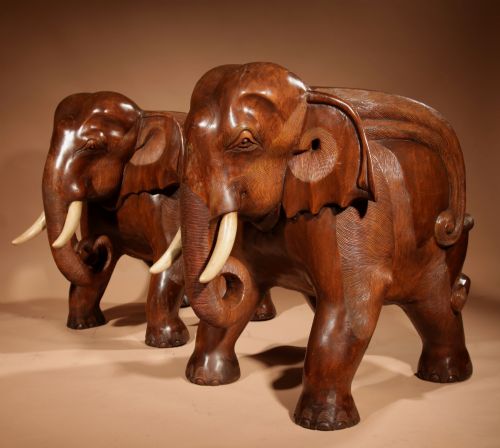
These hand carved wooden elephants bring strong colonial and Victorian character into a room through dense timber and patient chisel work.
Hand Carved Wooden Elephants
Hand carved wooden elephants span the Victorian era, the nineteenth century, and the early decades of the twentieth century, appearing in British homes from various colonial outposts. Buyers searching this phrase encounter substantial furniture such as centre tables, side tables, coffee tables, armchairs, and window seats alongside sculptural studies and bookends.
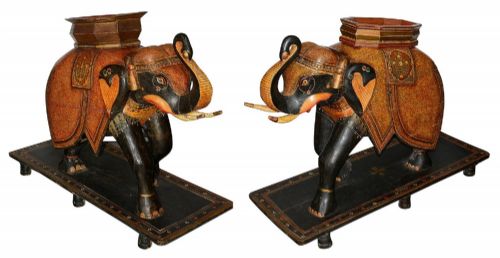
The regional origins on this page stretch from British India and the Bombay Presidency to Burma and the Black Forest. Forms range from small decorative figures in ebony and teak to large ceremonial tables supported by sculpted figures or legs shaped like elephants.
How they were made
Carvers shaped these pieces from dense tropical timbers including teak, ebony, and assorted hardwoods, frequently incorporating bone inlay for tusks and decorative details. Artisans utilised hand chisels to render deep relief carvings of ceremonial trappings, keepers, and musculature.
Cabinet makers constructed larger items such as occasional tables and armchairs using traditional joinery, integrating the carved elephant motifs directly into the structural frames or bases.
Several pieces include separate sculptural tusks, ensuring that every dusting session carries the subtle risk of a minor archaeological excavation.
What varies in quality
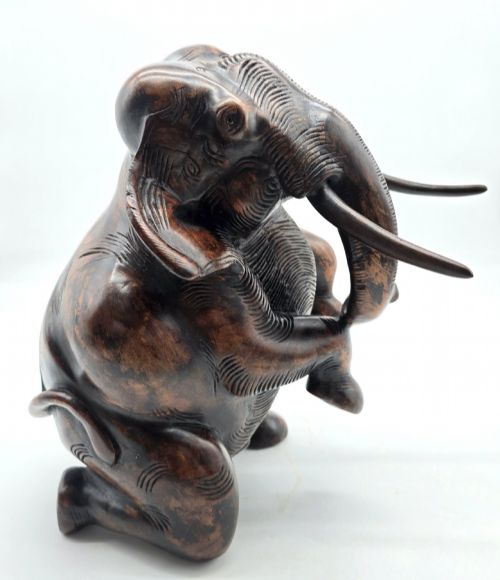
Quality rests primarily on the depth and animation of the carving, distinguishing stiff, repetitive lines from figures possessing muscular tension and expressive detail in the eyes and trunk. The choice of material also dictates distinction, with dense ebony and figured teak holding greater visual weight than softer utility woods.
Proportion and structural integrity separate standard utility items from ambitious masterworks, particularly in furniture where the carved animal supports must balance decorative presence with solid load-bearing capacity.
The Hand Carved Wooden Elephants Glossary
- Anglo-Indian
- A descriptive term for decorative arts and furniture produced in India under British rule, combining indigenous carving traditions with European forms.
- Bombay Presidency
- A major colonial administrative division noted for dense hardwood carving and distinctive occasional tables incorporating elephant motifs.
- Black Forest
- A European regional style of wood carving associated with realistic animal sculptures and domestic objects executed in limewood and other local timbers.
- Raj Period
- The era of British crown rule in the Indian subcontinent, which produced a distinct corpus of ceremonial and domestic woodwork for export.
Hand Carved Wooden Elephants: Frequently Asked Questions
How do I style an elephant table?
These occasional and centre tables work well as freestanding conversation pieces in a study or drawing room, where their carved timber bases remain fully visible. Keep surface objects minimal to let the sculptural woodwork define the silhouette.
Pair them with neutral upholstery or traditional leather armchairs to ground the heavy colonial timbers within the broader room scheme.
Are these pieces from the Victorian era?
Many examples on this page date from the nineteenth century and the Victorian period, reflecting the strong trade and administrative ties between Britain and India at the time. Others extend into the early twentieth century, including Art Deco interpretations.
Stylistic markers such as deep relief carving, specific colonial architectural motifs, and traditional timber choices help distinguish these older periods from modern reproductions.
How should I care for ebony and teak?
Maintain these dense hardwoods by keeping them away from direct heat sources and sudden humidity changes that can cause timber to split. Dust regularly with a dry cloth and apply a neutral beeswax sparingly only when the wood appears dry.
Avoid commercial liquid polishes, which build up a residue over time and dull the sharp edges of the hand-carved details.
What is the difference between a study and a sculpture?
A study typically refers to a freestanding animal figure carved with anatomical observation, often representing elephants in static or resting postures. Sculptures and statues on this page encompass both single figures and more complex groups involving ceremonial trappings and human keepers.
Both forms rely entirely on the carver's skill to convey weight and movement within rigid tropical timber.